Showing posts sorted by relevance for query piedmont ridge. Sort by date Show all posts

Sunday, November 30, 2014

Autumn Fall Color at Scyene Overlook And Beyond

The bold and vivid colors of a Texas sunset over the Great Trinity Forest as seen from the Piedmont Ridge Overlook in Dallas, Texas November 2014
The prolonged drought in Texas coupled with early frosts have brought a different kaleidoscope of color to the Great Trinity Forest's Piedmont Ridge in 2014. The orange and red hues of the oaks on the thin soils commanding the view of the ancient White Rock Creek Valley are as spectacular as ever. The pecans, walnut and ash trees wilted quite quick in retreat due to early cold. Their traditional mustard yellow hued leaves are absent this year replaced by earth toned browns.
At the Piedmont Ridge Overlook twenty minutes before sunset November 2014
The overgrown and abandoned Gateway Trail Kiosk near Renda
2014 was a rather short and dry growing year in the Great Trinity Forest. A very cold and bitter winter of 2013-2014 stretched into April with cooler and drier than normal temperatures. The result was a late spring with a muted wildflower bloom.

Further into the season, the lack of rains manifested itself in fewer fruit and nuts on area trees seen in the pecan and oaks that dominate the landscape.

As recently as 4-5 years ago there was a spiderweb of trails in the park system here that allowed first time users to easily navigate to points of interest and overlooks. Those trails are quite overgrown or blocked by dead fall now. The epic October 2, 2014 storm that struck Dallas also hit the northern Great Trinity Forest head-on. Many trees on the terraces weakened in the drought fell, shed branches and limbs in the wind.
Thick stand of cedar which even on a sunny day barely allows sunlight to penetrate the forest floor
Scyene Overlook From Grover Keeton Golf Course

Getting to this area is quite easy. Bounded on the north by historic Scyene Road and the south by Lake June one can get here from US 175 or I-30 quickly from Downtown Dallas.


2300 Jim Miller Road Dallas Texas
Best parking will be found near the address above or at the parking lot for the Grover Keeton Golf Course across the railroad tracks.

When maintained the Lower White Rock Creek Trails are comprised of a roughly 3-4 mile(depending on route) soft surface trail network spanning three different City of Dallas Parks. JJ Beeman/Scyene Overlook on Scyene Road, Grover Keeton Park which includes Piedmont Ridge Trail and Devon Anderson Park south of Bruton Road. Many of those trails are hampered by blowdowns and overgrowth this year. First time visitors might not be able to find the unmarked entrances.

Towering oaks in the floodplain areas around Oak Creek which forms the watershed below the escarpment before draining into White Rock Creek
The climb to the high points and overlooks of the hike are still visible. Start in the Oak Creek drainage near Grover Keeton. One can start hiking this section of trail either from the right field foul line of the softball field at Gateway Park or on the west side of the DART Tracks at the Grover Keeton Golf Course where a Gateway Trailhead marker exists on the far north end of the parking lot. The Grover Keeton Trailhead in the golf course parking lot is overgrown but the sign still stands.

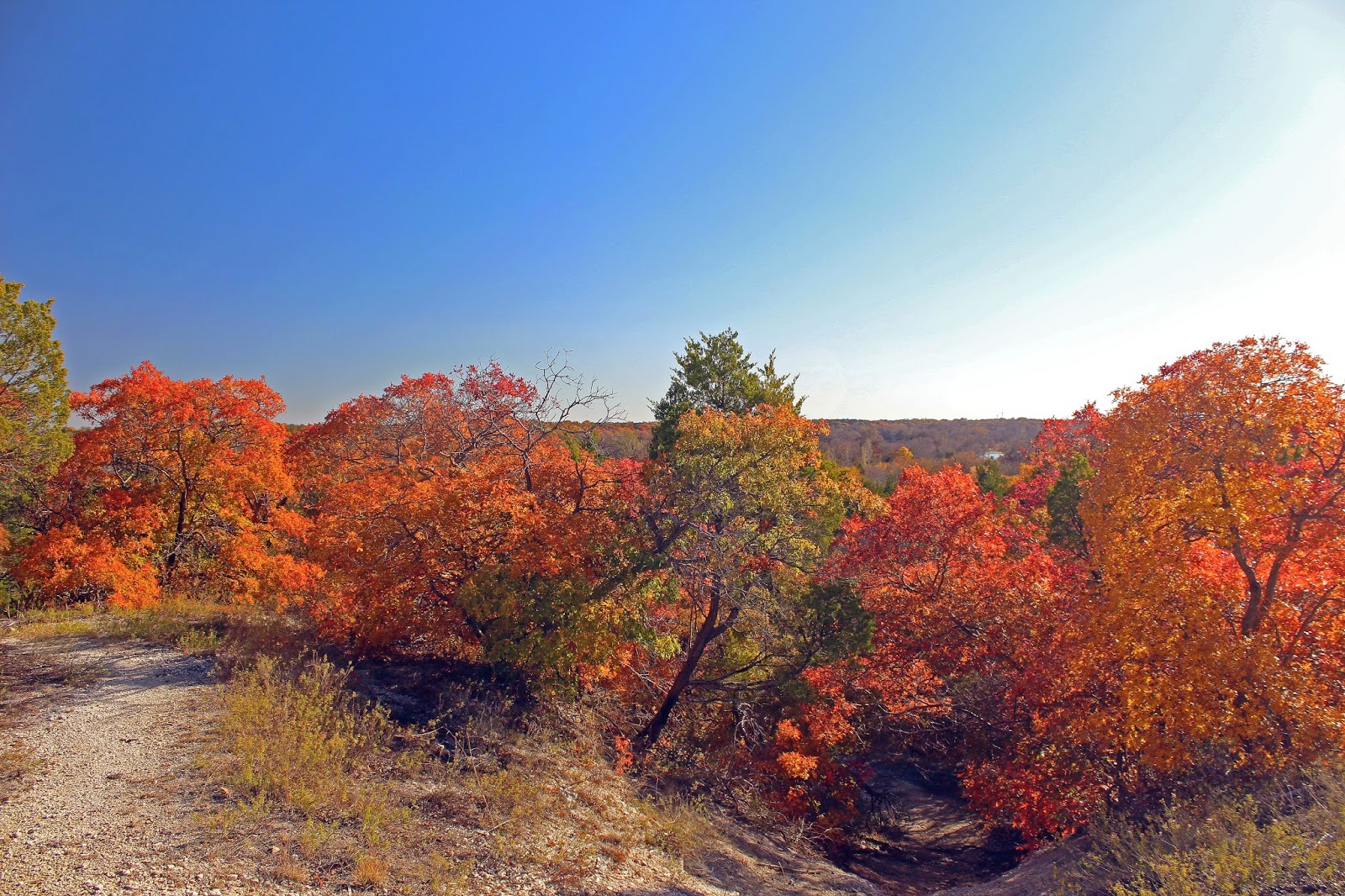
Vivid colors of oak and elm contrast the deep blue sky in the bottoms below Scyene Overlook
The trails are comprised of a random mix of paths with no clearly defined start or finish. Over the last couple years, trail maintenance has fallen off and as a result some of the sections might be a puzzling adventure to find. The trails are all still there just more faint in appearance for a novice visitor.


Oak Creek has a great influence beyond the escarpment here. It becomes a fundamental component to the lifeblood of the Great Trinity Forest by providing slow moving water that funnels into an area around Roosevelt Heights. The area is core habitat for beavers and otters who have large populations down there. Oak Creek also picks up the outflow of the natural spring Big Spring before joining White Rock Creek in Rochester Park.


Roughleaf Dogwood Cornus drummondii

Scyene Overlook

The trail up to Scyene Overlook is a confused jumble of poorly built old trails and equally poorly built newer ones that were designed to mitigate past problems. Having been here dozens of times, even I still get turned around trying to take the right path up.
Best advice is head northwest from Jim Miller @ Grover Keeton Golf Course and head towards the higher points seen in the distance. Just keep heading towards Scyene Road and follow the more worn trails. You'll hit some dead-ends and loops that double back. Chalk it up as fun.


Scyene Overlook is named for an old frontier settlement two miles east of the overlook named Scyene. The town center was at the present day intersection of Scyene and St Augustine roads . The name "Scyene" is a play on the ancient Egyptian town named Scyene an old frontier outpost on the east bank of the Nile. Around 500 BC, the same time the Book of Ezekiel references the ancient Egyptian town of Syene (Aswan), some ancient Native American left behind a Gary dart point(arrowhead) here on the bluff.

The knot of trails all approach Scyene Overlook from the southwest. Encountering fence posts, pickets and erosion control in a few spots the trail winds around to the northwest and eventually the north side of Scyene Overlook.
Scyene Overlook as seen looking south
A thin veneer of soil noted as the Eddy Brackett sits atop the high ground in this area. This soil was once common in a belt that stretched through Pleasant Grove, East Dallas and Lake Highlands. Paved and developed long ago very few places still exist to find these plants.


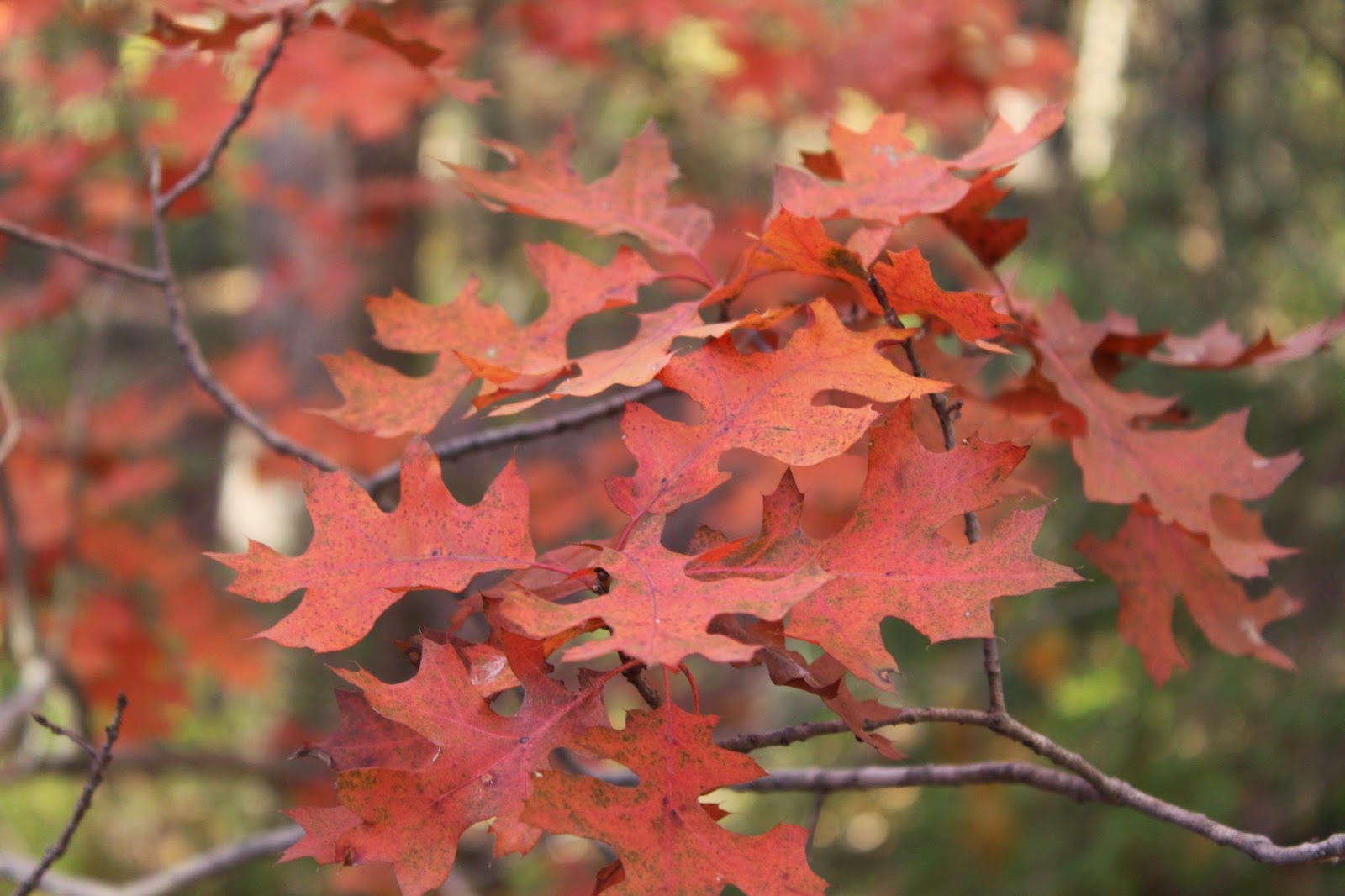
The focal point this time of year is of course the Red Oaks along the escarpment. Along the White Rock Escarpment through Dallas to San Antonio there are hybrids of Texas Red Oak Quercus buckleyi (Q. texana) and Shumard Red Oak, Q. shumardii. Smaller in size than most Red Oaks we Texans know so well, these trees thrive in alkaline soils and are very drought tolerant.

There is a close relationship between Texas Red Oak and Shumard Oak. This has caused many botanical classification problems. The two trees may be listed as two separate species in some manuals, while some list Texas Red Oak as a variety of Shumard Oak.

The colors that the trees exhibit in the Texas fall are a sight to behold. Using a polarizing filter in some of these photos takes the white shine of the leaves off and brings to true color of the leaves out. The intermittent sun and cloud cover changed the coloration of the trees from one minute to the next.


Piedmont Ridge

Oaks in the distance to the southeast as viewed from Scyene Overlook

Piedmont Ridge is slightly higher than Scyene Overlook. The long ago built trail along the topographical high is reached by navigating back across the Scyene Overlook escarpment across the driveway entrance of Grover Keeton. Heading south with Jim Miller on the left and the DART tracks to the right, one will find a trailhead kiosk and trail entrance.


Piedmont Ridge Trail looking south atop the level ridge
This is an easy section of trail to hike since much of the distance is atop the ridge. Some short and steep switchbacks climb quickly onto a level topped ridge with a set of cedar hewn benches roughly 2/3'rds of the way towards Bruton Road.

Beyond Bruton Road is yet another stretch of trail that has all but gone to seed. A lack of use, poor design and no maintenance has led to a trail that is treacherous in places and difficult to navigate if one has never been there before. The better trailhead to access this area is the southern anchor of the once existing trail.


Southern Trailhead at Devon Anderson
1700 Eastcliff Dallas Texas
This entrance is on the southern end of the trails. The City of Dallas actually wrongly installed the city park sign for Devon Anderson Park here, the sign reads "Devon Cr", assuming Devon Circle as the name of the street. Park at the wrongly installed sign(hey I called them about it and they never fixed it) and head back into the woods where a playground area once stood due west. Pick up the trail and head north.
Bare limestone area in Devon Anderson that some call the Comanche Storytelling place
The southern entrance is the best spot to start if one has never been here before. The issue parking other places to the north is that one will not be able to pick up the trail south of Bruton Road. Better to head from south to north, noting the southern Bruton entrance.

Up until recently at the first trail junction there were a couple trail signs noting the Comanche Storytelling Place to the south 1/10th of a mile and a scenic overlook some 1/4 mile to the north.

The Comanche Storytelling place serves as a prominent anchor to the southern end of the trails here. Beyond are steep root strewn gullies that lead nowhere to the south and west. The Comanche Story Telling Place at Devon Anderson Park has been identified by the Comanche Nation as a sacred holy ground. The Comanche nation tells us that the natural limestone shaped amphitheater was believed to have been used by Native Americans in the area prior to European settlement.

To the north the trail built here running towards Bruton has become a problematic source of accelerated erosion. Built substandard in areas the path vectors water in ways that are detrimental to the slopes and benchcuts upon which it was built. The result is a rugged piece of trail not by design but by lack of design. The blowdowns and trees across the trail are numerous from the October storm. As a result I would not recommend it for hiking.

Sunday, March 8, 2015

Hiking Dallas Great Trinity Forest In The Snow

Sojourn in the snow swept woods and ridges of the Great Trinity Forest in Dallas
The stunning beauty of the snow covered scene could be any mountainous terrain in North America. The near deafening silence of this place would suggest the nearest human would be far beyond the horizon. The snow covered trail we followed over the course of a couple miles only has the footprint of a lone coyote. No human has walked here for days. A place so remote in feel is in the heart of Dallas, inside Loop 12 and just minutes from Downtown.
One of the limestone strewn gullies along the Devon Anderson section of the trail

Hiking across Renda Meadow east of Scyene Overlook
The encroachment of development over the last half century has left much of this area encased in concrete and manicured lawn. The landscape has changed in many ways and in other places, a quickly disappearing few, have remained essentially the same.


The White Rock Valley known to many from headwaters in Frisco to the mouth in the Great Trinity Forest has lost much of the natural character which drew Dallas first settlers.

The creek's course has been confined for millennia by Austin Chalk limestone ridges that it traverses to the east.

To the west of said outcrop lies a magnificent tangle of oxbow tied meanders and sloughs replete with hawks, otters and beavers that will make even an untrained eye awe in wonder.

Here, in the Great Trinity Forest and the escarpments one can see in places what White Rock Creek and the woods it feeds might have looked like hundreds of years ago.


Barred Owl in the snow on February 28, 2015


Few venture places in Dallas during winter weather events. The combined effects of warm gulf air in variegated layers often turns a beautiful snow event one day into one of treacherous freezing rain the next. Such is the case here in Dallas on this last day of February 2015.


 Pioneer Family Roots Run Deep
Trail junction signs for the JJ Beeman Trail which traverses bottomland and the Scyene Overlook Trail which quickly gains elevation to a commanding view over the lower White Rock Creek Valley
In the simpler times and by any stretch the hardest times, this area was the domain of the Beeman family. What I would call as the real first pioneer family of Dallas, the Beemans settled this part of what is now Dallas County in the spring of 1842 on an old Indian and Buffalo trace now called Scyene Road. John Beeman (1799-1856) and his family were the first of that larger extended family to settle here. The history and legacy that those families wrote along with their neighbors are what cut what was then true wilderness into the city we see today.

The extensive discourse one can provide on the local pioneer history would fill many a line of a blog.  The conduit between contemporary Dallasites and that of the pioneers still runs through the bloodlines of their descendants that still call North Texas home. The original settlers to Dallas County were a strong people and that is still evident today.
 MC Toyer, his mother Lois Beeman Toyer, MC’s sister Cynthia Toyer Fusco


Sam Beeman,Margaret Beeman Bryan, John Neely Bryan Jr


The two photos at the time taken, represent the matriarchs of the Beeman family, taken over one hundred twenty years apart. At upper left Margaret Beeman Bryan, wife of John Neely Bryan, founder of Dallas. At right in the 2015 photo is Lois Beeman Toyer, the oldest living member of the Beeman family.
Lisa Dye Bentley and MC Toyer, descendants of Benjamin Dye lay a wreath at the gravemarker at Warren Ferris Cemetery near White Rock Lake in January 2015
 The occasion was a rare event in 21st century Dallas, a gravemarker dedication for a War of 1812 Veteran who settled Dallas in the infancy of Texas. His name was Benjamin Dye and is buried a few short blocks from the Dallas Arboretum at White Rock Lake. Paul Ridenour wrote a terrific piece for the White Rock Weekly on the gravemarker dedication found here:
http://www.whiterocklakeweekly.com/14792/107815/a/patriotism-prevails-during-dedication-event


Some would like to think Dallas is a poor place for local history. That the depth of events happening on the soils of our county is thin. Simply not true. It is rich and features many of the romanticized touchstones of other Texas history events that make Dallas history a fascinating study.

What sets Dallas apart are the places of yesteryear. Where the first explorers clad in buckskin pants and coonskin caps wandered across Dallas for the first time. Many of those spots still stand intact. Places like the Beeman lands, at interesting places like Scyene Overlook.

 Scyene Overlook
Bill Holston standing atop Scyene Overlook
 It is from the top of Scyene Overlook that not just the Great Trinity Forest spills out beneath your feet but also a chance to see for a few miles distant, the immense land holdings once held by the Beeman family.

Fresh rabbit tracks are the only footprints on the trail
It was across this land in the distance that JJ Beeman guided President Sam Houston and his Treaty Party entourage visit in the summer of 1843. JJ Beeman guided Sam Houston's Treaty Party from their overnight camp at Big Spring up White Rock Creek to John Neely Bryan's cabin in what is now Downtown Dallas.

The best known overlook in this trail system is Scyene. Roughly one hundred yards south of the road bearing the same name the overlook gives one a commanding view of the Great Trinity Forest to the south.
Below the overlook in a stand of cedar
Scyene Overlook is named for an old frontier town two miles to the east of the named Scyene. The town center was at the present day intersection of Scyene and St Augustine . The name "Scyene" is a play on the ancient Egyptian town named Syene an old frontier outpost on the east bank of the Nile.

Piedmont Ridge Trail and Devon Anderson Trail
The millennium old natural bison path and hard bottomed ford of White Rock Creek made this a preferred ox pulled wagon route into Dallas prior to the railroads. The long haul freight transporters of their time.


The Lower White Rock Creek Trails are comprised of a roughly 3-4 mile(depending on route) soft surface trail network spanning three different City of Dallas Parks. JJ Beeman/Scyene Overlook on Scyene Road, Grover Keeton Park which includes Piedmont Ridge Trail and Devon Anderson Park south of Bruton Road.

Best Parking
2300 Jim Miller Road Dallas TX

The JJ Beeman Trail starts near the corner of Glover Pass and Scyene and continues east to the Scyene Overlook. From there the trail roughly follows an Austin Chalk Escarpment high above the White Rock Creek Valley.  One clear days can see the VA Hospital in South Dallas, Cedar Hill, Hutchins as well as Downtown Dallas. The trail continues through Grover Keeton Park, up Piedmont Ridge, across Bruton and into Devon Anderson Park. 

The trails here are comprised of a random mix of trails with no clearly defined start or finish. Over the last couple years, trail maintenance has fallen off and as a result some of the sections might become an awkward adventure to find. The trails are all still there just more faint in appearance for a first-time visitor.

Piedmont Ridge
Crossing an open field before hiking up Piedmont Ridge
Piedmont Ridge, which sits to the south and east of Scyene Overlook is slightly higher than overlooks to the north. The long ago built trail along the topographical high is reached by navigating across the Scyene Overlook escarpment and across the driveway entrance of Grover Keeton Golf Course. Heading south with Jim Miller on the left and the DART tracks to the right, one will find a trailhead kiosk and trail entrance.
Climbing up the short switchbacks that lead up the spine of Piedmont Ridge
Some short and steep switchbacks climb quickly onto a level topped ridge with a set of cedar hewn benches roughly 2/3'rds of the way towards Bruton Road.
Piedmont Ridge Overlook
Cactus covered in ice


The cedar benches here have some of the most photogenic views of Dallas and Oak Cliff to the west. A real showstopper of a place to take in a sunset and only a ten minute walk from where one can park a car. The smell of this spot is that of the Texas Hill Country and even during below freezing conditions, the cedar pollen of this spot is thick.


 Devon Anderson Trail

Mexican Buckeye seed pod


South of Bruton Road, the becomes nearly non-existent in many spots. Even in dry weather the trail is not much more than a faint trace of a path frequented more by that of a coyote, a couple rabbits and bounding squirrels. No human traffic as evidenced by the clean snow.

Footbridge across a very deep gully in Devon Anderson Park
The trail follows ridge lines and then switchbacks down into a series of gullies. The rewarding views of each new ridge afford different views of the forest and city skyline in the far distance. The gullies offer something much different this time of year, the first signs of spring.
Down in one of the deeper gullies

Trout lilies partially encased in snow
Residing in the organically rich leaf strewn soils just inside the sun dappled treelines for a short few days become home to one of Texas most unique natural blooms. The Trout Lily, Erythronium albidum. Along this trail system, particularly south of Bruton Road one sees vast numbers of these early bloomers, many of the plants grow next to and even up through the trail here.


Above is a video clip of trout lilies growing on the banks of a small arroyo stream in Devon Anderson that is swollen with ice melt from a recent winter storm to hit Dallas.

White Trout Lilies are known to exist in the State of Texas in 15 counties. Trout Lilies, also called Dog-Tooth Violets or Adder's Tongues are a spring flowering woodland native to Texas. The flowers have 6 white tepals (inverted petals), 6 stamens and bright yellow anthers that hang downwards forming an inverted shape. Each plant is about 6 inches tall and roughly the diameter of a dinner plate. It takes 6 long growing seasons before a Trout Lily will produce a flower in year 7.

Trout lilies take so many years to mature, so difficult for their seed to spread, so hard to see in other times of the year that they have become a splintered subset of colonies here in the Dallas area. Separated by great distances in geography and existing in ecological isolation they are a unique plant worthy of distinction.

Friday, May 27, 2011

Lower White Rock Creek Valley Trails


White Rock Creek runs south from Dallas' best-known land form, White Rock Lake. But for all the popularity of the old city reservoir, the creek that first had the name remains scarcely recognized. Once the water of the creek leaves the White Rock Lake Spillway in dramatic fashion it begins a slow and methodical march towards the Trinity River.


Texas Horned Lizard in Dallas at Devon Anderson Park

Piedmont Ridge Trail Lower White Rock Creek

Lower White Rock Creek, on its way to the vast hardwood bottoms of the Great Trinity Forest, runs nearly unknown through some of the city's best natural areas and most historic neighborhoods. This is the land that the Caddo and Comanche consider sacred ground. This is the land that sustained the first pioneers that settled Dallas. This is the land where Sam Houston and his men camped on the way to work a peace treaty. You do not have to look in a book or read accounts of the sites to imagine what it must have been like. Using these trails you can stand on the ancient sacred ground of the Comanche, wander across the old pioneer Beeman and Bryan homesteads, stand at the spring where President Sam Houston camped. All of it is still there, untouched. Dallas over the last century and a half grew up around it, oddly leaving it in it's original condition.


Purple Coneflower Echinacea purpurea (Asteraceae) in Lower White Rock Creek meadow


Video overview of trails:


The Lower White Rock Creek Trails are comprised of an ever expanding 4 mile soft surface trail network spanning three different City of Dallas Parks. JJ Beeman/Scyene Overlook on Scyene Road, Grover Keeton Park which includes Piedmont Ridge Trail and Devon Anderson Park south of Bruton Road. The JJ Beeman Trail starts near the corner of Lawnview and Scyene near the DART Lawnview Station and continues east to the Scyene Overlook. From there the trail roughly follows an Austin Chalk Escarpment high above the White Rock Creek Valley. One can see the VA Hospital in South Dallas, Duncanville, Hutchins as well as Downtown Dallas. The trail continues through Grover Keeton Park, up Piedmont Ridge, across Bruton and into Devon Anderson Park. 

Scyene Overlook with view of Great Trinity Forest


JJ Beeman Trail Scyene Overlook Trail Junction


Piedmont Ridge Trailhead Grover Keeton Park


Access to the trails are easiest from the Grover Keeton Parking Lot on Jim Miller Road; Devon Anderson Park on Umphress Road or via DART on the Green Line to Lawnview. Scyene Overlook is also just a quick 15 minute or less ride from White Rock Lake.

Location:

North Trailhead for Scyene Overlook:
2800 Renda Street Dallas

Grover Keeton and Gateway Park:
2300 Jim Miller Road

Devon Anderson Park:
1700 Eastcliff

White Rock Creek Trails Map --green dot notes Lawnview DART Rail Station on  Scyene. Yellow dots mark formal trailheads for Scyene Overlook, Piedmont Ridge Trail and Devon Anderson.


Some sections of the trails feature steep switchbacks, loose rocks and off camber surfaces. Caution should be taken when hiking or mountain biking these areas. Technical climbs and descents along with some steep dropoffs warrant diligence if you are riding a mountain bike. Some sections will require dismounts by even experienced riders.  

Devon Anderson Park sign noting distances to Comanche Storytelling Place .2 mile and one of the overlooks .4 mile.

Piedmont Ridge Overlook


Comanche Storytelling Place Devon Anderson Park Dallas, Texas


The Comanche Story Telling Place at Devon Anderson Park has been identified by the Comanche Nation as a sacred holy ground and has been identified as a candidate for inclusion in the National Register of Historic Places. The natural limestone shaped amphitheatre was believed to have been used by Native Americans in the area prior to European settlement. Gateway Park was also the site of an Indian Marker tree, over 300 years old that served as a guide to Native Americans in the area. This tree was lost in 1998 during a thunderstorm.