Showing posts sorted by date for query Little Lemmon Lake. Sort by relevance Show all posts

Tuesday, July 22, 2014

Roseate Spoonbills Wild Passage To The Great Trinity Forest

The dance of the Roseate Spoonbills in the Great Trinity Forest Dallas, Texas Summer 2014

One can only imagine what this place must have looked like ten centuries ago when the Caddo danced on this very spot. The soil here is ancient. Holding profound human history and insight into the lives they lead, their environment and culture. It is the first Dallas, the ancient civilization that commanded this part of Texas for centuries.

For the most part, the land here remains as rugged, heavily timbered and green as it was when King Solomon ruled the Israelites. The charcoal remains of the Caddo cooking fires tell us so. The natural seeps of abundant sub-surface water still flow here across the soft sand and underlying limestone outcrops. No longer fit for human consumption but interesting none the less.

Wild Mustang Grapes by the bushel at Joppa Preserve


The shelter and forage still found in the woods here could still support those human bands of yesteryear. The grapevines laden so heavy with fruit in July that the ground in many spots cannot be seen through all the fallen fruit. Vitis mustangensis the Mustang Grape is one of the most high climbing and heat tolerant varieties of grapes in the world. Disease resistant and bearing loads of fruit the grapes would be a real hit were they not so tart when raw.

Other more ready to eat fruit like the Purple Passion fruit can be found within arms reach.


Flowers of the Maypop Passion Fruit, Joppa Preserve July 2014


The plants Passiflora incarnata were given the name Passionflower or Passion vine because the floral parts were once said to represent aspects of the Christian crucifixion story, sometimes referred to as the Passion.

The 10 petal-like parts represents the disciples of Jesus, excluding Peter and Judas; the 5 stamens the wounds Jesus received; the knob-like stigmas the nails; the fringe the crown of thorns. The name Maypop comes from the hollow fruits that pop loudly when crushed.

Little Lemmon Lake and Roseate Spoonbills
The Texans of old knew this place. Caddo hunters had waded the river here. The old South Dallas legend exists of Spanish searching for their city of gold  and are thought to have dropped a battle axe in a creek within eyesight of this spot. Mexican and Anglo ox-men drove wagons this way. Freed slaves settled it and called it their own, a place called Joppa.

A newcomer expecting blight and a muddy river might be surprised by the diversity to be found here. A true melting pot of Texas nature at your feet. As one comes to appreciate the river here, the focus of nearly all those things one thinks of as truly Texan. A roadmap of twists and turns in the woods with surprises around every corner.

Few ever come to appreciate a place. A rare number have visited these places for many years. Then there is one, only one, known to me that is to have visited these spots for decades.

The Luminary, A Voice From The Woods -- Father Timothy Gollob
Father Timothy Gollob discussing the call of the Indigo Bunting and keen insight on decades of Roseate Spoonbill observations, Joppa Preserve, Great Trinity Forest, Summer 2014
He was looking my way with a smile, pointing with his arm extended to smudges of pink on the far end of a lake. From a hundred yards away the lone man in black, crouched among head high cattails, armed with a pair of binoculars was espying Roseate Spoonbills. I knew I had found Father Timothy Gollob.

Here among the jagged, rough and steep terrain of the river bottoms walks a Catholic Priest. For nearly half a century Father Tim has explored the river here. Noting not just the ebb and flow of the river but the countless bird and animal species that abound here. His church and his rectory home, Holy Cross Catholic Church sits just up the road from the river at Bonnie View and Ledbetter.
Father Timothy Gollob watching Roseate Spoonbills through his binoculars at Joppa Preserve

The Trinity River has served as Father Tim's cageless aviary where he has documented decades of bird activity and sightings. His hundreds of reports and sightings rank him among the most prolific birders in Texas history, a true legend in many outdoor circles. His work as a man of God for a half century in South Dallas overshadows his bird study and fishing tales. A man who many regard as one of the great Texas humanitarians and cornerstones of a city which he calls home. If you don't know him, you should.

In the field, his graceful hand whittled narrated account of the land here and his description of bird sightings is a true treasure of knowledge. His accounts of the erstwhile Sleepy Hollow Golf Course turned lower chain of wetlands provides a great back story to this area before it became a civil engineering project.

The stories of his sightings are weaved through Texas lore. Conversation that is very much that of the Deep South yet Southwestern. Something that is authentic Texan. His accent has a strong Texan flair to it, one decidedly North Texan in depth if there is still such a thing. Talk turns to the gravel pitted terrain of South Dallas County's Sand Branch and Jordan Valley area. Travels across hard scrabble ranchland south of Dallas on fishing trips. It is the chat that describes the narrative mastery of the woods. A picture of the Trinity and North Texas in microcosm that is so rare to hear in such humble words.

Jeff Lane riding at Joppa Preserve
Father Tim learned much of his birding craft from ornithologist and late University of Dallas Professor Warren M. Pulich. Pulich is considered the first resident professional ornithologist in North Texas. In the 1960s he authored the Birds of Tarrant County and later The Birds of North Central Texas. His groundbreaking work specialized in species like the rare Golden Cheeked Warbler. As Professor of Ornithology at the University of Dallas he led the way with many pioneering bird collection projects, many of which were from antenna strikes on local communication towers.

Often joining Father Tim is one of his parishoners, Jeff Lane, seen at right. Jeff's family has owned a metal plating company just up the street for the last eighty years. He will pick up Father Tim at his church, drop him off at a starting spot and meet up miles on the other side of the woods.


 Hurricane Alicia August 1983


Father Tim remarked that during a hurricane in 1983 that he observed Roseate Spoonbills off Loop 12 near I-45. He said that the birds appeared to have been storm blown to some extent maybe removed from the coast by the heavy winds and rain. I was able to look back through his bird reports, find the date and trace it to Hurricane Alicia which hit the west end of Galveston Island in August 1983.

The storm made a direct path up Trinity Bay and to Dallas where it hit much of North Texas with Tropical Storm and Tropical Depression winds and rain. An interesting observation on birds and weather.

Using the Trinity River Authority's river data, this area sits on mile 463 of the Trinity River. A grand distance from where the freshwater of the Trinity meets that of the salty Gulf of Mexico.

Reconnoitering For Roseate Spoonbills
A solitary Snowy Egret joined by four Roseate Spoonbills at Little Lemmon Lake, Joppa Preserve, Dallas, Texas
It is in the early evening, about when the sky goes to purple that Father Tim can be found on the river. The sky can appear enormous this time of day. The drone of rush hour dies away and the natural sounds of the woods take over the senses.
Heavy thunderstorm with pronounced anvil over Southern Dallas County as viewed from Little Lemmon Lake

Roseate Spoonbill landing at Little Lemmon Lake
Summer Saharan sands blowing in from Africa on the jet stream give the early summer of 2014 a pronounced rare shade of sky that is not often seen. A milky color of phosphorous tinged haze lingers over Dallas as a result.

Large storm cells often appear this time of year in the distance. Rarely do they make it into Dallas proper but provide a great background for photographing the sky. When the storms do come overhead the rain fires like bullets, chewing across the shallow water and into the tree canopy.
Changing light of an approaching storm mutes the light on the Roseate Spoonbills
The pink specks of birds some hundred yards or more away presented a challenge for getting some good photographs. The ever widening stretches of cracking mud playa between the birds and the shore offer no cover to get close. The setting sun to the west would put the birds in unfavorable light.

The solution to the issue was to hit the heavy mangled overgrowth to the northwest of Little Lemmon Lake where lush and belt high poison ivy abounds. It is one of the old indestructible realities it seems of getting some good shots. Going places no one else would think of going. The high winds of approaching storms and the very dense poison ivy provided a great approach towards the ten foot high cattails that ring the shore. Here, smashed down in the reeds I was able to get closer than ever before to Roseate Spoonbills.

The being close part is not so important as it is the relaxed and natural state of the birds. The acts of capturing the preening, napping and natural behavior far exceed those of action photos of spooked birds in flight.

The real trick is getting in and back out again without your subject ever knowing you were ever there. Doing so, for a couple nights in a row allowed repeat visits to where the birds were wading and resting.

Spoonbills At Their Most Vibrant
Roseate Spoonbills preparing for an evening of feeding at Little Lemmon Lake


The Roseate Spoonbills plumage for 2014 is the most vibrant in color ever to be seen among Great Trinity Forest Spoonbills. Famed birders like  Robert Porter Allen, likened the species to "orchids taking wing".

The absolute brilliant colors of orange, red, pink and red are offset under close review by a green hued head coloration only visible during breeding season. These are the apex of color in the North American bird world.

There are only two large pink hued birds in the United States, the Pink Flamingo and the Roseate Spoonbill. Natives of the sub-tropics, tropics and coastal areas, seeing either of the two species in the United States makes for a rare sight.

With a pink body and long, spatulate bill, the spoonbill is a marvel to behold. This coastal character even seems to wear a smile on its face.

Roseate Spoonbill Platalea ajaja

Roseate Spoonbills (Platalea ajaja) , which share the same pink plumage and long twiggy legs as flamingos, are actually members of the ibis family. Generally smaller than flamingos, Roseate Spoonbills grow to a height of 32 inches with a wingspan of 50 inches, have shorter necks, and longer, spoon-shaped bills.

The Roseate Spoonbill is typically a far southern bird of the Americas, breeding in Southern Mexico and Central America. In the United States it is typically found only along the far southern Gulf Coast. During summer and early fall the birds move inland searching for food and habitat along marshes and shallow ponds.

Uncommon in North Texas, Roseate Spoonbills can be seen infrequently in the shallow drying ponds and swamps in the Great Trinity Forest. Spoonbills are traditionally coastal birds and are a regular sight along the Texas Gulf Coast. Rare to see them hundreds of miles inland in not only a prairie but also a densely populated urban environment.


Hunted to near extinction in the early 1900s, the Roseate Spoonbill population dwindled to only 100 breeding pairs in Texas by the 1930s. Their striking pink feathers were popular on women's hats and hunters from all over the United States competed for spoonbill plumes. Little did the buyers of such feathers know that the colors fade quite fast when removed from the bird.

Today, threats to Roseate Spoonbill populations come as a result of habitat loss. Even by 1979, their numbers had only rebounded to 2,500 birds in the wild. Currently their numbers have rebounded substantially enough to be removed from Federal protection as an Endangered and Threatened species.

Breeding populations are found along the south Florida coast from the Florida Keys north to St Joseph Bay, with some populations in northeastern Florida and along the coasts of Texas and Louisiana. The worldwide population is only 175,000 with 30,000 living in North America. Whittling down that number further, many of those 30,000 live in Florida, the Caribbean or along the Gulf Coast. It is estimated that there are 5,500 breeding pairs in the USA.

In Texas, the birds are still very much threatened as a population. The State of Texas is studying whether or not to declare Roseate Spoonbills as a state Threatened Species. This designation is a result of habitat loss and nesting areas across the state. In 2014 the farthest north in Texas a nest has been located is the Richland WMA southeast of Corsicana.
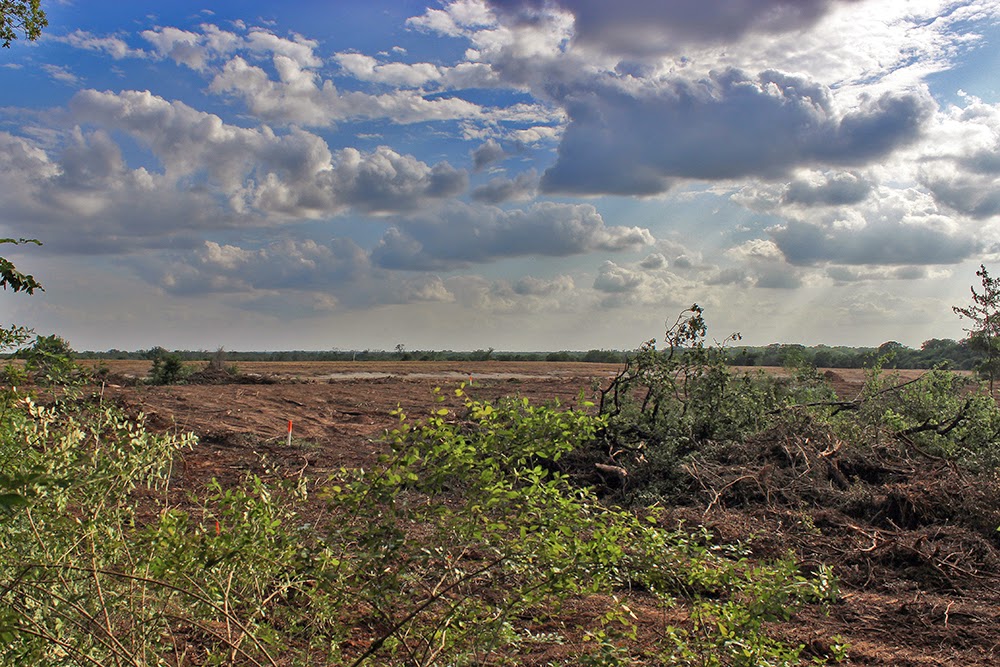
Trinity Forest Golf Course Construction clearcut exposes the old Loop 12 Landfill and in the far distance, the current McCommas Bluff Landfill can be clearly seen. Home of the future Byron Nelson Golf Tournament
Pocket ponds and unnamed seldom visited waterbodies exist around the footprint of the future Byron Nelson Tournament site known as Trinity Forest Golf Club. These casual waterbodies called pulse inundated wetlands serve as vital habitat for many bird species.  The shallow feeding areas of the Roseate Spoonbill is paramount to the species survival. Little Lemmon Lake and other pocket ponds and abandoned gravel quarries that dot this part of town serve as critical habitat for these wading birds.


A common theme in pulse-inundated wetlands are overbanking events from the flooding Trinity River.

The prey base like crawfish and minnows increase in abundance while the wetland is flooded and then become highly concentrated in deeper water refuges as water levels recede, becoming highly available to wading birds whose overall success depends on these concentrations.

The average lifespan of a Roseate Spoonbill in the wild is estimated at 28 years. During the course of its life a Spoonbill might have twenty solid breeding seasons and successfully raise young many of those years. It's rather remarkable to let your mind wander that these birds come back year after year. I have been seeing them every year like clockwork since 2007. Same individual birds.

 Video of Roseate Spoonbills at Joppa Preserve, Little Lemmon Lake

This was filmed at normal speed. The ability of the birds to filter feed through the water is astonishing.

Spoonbills consume a varied diet of small fish, amphibians, aquatic invertebrates, and some plant material. They feed in the early morning and evening hours by wading through shallow water with their bills partially submerged. As a Roseate Spoonbill walks it swings its head back and forth in a sideways motion. When the bird feels a prey item it snaps its bill closed, pulls the prey out of the water, and swallows it.

Here they are wading patiently in the shallows, nipping at fish, crawfish and snails with a long, rounded beak that gives them their name. With a super sensitive beak they can detect the smallest of watery prey.

It's so very hard to express the rarity of wildlife movement through the Great Trinity Forest in Dallas or tell in words or pictures what is really there. What makes it a special place like no other in North Texas is hard to show. So many birds down there look alike, so many other animals are of a secretive nature where one only sees faint footprints rather than the creature itself.

Friday, June 27, 2014

Wood Storks Taken Off Endangered Species List And Return To The Great Trinity Forest

A Juvenile Wood Stork at Joppa Preserve on the evening of Juneteenth 2014, Dallas Texas. One of the most rare and special animals in Texas.
It was an early summer Thursday, June 26, 2014 to be exact that marked a significant moment for one of the most imperiled wading birds in the world, the Wood Stork. A mere thirty years ago, biologists said that by the year 2000 the Wood Stork would be extinct from the planet. It was on that Thursday, Sally Jewell, Secretary of the Interior announced the down listing of the Wood Stork from “endangered” to “threatened,” finding that the birds, which breed only in the Southeastern United States, no longer face imminent extinction.

A young Wood Stork stands alone in the Great Trinity Forest June 2014 taking a brief break from foraging the submerged bottom of a lake for food.
Wood Storks were protected in 1984 under the Endangered Species Act after the birds had declined from approximately 20,000 pairs in the late 1930s to 5,000 pairs in the late 1970s, largely due to draining and development of wetlands. After the Wood Stork was designated as endangered, work began to preserve and restore wetlands and protect nesting areas. According to the US Department of Fish and Wildlife the most recent three-year population average ranged from 7,086 pairs to 10,147, however, the five-year average of 10,000 nesting pairs identified in the recovery plan as the target for delisting had not been reached.

Wood Stork spreading wings with the imminent approach of a fast moving storm over the Great Trinity Forest, June 2014
The change in designation by the U.S. Fish and Wildlife Service marks an important step toward full recovery but will not reduce the species’ legal protection. Some believe political pressure by golf course corporations and homeowners associations pressured the move from endangered to threatened. The rigid enforcement protections for the birds and their habitat remain in place despite the change in designation.

About The Wood Stork Mycteria americana


Wood Stork Mycteria americana exhibiting the unique to the species feeding technique

Few Dallasites have ever heard of a Wood Stork. Only a handful of even experienced birders have even seen one.

Wood Storks (Mycteria americana) also called the Wood Ibis are large water birds that stand 4 feet tall and are the only stork in North America. They have wingspans as wide as 5 1/2 feet. They are mostly white, but have a black tail and many black feathers under their wings. Storks are related to ibises, herons and flamingos. Adults have no feathers on their head and neck, so the black skin underneath shows. This makes wood storks the only tall water birds with black, bald heads. Since they have no muscles attached to their voice box, they are very quiet birds.

Best Places In Dallas To See A Wood Stork
Trinity River Audubon Center

John Bunker Sands Wetland Center

 Both nature centers have sightings of Wood Storks off and on from the 4th of July till August. The Wood Storks move around between feeding and roosting zones so they are not round-the-clock residents on any given day. You can call ahead and check for sightings. Both locations have confirmed sightings in 2014.
Wood Stork and three Snowy Egrets working a nearly dried up Little Lemmon Lake under darkening skies of a thunderstorm, June 19, 2014
Faster than a hummingbird, the quick snaps of the beak are blurred even in high speed photos
Wood storks use the massive beak as their source of food gathering.  The feed in water no deeper than their beak and catch a variety of things in their bill which they then toss their head back and swallow.

This technique is known as “grope feeding”.  This because the stork does not use vision in food collection, but instead does everything by touch.


The reflex of the bill after it touches food is thought to be the fast of any reflex in the vertebrate world. When it feels a fish, the stork can snap its bill shut in as little as 20 milliseconds—an incredibly quick reaction time.

Video footage of the Juvenile Wood Stork at Little Lemmon Lake during a gathering thunderstorm and downbursts of wind


Their diet has been known to consist of fish, crayfish, salamanders, tadpoles, shrimp, frogs, insects and an occasional snake. Storks also use their feet to stir the bottom when collecting prey.  This technique startles the food from the vegetation into the beak. Some think that the water turbulence caused by this action simulates the water movement of a feeding frenzy, and can attract fish to become prey. 

Wood Stork with another catch, a small fish most likely one of the hardy species of Mosquito Fish that are found here

A Dry Spell And Habitat Loss For Wood Storks In The Great Trinity Forest
Seabreeze storms boiling up from the Gulf as seen from Miller's Switch in the sleepy community of Joppa, evening of June 23, 2014
Wood Stork in the Great Trinity Forest June 2014
The seabreeze fronts that start in the Gulf of Mexico push northward during the daylight hours. They track roughly up the Trinity River from the Gulf of Mexico to about Corsicana. If they are long lived fronts they can make it as far as the Dallas area with a pronounced gulf smelling breeze and cool humid laden air. Most evenings, like the photo above illustrate, the storms make it to Navarro or Ellis Counties.

Spring 2014 came in late, cold and dry for North Texas, third year in a row. Dry years stacked on top of one another start changing the look of things down here on the Trinity. Ponds and small lakes don't hold as much water or none at all. Those water bodies that do have some depth to them go dry in June rather than August.

The weather might be late but a few brave Wood Storks ventured into the Great Trinity Forest weeks ahead of years previous.


In years past, especially in 2011 and 2012 there were many overbanking events with the Trinity River that filled Little Lemmon and Lemmon Lake. These events created ideal habitat for Wood Storks which gathered in the hundreds seen here in 2012


And of course the African safari like backdrops of wild pigs wading across Lemmon Lake with well over 100 Wood Storks and hundreds of other wading birds in the lake:


Little Lemmon Lake going dry months earlier than normal, June 2014


The past half century has borne witness to dramatic changes in the quality and quantity of wildlife habitat. Throughout the United States, Mexico and South America, wetlands continue to be drained and filled, forests cut and fragmented, and grasslands developed for construction. Other less intrusive land use practices like golf courses have upset the natural balance as well.
Caterpillar D6R clearcutting a large swath of the Great Trinity Forest for the Trinity River Golf Course


http://www.dallasnews.com/sports/golf/headlines/20121129-city-att-smu-plan-championship-golf-complex-in-southern-dallas.ece
From the article written by Bill Nichols and Rudolph Bush "Suhm and Rawlings pledged that the Great Trinity Forest will not be disturbed by the golf course development. The land for the course will be limited to the bare landfill property.  “They won’t be doing things in the forest. No taking down trees. They will be planting trees,” Suhm said."

One could take a guess as to whether or not those were sincere promises now.
Same spot a few days later as viewed from across the fence standing on the Trinity River Audubon Center property. Better wear your sunscreen if you plan on visiting the Byron Nelson when it moves here.
Many of these habitat changes from natural woodlands to managed groomed greenspace are not what they appear. While forest and woodland cover in some areas has actually increased, the quality of those habitats compared to the original woodlands may not be similar at all because of changes in vegetation composition and artificially abundant predator populations.
Wood Stork working for crawdads and small fish among the dilapidated pilings of a circa 1920s fishing pier in the Great Trinity Forest
Without some heavy tropical systems brewing in the Gulf this summer, the habitat for wading birds will be quite scant in the Great Trinity Forest. The moonscaped clearing of the Great Trinity Forest and landfill areas for the golf course will impact the wading bird habitat that use the pocket ponds in that area during the height of the summer months. Perhaps it will be a permanent change.

The rare places left inside the city limits of Dallas that attract such wildlife seem to be in real peril from planned development. These smallish ponds and drying beds are the real endangered species of note. Oh so rare and important to so many species of birds, the world over, who seek out the water here for habitat. It would be a tremendous loss to the city as a whole, we would all be poorer for it, if the planned development here impacted the wildlife in any way.

Where does a federally protected threatened species fit into the mix remains a cloudy picture.

Up A River Without A Paddle -- Tracking The Fascinating Inland Dispersal Of The Wood Stork
Eye to Eye with a Wood Stork not 15 feet away at Joppa Preserve June 2014. In the higher resolution version of this photo I can see myself in the eye reflection. Too many people rush for shots of wildlife. Patience pays off, in this case sitting among the high swamp grasses and mud, then letting the birds slowly march along foraging for food. Stalking or slow walking up to these birds never works. What does work is letting the wildlife decide what is comfortable. The result is a look into the bird few see. A slight turn of the head look but without the flighty facial expression of profound shock so many pictures often exhibit.
Wildlife, both fleet footed and on the fly, use the Trinity River as a main artery of travel from the parched uplands northwest of Fort Worth, clear to Trinity Bay on the Gulf of Mexico.

The Wood Stork that we see in Texas, moves inland after nesting along the Gulf of Mexico during the spring. The birds seek out shallow drying ponds and water bodies where concentrations of fish exist in great numbers. A reverse migration of sorts that when seen through human observed reports read like a ten mile march up the Trinity every day from May through July.
A Wood Stork mimic marches the gait of a Snowy Egret as a Tri-Colored Heron watches in the foreground
The easiest way to track movements of Wood Storks or any migratory bird species is to use Ebird, a google map based website http://ebird.org/ebird/map/ which allows the user to search for specific species, locations, dates and years that birds have been spotted.

Wood Stork migration and dispersal has likely been this way for hundreds or thousands of years, a route implanted upon the DNA of the species who frequent the river. Wood Storks are most likely no exception to that process. Many of us humans were not born into the intimacy of our natural environs, using tools like Ebird gives us the ability to see the ebbs and flows of the natural world transformed into data we can understand.
As mentioned earlier, Wood Storks have a unique feeding technique and require higher fish concentrations than other wading birds. Optimal water conditions for the Wood Stork involve periods of flooding, during which prey (fish) populations increase, alternating with drier periods, during which receding water levels concentrate fish at higher densities coinciding with the stork's nesting season.

The Wood Stork, Bald Eagle and many other species of migratory birds owe their current existence in the United States to the determined, last-ditch efforts carried out under the legislative milestones of the Endangered Species Act. Attempting to pull species back from the brink of extinction can be an expensive and contentious proposition.

Even today, despite considerable conservation gains in the past few years, many challenges still threaten to drive species away from healthy populations, and onto the endangered species list. There are many cheap and smart ways to increase habitat for these type birds in the Great Trinity Forest with no impact on planned "World Class" amenities as they are called for the area. Money can buy a lot of things, almost anything, a Wood Stork and their free will to call this neck of the woods home is not one of them.

Sunday, June 8, 2014

Great Trinity Forest and the Big Swamp

Sabal minor palms growing on the floor detritus of the Great Trinity Forest, Dallas Texas, June 7, 2014
The deepest part of the Great Trinity Forest lies here. One that is rarely if ever visited by humans. The lair of water moccasins, snakes hanging from trees, snorting feral hogs, spiders the size of your hand and chest high poison ivy. We were greeted by all of that fifty feet from the road. We had miles to explore beyond into the only known stand of palms growing in Dallas. A special and fragile place protected by impossible terrain and veiled secrecy on the location.

Master Naturalist Bill Holston moving through a shaft of early morning light in the otherwise dense and dark forest
 
Flash required to highlight the flowering stems of the palm

Dark. Even on the brightest of June mornings. The sun's rays strain to reach under the double dappled canopies of mature pecans, walnuts and oaks. The exceptional experience is one that would one would think to be found afar from Dallas. Maybe Big Thicket or swamps on the Sabine hold such caliginous and musky spots. No. It exists inside the city limits. Fitting that such a place holds the most biodiversity in the Great Trinity Forest. One of the more unique species found here, an outlier species that defies the status quo is the Sabal minor palm.

The Sabal minor, the Dwarf Palmetto, is an understory palm generally occurring in low-lying, swampy habitats. Sabal minor occurs from Southeastern Oklahoma and Texas eastward to Florida and North Carolina. It is a wetland species that thrives in swamps, floodplains and backwater regions of the southeast where the land is often inundated by prolonged periods of water.

Budding flowers on a Sabal minor, Great Trinity Forest, Dallas Texas, June 7, 2014
Three foot long flower stalks appear this time of year, covered with small, yellow-white, fragrant flowers  The flowers are followed by small berries that ripen August through October. The berries ripen from green to black on a branched cluster shorter than the leaves. Flowering and fruiting are not necessarily annual events, and some years see more abundant flowering than others. Even when flowering is abundant, fruit production is erratic; the causes are unknown.
Sean Fitzgerald works through the bright sun and very dark shadows which is uncommon in North Central Texas

Sabal Arecaceae constitutes sixteen species of palms that are distributed in the eastern woodlands and coastal plains of the Southeastern United States. Spanish explorers who landed on what is now the Gulf coasts of the United States immediately noticed the “palmito” or little palms growing everywhere. The “palmetto” name has since been applied in common names to these small palms.


Sabal minor dwarf palmetto or swamp palmetto has a solitary subterranean(underground) stem and rarely seen above ground in North Texas with 4–10 dark green leaves. It is thought that the trunks are subsurface to aid in protection from freezing cold weather and frozen conditions. Hardier than many palms, these plants have endured countless cold snaps and ice storms that few of their southern counterparts will ever experience. These plants made it through some of the coldest winter weather conditions that North Texas has experienced in many years. The cold weather of December 2013 sent temperatures in Dallas into the near single digits for days. Cold hardy and the ability to thrive in extremes make the plants here a special and unique colony.

Biologist Scott Hudson and Photographer Sean Fitzgerald checking out feral hog damage in an ephemeral section of swamp, dried after recent rains in May


A mushroom growing up through a decayed pecan limb on the forest floor

Honeybee hive in a Bois d' Arc tree
Years of fallen leaf litter, branches and storm debris cover the ground in this area. This type of wet and dark environment provides the ideal conditions for fungus species to thrive on the slowly decaying material.

A number of larger trees here have voids in them. Seen at left, a large honey bee colony has built a hive about 8 feet up in a cavity of a Bois d' Arc tree. Many Bois 'd Arc trees exist in this area. Tough and resistant to nearly all diseases, they can live centuries in the riverbottoms under ideal conditions. These trees prefer a slightly higher elevation just out of the immediate floodplain on slightly drier ground.

Red bellied woodpecker in a cedar elm
Other species of trees found in this area include pioneer species like ash and cedar elm.


The Red-bellied Woodpecker is a familiar year round resident of forests in the eastern half the United States  It is a bird of densely wooded lowlands and bottomlands, open forests and swamps. It too uses the voids and cavities of trees. The bee hive and the woodpecker seen in the photos here were taken within 100 feet of one another.


Engaging the formal swamp
Acres and acres of snake filled swamp that we slogged though
Ankle deep water in the flooded sedge, acres of it
The goal for this hike was to push through the Sabal minor groves, ash bottom and pockets of heavy ragweed to reach the immense and large water bodies we hope will hold tropical wading birds later in the summer.

Lots of over banking events this spring have created ideal aquatic habitat and food for wading birds, snakes and frogs. Getting there requires wading through flooded aquatic grasses that are prime habitat for water moccasins and alligators. Called sedge, this aquatic grass in the lifeblood of environments like this.

Black Crowned Night Heron in a pocket pool surrounded by sedge

In Texas, there are over 100 species of sedges and they are difficult to identify without using detailed botanical indexes. In general, sedges are perennial plants that resemble grass, grow in shallow water or damp soils, and can reach 3-4 feet in height. Sedges often grow in thick clusters called tussocks.

Submerged portions of all aquatic plants provide habitats for many micro and macro invertebrates. These invertebrates in turn are used as food by fish and other wildlife species (e.g. amphibians, reptiles, ducks, etc.). After aquatic plants die, their decomposition by bacteria and fungi provides food for many aquatic invertebrates. Sedges are considered good wildlife plants. Sedges are grazed by muskrats, nutria, and rabbits, while the seeds are consumed by waterfowl and small birds.

Panorama of open water, Great Trinity Forest
The sedge and willows break open into the bright brilliant light of a true swamp with beaver built islands, beaver slides, copses of willow studded islands and high tree canopies that line the water's edge for hundreds of yards.
A first look at a promising site for dispersal birds later in the summer. Left to right, Sean Fitzgerald, Bill Holston, Scott Hudson. Scott with the field glasses is observing a Yellow Crowned Night Heron on the opposing shore
Tri-colored Heron with a sunfish
There is a certain recipe for attracting wading birds to bodies of water. The ideal conditions are lots of food, shallow water, good cover and a secluded environment from predators. This unnamed body of water meets all those criteria and more.

Great Egret in breeding plumage, note the neon green around the nose
The difficult wading hike to make it here for a human is actually a great asset to one wanting to observe wildlife. Other bodies of water similar to this like Lemmon Lake in Joppa Preserve, require a long slow belly crawl across grass to reach the shoreline. Here, at this location, the dense treeline all but obscures a person for wildlife viewing up close.
Checking out the water depth and making mental field notes
High quality habitat like this is very rare in Dallas. It attracts birds seldom seem in other places in town. The area acts as an incubator for many animal species to raise their young, it was clearly evident that birds, especially the Yellow Crowned Night Heron had a nearby rookery.
Yellow Crowned Night Heron
Rough Green Snake in an Oak
Rough green snakes are typically found on forest edges near ponds or lakes. Although they are arboreal snakes, they forage in dense vegetation along pond and lake shorelines during the day. Nights are spent coiled in the branches of trees. Rough green snakes choose perches based on distance from water sources, height in branches, and thickness of the branch.


Some Birds Of The Swamp
Tri-colored Heron, Snowy Egret and White Ibis, Great Trinity Forest, June 7, 2014
Three birds featured above, all wading birds of near similar size and height with all very different methods of catching prey.

Perhaps a decade ago, the sight of a White Ibis was a rare occurrence in Dallas. Same with the Tri-Colored Herons who, even today still exist on ornithological range maps as birds of the Gulf estuaries and Louisiana swamps.


White Ibis foraging for food
This spot is so remote and so unexpected to have humans visit that we were able to spend a long length of time inside the shade of the trees observing not only the feeding habits of these birds but watching many of the birds fly directly over our heads and land directly in front of us, 20-30 feet away.

Snowy Egret
When foraging, the Snowy Egret walks upright with the neck slightly arched, and it flies strongly with deep wing beats, the yellow feet visibly trailing behind the body. It is an extremely vocal heron, particularly during aggressive encounters, when a characteristic “rah” call is emitted.The Snowy Egret will often shake their legs and feet, agitating the water and mud to stir up prey underneath.

Snowy Egret prowling for prey

Juvenile Little Blue Heron
The snowy egret is often confused with the juvenile Little Blue Heron (Egretta caerulea), but may be distinguished by the pure white tips on the wing feathers, the solid black bill and the bright yellow feet, which give the impression that the bird is wearing gloves.

Green Heron
The Green Heron is sometimes called the Green-Backed Heron. It is a smallish heron that is about the size of a large crow. It is a foot and a half to two feet in length. The Green Heron has a dark head with a small black crest. Its back and wings are dark gray-green to dark gray-blue. Its neck is rust colored. It has a dark bill and its legs are orange or yellow. Elusive little birds that are very hard to photograph in flight.


Yellow Crowned Night Heron

The Yellow-Crowned Night Heron is a migratory bird that resides here along the Trinity River in Texas  Unlike other night heron species, the yellow-crowned forages both late in the day and night. It forages much like other herons by wading through water waiting for its prey to come within striking distance. Also, unlike the great heron which many have seen standing motionless like a statue in many Texas waters, the yellow-crowned will stir up its quarry by wading briskly at the waters edge. With a quick dancing motion, the dagger like bill stabs its prey.  The prey of a Yellow-Crowned Night Heron normally consists of fish, frogs, grasshoppers, and occasionally snakes, but its primary diet is crustaceans.

Juvenile Yellow Crowned Night Heron on the branch of a willow

Tri-colored Heron
The Tri-colored Heron's signature movements, aesthetic features and picturesque plumage draw it apart from the other birds. The Tri-colored Heron's color is a slate blue/dark blue gray color. It has light greenish/yellowish legs and the color on the beak matches its legs. It also has a white stripe on its purple neck. The heron's white belly gives it its unique identity. It is named the Tricolored Heron because of these three different shades.

It is the only dark colored bird with a white underbelly in the heron family. The Tri-colored Heron usually measures a little over two feet in length and has a little over three foot wingspan.

White Ibis

Because they require shallow water for feeding, many white ibises are found in coastal, aquatic environments such as ponds and lakes or inland wetlands. White Ibises are primarily found in southern coastal regions of the Gulf states and during the summer and move inland after the breeding and nesting seasons. Called "dispersal", the wading birds head inland from the coast in search of slowly drying ponds and beds. Because water depth is of the upmost importance for their feeding and reproductive behaviors, White Ibises may shift locations due to the rise and fall of water levels.

White Ibis in the Great Trinity Forest June 7, 2014