Showing posts sorted by date for query big spring. Sort by relevance Show all posts

Tuesday, July 28, 2015

Dallas Great Trinity Forest Flood -- Kayaking across the flooded forest

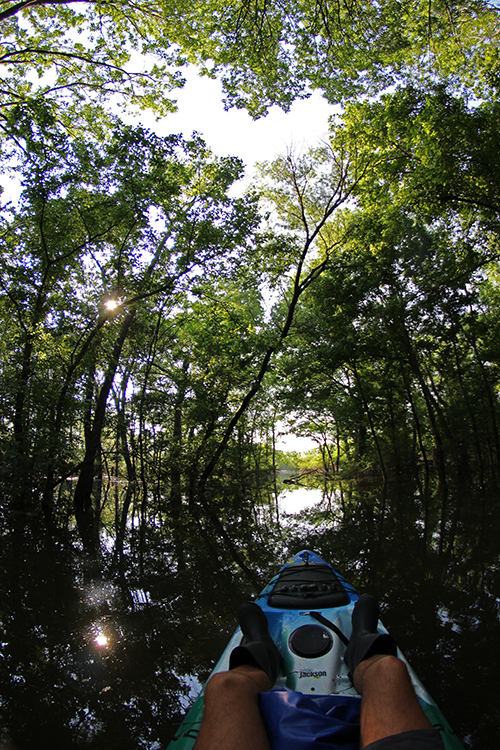
Kayaking the tree canopy in the 20 foot deep water of Dallas Great Trinity Forest

The easy to photograph shots of a flooded Trinity River made a splash on the evening news or social media feeds where a 100 yard walk down the levee from parking lots at Trinity Groves affords the hallmark postcard shots residents have not seen in years. For many, it is the first time they are discovering that Dallas is a city built upon the banks of a river. The Trinity.

Usually seen as an economic divide, a barrier that separates the haves and the have nots, the river is often more of an untangible figment of human imagination. Few ever see it as a big river with plans of it's own.
Time exposure of water coursing over the submerged Skyline Trail creating an interesting nocturnal effect on the water

A dwarfed Old Red Courthouse standing among buildings 100 years junior
So long has it been since the Trinity flooded that Twittering was something only birds did and instagram was something people would probably associate with a Western Union wire transfer.

The Margaret Hunt Hill Bridge designed by Santiago Calatrava had yet to open. It was that long ago.


It is beyond the neon lights of the city, down the river, past the channeled and bastardized levee protection where the river is turned loose and allowed to run wild. Down in the wilderness of the Great Trinity Forest.


It is here, where few ever walk, much less paddle. A place so quiet that one can hear their own heartbeat and the fluttering feathers of a bird in flight. That quiet. Inside Loop 12. A flooded expanse of riverbottom that is completely submerged with no dry ground as far as the eye can see. An area so large that both Dallas bedroom communities of Highland Park and University Park would fit inside of it with room to spare.


Paddling from Pleasant Grove to Joppa and back

A flooded fifteen acre wildflower field behind Big Spring under 12 feet of water. Looking north.

The novelty of paddling from Pleasant Grove to Joppa has always been on a bucket list of sorts. The ease of crossing flooded timber and venturing into areas which are usually impassable swamp. The high water makes the usually treacherous terrain of traversing the woods a breeze. If you know where to go. It is the river in the raw. The beautiful waterscape of flooding areas. Coupled with the redeeming quality of time that begins a healing process from sustained drought.

Paddling across the ONCOR right of way from Big Spring towards Joppa
Floating the flooded timber of the Great Trinity Forest with a brief opening in the treeline exposing Downtown Dallas some three miles distant


With Sean Fitzgerald and Dallas Police at Joppa during Tropical Storm Bill checking out the immense flooding

Texas Task Force One recovering boats at Loop 12, Joppa Preserve

It seemed necessary to wait till the water receded completely before posting such photos. The water looks placid and calm to a novice. The reality is a dangerous mix of currents, uneven flows and unknown obstructions. With the endless drumbeat of news stories featuring kayak deaths on the Trinity in 2015.


The Trinity even in normal flow conditions can bark and bite with a full set of teeth. During high flows those teeth turn into venom filled fangs that rival western drainage whitewater features. High water renders the Trinity Trail bridge over the river near the Audubon Center into a death trap. Any bridge, column or benign obstruction become a vortex of eddies and whirlpools.

Loop 12 Boat Ramp turns dangerous with currents that would kill the strongest of swimmers
There are places in the Great Trinity Forest where no man has ever walked or visited. Impossible to say such a thing inside Loop 12 but it is true. Places where the water is just deep enough not to float a boat but too deep to wade. A flood changes that.
The historic Bur Oak at Big Spring with a blanket of winecups in the foreground serves as launching point across to Joppa
Launching from the 900 block of Pemberton Hill Road in Pleasant Grove off Lake June the transect across the Great Trinity Forest is a straightforward affair to Joppa. Unless one wants to wander into the unexplored.

Bryan's Slough
Up Bryan's Slough...with a paddle
One such unexplored and never photographed spot are the deep twists and bends of Bryan's Slough, also called Oak Creek. I suppose no one has ever quite decided where the name changes, perhaps US 175 is a good line of delineation. The slough is named for the John Neely Bryan family who once lived on the property. John Neely Bryan is regarded as the founder of Dallas.
Bryan's Slough, flooded. Narrow snaking passageways through acres of native hibiscus
In normal river conditions, access to the dense hibiscus groves on Bryan's Slough would be a hip deep slog through prime snake habitat. Conditions that make it impassable even to the most determined. During high water the paddle is still a tad difficult but affords a view or two that no one has ever seen. The sights here resemble that of mangrove swamp. Densely packed plants with narrowing channels and a labyrinth of plant built cul-de-sacs of dead ends.

Great Blue Heron with a water moccasin snake
The water in some areas in this section are still shallow enough to support the long legged Great Blue Heron. Seen above, surprised after being spotted by an unexpected kayak rounding the bend. Had the camera not been in a dry bag, the whole spectacle of coup de gras on the snake would have been captured.

In coming weeks this area will bloom into early morning brilliance with saucer sized white flowers of the native Halberdleaf hibiscus. The water loving plants put on a show that no human ever sees. A place remarkable for stunning beauty that no person will ever see.

Rochester Park
The endless Ash trees that are flooded as one approaches the river channel


Ash is the dominant species of tree in Rochester Park, Lower White Rock Creek and in areas earmarked for mitigation in the Great Trinity Forest. The photo above is in a planted mitigation area under 6 or seven feet of water. Drowned under all that water are hundreds of planted seedlings of various species from trees to understory plants. Should be interesting to see if any survive inundation for such a prolonged period.
Making a wake paddling the Lower Chain of Wetlands across an epic tropical sky


Cumulus clouds begin to build to the west and the south after crossing the river channel. Into the wetland cells where the trees have been cleared to allow for something the Corps of Engineers calls "conveyance". A popular term entering the vocabulary of many this year. The word takes on a sinister meaning for some, as a large piece of riverbottom is clearcut for a pedestrian bridge. Over a quarter mile's worth of trees.

The Flood At Joppa

It is a few miles downstream of Downtown that one finds the small community of Joppa. A place forgotten and cast aside by a hundred and a half years of less than stellar support by the city that annexed the Freedman's Community. The lack of infrastructure, lack of public services make Joppa a place with a lot left to be desired. But they sit on high ground and no home in the near sesquicentennial of the community has ever seen flood water.

It is below Joppa, where the city and Corps of Engineers funded the DFE Project known as the Lower Chain of Wetlands. A place that will never carry the eponymous designation of the community next to it. A series of ponds pumped with treated sewage during the dry weather is overbanked by the Trinity during times of flooding rain. The swales or cells have concrete gate structures on the downstream end that regulate flow and water height during dry spells.
The rip rap road structure a top the earthen dam between Cell F and G and Joppa
Dry land at last, some two miles across the Great Trinity Forest one finds first exposed land at the earthen dam bunkering Cell G in the Lower Chain of Wetlands. In the photo above, a thundershower cracks the evening sky over Fair Park and South Dallas. The thunderclaps in the humid air brings concussion with it. Loud reverberating across the near featureless submerged plain.
A Snowy Egret awaits wayward fish to spill across the dam between Cell F and G in the Great Trinity Forest

It does not take astute powers of observation to understand the power of water at work. The once tidy and utilitarian weirs and concrete have been altered by a touch of nature in all the flooding. Billions of gallons of water on their way to the Gulf of Mexico pass over this spot carving and weaving man's work into something else.

The damage to such places is hard to know. Even as the flood waters recede and the silt begins to harden into a near cement the tally in what man has built in the floodplain will be a hard price tag to determine. The Trinity River to some took on a larger-than-life appearance for a month. One that some downplay. To others it is a wakeup call that the Trinity is capable of prowess that humans have little control over. Things such as this ponder the mind as one paddles back across the river from Joppa to Pleasant Grove. In the muting light float of a fading summer's night it makes even those who think they know the river change their opinion on the place.

Monday, May 25, 2015

Exploring Dallas Great Trinity Forest At Flood Crest


Trinity River in Dallas, Texas flooding out the Great Trinity Forest under a spectacular sunset sky May 24, 2015
 
It's the Flood of 1957. Carbon copy of a large scale drought buster that quenched thirsty North Texas and ended years of sustained drought. To the month, to the week of the month, to the day of the month and even the river height are near duplicates to the inch. It is often hard to convey relevance to many when it comes to this place. Maybe there are not many around anymore who recall what the Flood of 1957 brought, the lessons learned and why you don't mess with the river.
Wading deep into the Great Trinity Forest on May 24, 2015 off Bexar Street in an area known for Texas Buckeyes and wooded views

White-lined sphinx larva (Hyles lineata), commonly known as the hummingbird moth searches for high ground in the flood water


Snowy Egret walking double yellow line down Carbondale
In order to gain such appreciation to take a place for granted one needs to talk about what is present in the landscape, what is absent or what has been absented. No one told a man named Wallace Jenkins that. No one sat him down in the 50's drought when he decided to plant 500 acres in the bottoms near the mouth of White Rock Creek and the Trinity.

His ranch headquarters stood where the recent Texas Horse Park was constructed in 2013. Jenkins was so furious that his crops were ruined by changes in flooding that he ran for and won a seat on the county commissioner's court. The whole of his effort was directed at flood protection and mitigation from changes in riparian flooding in the rapidly urbanizing watershed upstream.

The old Riverlake Country Club entrance with the parking lot under 7 feet of water
It was the flood that led to the bankruptcy of Riverlake Country Club in what we contemporary Dallasites now call the Great Trinity Forest. Backed by big sports names like Mickey Mantle, funded by well connected Dallasites with braggart attitudes of controlling a piece of river bottom spilled across the pages of the Dallas Morning News of yesteryear in paid advertisements. The river smashed that idea to pieces. Over and over again.


Dallas Floodway Extension between Cell F and G near Fellows Lane at major flood stage 5/24/15

Joppa resident fishing before flooding rains in April 2015

That old golf course was bought for flood control in the last decade. Gone are the sand bunkers, manicured greens and the clubhouse. The ghostly cart paths remain intact. Portions of a levee built, rebuilt, fortified and left behind still exist.

A confusing plan to demolish 1200 feet of it in 2015 has left everyone scratching their heads. Everyone I show the spot to all cuss under their breath about it. Some cuss loudly. The people in Joppa cry about their big trees lost. The ones their great grandparents told them about as children. The trees that they as great grandparents tell their great grandkids about.

 Where the water goes once it leaves the confines of the Trinity Levees in Downtown is a complete mystery to so many. It is cringe worthy reading others thoughts on what happens to the water, impact on new construction and the often untold stories of South Dallas residents who live without flood protection. Large technological dreams of concrete are stalking the river which will ever change the hydrology of not just the Downtown area. The water flow will accelerate and scour the Great Trinity Forest in ways no one has yet to imagine.
Residents of Joppa trying to drain the flood waters from their property using gas powered pumps on May 24. 2015

Crested Caracara the Mexican Eagle lands on a pile of clearcut tree trunks in the Lower Chain of Wetlands Dallas, TX May 24, 2015
Crested Caracara moves in for the kill on a Cattle Egret May 24, 2015
A Mexican Eagle on May 24, 2015 is the only living thing seen across the horizon. Across an angry chain of river raged swale that was once golf course across from Joppa. Standing on a pile of clearcut tree trunks admiring the view of a bend in the river. A bend that the freed slaves who founded the community here referenced a similar bend in the Old Testament. A bend that Moses and his followers found when freed from bondage.

Many Dallasites have never seen an eagle outside of a zoo. Fewer have seen one in Dallas. Fewer still have seen one chasing down killing another bird in aerial combat as the photo sequence above shows at Cell G in the Lower Chain of Wetlands.

Black Bellied Whistling Ducks, a tropical duck rarely seen in North Texas
The flood waters are not high enough to build an ark but in some places the animals are lining up in twos. At Joppa Preserve pairs of Black Bellied Whistling Ducks line up and feed among the flooded shallows of the ever rising Trinity whose channel is some 3/4's of a mile away. Black Bellied Whistling Ducks are an uncommon site in the Dallas area. Many experienced birders don't have them checked off their bucket lists for the county. Here, in South Dallas they can be seen with some regularity in the summer and early fall.

Birds like the Black Bellied Whistling Duck which hails traditionally from the corn belt of Mexico has been drawn in Aztec and Mayan art on their temples for centuries. The Mexican Eagle also known as the Crested Caracara has been depicted as an ancient symbol in sacrifice and even adorns the current flag of Mexico.

These birds exist here as summer residents yet rarely documented. The reason is that traversing this land, this river, this river bottom turns away all but a few. The long winded stories about personal safety have a ring of truth to it. Throw in high fast moving water and the number of people visiting such a place whittles down to about zero. Visit this place and you will have it to yourself.


Photographer Sean Fitzgerald shooting wildflowers in floodwaters
Getting into these spots is less than straightforward during dry spells. The adventure of making your way into the unknown and untouched masterpiece of nature here is one that people crave yet few know it exists in their own backyard.


The few who do know these places well are folks like Sean Fitzgerald a well known and popular professional photographer based out of Deep Ellum in Dallas, Texas. His website http://www.seanfitzgerald.com/ has photos from all over the world. Quite a few are from garden spots across Texas like Big Bend, Blackland Prairies and the Great Trinity Forest.
Sean Fitzgerald wading the Great Trinity Forest in very deep water
Making headway across water neck deep with delicate camera gear is a tough chore to accomplish in dry weather and very tough in high water. One false step and the camera gear can be ruined in an instant. The risk is worth the reward when the weather, light and wind cooperate to allow for sights so stunning that a camera cannot capture the intense color and beauty.
The perfect light of a setting sun illuminates an island at Rochester Park in Dallas Great Trinity Forest
This is the Great Trinity Forest. The wild open lands inside an urban metropolis of millions. A complete fluke of a gift left behind untouched by people for decades. To be here at this spot, at this time under sunset perfected light is something I wish all decision makers could see with their own eyes.
Clasping Coneflowers submerged up to their flower heads in floodwaters


Spiders and insects of all kinds seek dry refuge

Seeing such a place would change their perspective and prejudices of such a place. It will make anyone second guess their ideas of blight and trash in South Dallas. It is a beautiful place of water, wildflowers and wildlife that cannot be equaled upstream or downstream.

As the light begins to soften and the sun begins to set the real true colors of a Texas spring take shape. It is the magic hour for photography when the sky comes to life.


 These sights are only temporary. As the river rises and crests it is soon surely to fall. A brief period of inundation that spreads nutrient rich silt, aquatic life and plant seeds into new areas. The harvest of such a flood comes months from now as the water recedes and brings forth a new beginning to the ecological cycle of the Great Trinity Forest.

Tuesday, May 19, 2015

Big Spring's Vireos In The Great Trinity Forest with Father Tim Gollob

A vibrant White Eyed Vireo in the Great Trinity Forest at Big Spring
The winter and spring rains of early 2015 has brought an ocean of green growth to the Great Trinity Forest. The magnitude of growth the forest has not seen in several years due to drought. The flora and fauna of the woods have responded, signaling a new year of promise. Each spring sunrise seems to illuminate another inch of growth overnight.

Father Timothy Gollob and Bill Holston walking among the soon to be blooming wildflowers of Big Spring in the Great Trinity Forest


It is on of those fine spring mornings one can pursue the wild birds of the Trinity. In this case the brightly colored White Eyed Vireo population at a place called Big Spring in the Great Trinity Forest.

The story of Dallas County's vireo population runs through the recorded sightings and observations of a South Dallas Catholic priest. His name is Father Timothy Gollob of Holy Cross Catholic Church.


Father Timothy Gollob has been telling the story of the Trinity River for over a half century through his extensive bird observations. If there were a search for the man alive who knows the most about vireos in Dallas, it would be Father Tim.

Into the early fog of the Great Trinity Forest at Big Spring
His parsonage sits just west of the river bottoms only a minute or two drive from Joppa. It is there in the cooling atmosphere of early evenings where one can often find Father Tim with his field glasses walking the woods.
 
The Wood Storks, Roseate Spoonbills and Egrets all have been documented by him. On casual walks with Father Tim, he has mental notes about where the resident chickadees like to spend their mornings and evenings. Where the buntings feud. The favored nest sights and perches of the tanagers.
Two of Dallas great citizens, Bill Holston and Father Tim Gollob stand under the limbs of the historic Bur Oak at Big Spring

The body of his work in birding observations is overshadowed by his lifetime of service as a Catholic priest where he is known as one of the greatest humanitarians ever to call Dallas home. Ask around. He work is inspirational to many in a challenged part of Dallas where life does not often come easy.

Father Tim hip deep in recycled beer cans back in 1975
Father Tim learned much of his birding craft from ornithologist and late University of Dallas Professor Warren M. Pulich. Pulich is considered the first resident professional ornithologist in North Texas. In the 1960s he authored the Birds of Tarrant County and later The Birds of North Central Texas. His groundbreaking work specialized in species like the rare Golden Cheeked Warbler. As Professor of Ornithology at the University of Dallas he led the way with many pioneering bird collection projects, many of which were obtained from bird strikes on high towers at Cedar Hill. Often accompanying Pulich was Father Tim.

Warren Pulich and Father Tim Gollob did extensive surveys and observations of vireo populations in the 1950s-1970s. Many of those observations were for the Black Capped Vireos of Dallas County in the southwestern portions of Dallas in the cedar ridges and woods there. The habitat was largely extirpated and with it the loss of habitat for that species of vireo. That species of vireo now resides on the endangered species list and is very rarely seen in North Central Texas. If there ever were a Dallasite you would want along to look at vireos it would be Father Tim.....

Jeff Lane and Father Tim
Hiking along this fine morning are one of Father Tim's close friends and lifelong parishioner Jeff Lane. Jeff's family has a multi-generational relationship with Father Tim's church. Jeff Lane has performed a number of volunteer roles in the Great Trinity Forest and Trinity Corridor. Working in his free time with the county, he has kept many of the levee areas mowed at Goat Island Preserve and in the past mowed in areas around Joppa Preserve to keep trail access open.

Also joining along are Bill Holston and Scott Hudson. When Scott is not hiking on the weekend he can be found running one of the local municipalities environmental services departments. Below Father Tim and Scott Hudson listen for the identifying call of an Indigo Bunting.

Bill Holston earlier this spring was recognized by Southern Methodist University with their 2015 Distinguished Alumni Award for Public Service
https://www.smu.edu/News/2015/law-daa-19march2015

The White-eyed Vireo

About fifteen species frequent the United States. These are all members of the genus Vireo, and some of them have a wide range, only equaled in extent by some of the warblers. The name vireo signifies a green finch and is from the Latin word meaning "to be green." The body color of nearly all the species is more or less olive green. A fitting hue of a bird to look for on a lush green morning.
White Eyed Vireo in the early morning foggy light

The vireos form a varied and interesting family — the Vireonidae, which includes about fifty species.
All are strictly American and the larger number inhabit only the forest or shrubby regions of Central and South America.

Insects are the principle food taken by this species of vireo, and especially Lepidopteran (butterfly and moth) larvae.

The White-eyed Vireo is a foliage gleaner, and it forages deliberately with short hops or flights. Most of the food is taken from leaves, and after a food capture, the bird will usually perch and swallow. An interesting behavior is the repeated flogging of large caterpillars on a branch before eating.
Vireo with a mouthful of caterpillar
In migration and during the early days in the breeding season, males sing to attract mates, usually while perched high in a tree. It is at this time they are easiest to observe. Males vigorously defend their territories, while females are tolerant of others sharing the same area. Males often use the same territory from year to year, and older males arrive on the breeding grounds before young males. Females wander from territory to territory and eventually choose a mate and then a nest site. The pendulous, cup-like nest is attached to a Y-shaped horizontal branch a few feet off the ground in dense vegetation. The Big Spring vireo calls loudly, pronouncing rather proudly that he has the best territory in town.
White -eyed Vireo singing in the bows of a willow
Up to twenty five songs are predominate in the White-eyed Vireo population in the United States. Each individual has a repertoire of about a dozen songs, only males sing on the breeding grounds. Both sexes sing on the wintering ground to defend territories. Singing is believed to be learned behavior, with young birds adapting the song set of their father. White-eyed Vireos repeat an individual song type multiple times before switching to another song, and the order of songs appears to be random from one singing bout to the next.

Our hike started on the high terraces of Pemberton Hill on an early morning after a heavy night of rain and thunderstorms. The rain, dew and fog made for a rather wet experience in the high grasses.


The topography of the land here steadily drops 50 feet in elevation over the course of a quarter mile which winds up at the site of Big Spring, a natural and free flowing spring at the boundary of Trinity Terrace sand deposits and the floodplain proper. It is an idyllic place.

A spot where it takes very little imagination to see the fondness generations of Native Americans, explorers and pioneers had for the place. It continues even today in contemporary times as people look for a connection to things natural and unspoiled.
Father Tim Gollob is dwarfed by the massive arms of the mighty Big Spring Bur Oak

As we dip farther down into an older forest the sounds of the song birds begin to erupt. The distant calls of Indigo Bunting, Painted Bunting and the more familiar Mockingbirds. It is here in this treelined transition zone between upland and bottomland where so much biodiversity can be seen.
In the distance a Red Tailed Hawk stands perched on a fencepost casually eating a squirrel. Hawks usually fly away with prey when encountering humans, this hawk spent over an hour lazily nibbling on the squirrel.

The trees, grasses and the wildflowers have formed a reciprocal community here fostering an environment of tremendous bounty. With the addition of heavy rains and flooding, the Great Trinity Forest is primed for an excellent late spring and summer of increased wild bounty.

As we walk from the flooded bottoms near the confluence of White Rock Creek and the Trinity back up the hill Father Tim is quick to point out the ladybugs afoot.

The rains are renewing a land parched for years. Talk of great things to come and a hopeful summer filled with the wild observations and sightings that make Father Tim Gollob and the little vireos he knows so well a treasure of the Great Trinity Forest.