Thursday, August 4, 2011

Portaging the Dallas Standing Wave on the Trinity River


Seems that the City of Dallas is trying to limit portage and scouting of the stream bank around the Dallas Wave Whitewater course. Recently the city has sent notice to a Dallas canoe outfitter, Canoe Dallas, that serves him effective trespass notice if he enters the Dallas Wave and Trinity Trestle area on the Trinity. The law clearly does not favor the City of Dallas position. Outlined below are a number of laws and rulings countering the City of Dallas position. The city can limit access to launching boats from the Trinity River Standing Wave/Dallas Wave Park but they cannot limit access to safe portage around their navigation hazard.


Below are some notes and legal briefs describing the right of river users to scout and safely portage the river.

Use of Stream Bank to Scout and Portage Hazards

Historically, the law of Texas, both in statute and in common law, has protected public rights relating to navigable streams. Although until recently there appeared to be no Texas statute or case specifically dealing with scouting or portaging, several aspects of Texas law seem to support the proposition that a portage right is a necessary corollary to the fundamental right of navigation. The authorities set out below support the principle that when a person floating a navigable stream encounters an obstruction like a log jam or a dam, or some other potential safety hazard, the navigator has a limited privilege to go onto adjoining private land to scout and if necessary make a safe, reasonable portage. The intrusion on private land should be minimized.
Other states that have addressed the issue concur in recognizing a portage right. Of course, as is sometimes the case, particular or peculiar fact situations may alter the application of general concepts in specific instances. A recent Texas statute acknowledges that stream users do portage over or around barriers and scout obstructions, and it precludes such use from creating a prescriptive easement over the private property.
There is a fundamental distinction between using private land to portage around an obstacle and using private land as a short cut to get to or from a river. In Texas one has no right in general to cut through private land simply for convenient access to or from a stream.
Dallas Paddling Trailhead

Portaging Obstructions as a Traditional Part of Navigation

Obstructions have always been a natural part of streams. As the waters flow through the land, streams become obstructed by fallen trees, log jams, rapids, sand bars, shoals, etc. Historical accounts of navigating streams often mention the hazards and portages encountered. See, for example, Kenneth G. Roberts and Philip Shackleton, The Canoe, a History of the Craft from Panama to the Arctic (1983). Thus, portaging has always been a part of navigation.
The U.S. Supreme Court has explained that under the federal test of navigability (involving capacity for use in interstate commerce) the presence of a portage does not defeat navigability:
Navigability, in the sense of the law, is not destroyed because the water course is interrupted by occasional natural obstructions or portages; nor need the navigation be open at all seasons of the year, or at all stages of the water.
Economy Light & Power Co. v. United States, 256 U.S. 113, 122, 41 S.Ct. 409, 412 (1921).
As discussed elsewhere, Texas law has long recognized the public’s navigation right, a right of free passage along navigable streams. Texas law disfavors obstructions to navigation. The right to navigate would be meaningless if the presence of a single hazard—a fallen tree, for example—could legally “cut off” navigability.

Advice to Scout and Portage...

In National Publications

  • The American Red Cross, Canoeing and Kayaking (1981) pp. 5.12-5.15.
  • Dave Harrison, Sports Illustrated Canoeing (1981) pp. 154-155.
  • William “Bill” Hillcourt, Official Boy Scout Handbook (1979) p. 161.

In Local Publications

Texas Rivers and Rapids, a commercial guide describing commonly used waterways, has been through several editions over the past three decades. It advises a number of portages on various streams. Volume II, published in 1973, includes this advice in a discussion of river currents: “Never run a dam or drop unless absolutely necessary.” The book cautions, for example, of a portage along the Clear Fork of the Trinity River near Fort Worth:
Roll’s Dam is approximately ten feet high and should not be run. It is an easy portage on the right bank adjacent to the dam at low water levels.

At high levels, the portage is longer and must be started on the left bank quite a way upstream from the dam. Use the left bank portage only when necessary because you will have to travel on private property behind a house.
Volume VI of Texas Rivers and Rapids, published in 1983, warns of particular hazards potentially requiring portage on a number of rivers, including the Brazos, the Colorado, the Frio, the Guadalupe, the Leon, the Neches, the Pecos, the Rio Grande, the San Marcos, and the Trinity. It also cautions of log jams on several streams.
The Big Bend Natural History Association in cooperation with the National Park Service publishes guides to floating the Rio Grande, not only within Big Bend National Park but also downstream along the “Lower Canyons.” The Lower Canyons guide advises boaters of several locations where challenging rapids should be scouted or portaged, including using private land along the Texas side of the river.
The Lower Colorado River Authority has published a guide to the Lower Colorado, from Austin to the Gulf of Mexico. In its discussion of public and private river rights, the guide contains the following passage (p. 13):
Along the Colorado River, almost all the land outside of the riverbed is privately owned. However, if a boater encounters a hazard like a log jam, low-water dam or some other obstruction, the boater may get out and scout to see whether there is a safe route through and portage if boating would be dangerous. The intrusion on private land should at all times be minimized.
The Greater New Braunfels Chamber of Commerce distributes the “Guadalupe River Scenic Area Information Map and Pamphlet.” It highlights the time-honored advice, “WHEN IN DOUBT STOP AND SCOUT.” The map of the Lower Guadalupe marks the locations of dangerous falls, rapids, and dams, as well as the low bridge at Gruene. It also states, “DO NOT RUN HORSE SHOE FALLS.”
The City of New Braunfels has posted maps of the popular Comal River at several public access points. Those maps note two spots where “Safe By-Pass Steps” are available to allow passage around rapids. One spot is just above the tube chute, and the other is just above the old Camp Warnecke dam (now adjacent to the Schlitterbahn water park).

Citations

Use of Stream Banks Under Civil Law

The civil law (the law of Spain and Mexico, and the early days of the Republic of Texas) recognized the right of a navigator to use the banks, even though privately owned, for various purposes associated with navigation. The civil law still applies to particular land grants. The permitted activities set out in law 6 of title 28 of the third Partida (quoted below) amount to what might be considered today as fairly substantial uses. It is difficult to imagine that a generally less intrusive use involved in a portage would be forbidden.
Law 6. That Every One may Make Use of Ports, Rivers, and Public Roads. Rivers, ports, and public roads belong to all men in common; so that strangers coming from foreign countries may make use of them, in the same manner as the inhabitants of the place where they are. And though the dominion or property (senorio) of the banks of rivers belongs to the owner of the adjoining estate, nevertheless, every man may make use of them to fasten his vessel to the trees that grow there, or to refit his vessel, or to put his sails or merchandise there. So fishermen may put and expose their fish for sale there, and dry their nets, or make use of the banks for all like purposes, which appertain to the art or trade by which they live.

Statutory Acknowledgement of Portaging and Scouting

Parks & Wildlife Code § 90.007. Landowner Rights.
(a) A prescriptive easement over private property cannot be created by recreational use of a protected freshwater area, including by portage over or around barriers, scouting of obstructions, or crossing of private property to or from a protected freshwater area.
(b) Nothing in this section shall limit the right of a person to navigate in, on, or around a protected freshwater area.

The Common Law

Since January 20, 1840, the common law has been included as part of the rule of decision for Texas courts. The pertinent statute now reads:
“The rule of decision in this state consists of those portions of the common law of England that are not inconsistent with the constitution or the laws of this state, the constitution of this state, and the laws of this state.”
Texas Civil Practice and Remedies Code § 5.001.
As explained by the Texas Supreme Court, this statute is not an adoption of the common law as it was in force in England in 1840, but rather of the common law as declared by the courts of the different states of the United States. See Grigsby v. Reib, 153 S.W. 1124, 1125 (Tex. 1913).

Recognition by Other States

A right to portage has been explicitly recognized in a number of states in a variety of contexts. For example:
Montana. The Supreme Court of Montana in construing Montana law has stated:
Therefore, we hold that the public has a right to use state owned waters to the point of the high water mark except to the extent of barriers in the waters. In the case of barriers, the public is allowed to portage around such barriers in the least intrusive way possible, avoiding damage to the private property holder’s rights. ... [T]he right to portage must be accomplished in the least intrusive manner possible.
Montana Coalition for Stream Access v. Curran, 682 P.2d 163, 172 (Mont. 1984).
Ohio. The Ohio Attorney General has concluded:
The reasonably necessary entry of a boater upon land adjacent to a dam obstructing a navigable watercourse in order to portage his boat around the dam by the nearest practical route and in a reasonable manner constitutes a privileged intrusion on the property of the landowner.
Op. Ohio Att’y Gen. No. 80 094 (1980).
Nebraska. A Nebraska statute allows an affirmative defense to a criminal trespass charge if:
The actor was in the process of navigating or attempting to navigate with a nonpowered vessel any stream or river in this state and found it necessary to portage or otherwise transport the vessel around any fence or obstructions in such stream or river.
Neb. Rev. Stat. § 28-522.
New York. Under New York law, the beds of most navigable streams are privately held, subject to the public’s rights. A recent court opinion rejected a plaintiff landowner’s attempt to obtain a summary judgment for trespass against boaters who had scouted and portaged in the bed of a stream considered navigable by the court:
Pursuant to the public trust doctrine, the public right of navigation in navigable waters supersedes plaintiff’s private right in the land under the water. ... Plaintiff contends that the public right of navigation is limited to riding in boats and does not include the right to get out of a canoe and walk in the bed of the river to guide the canoe through shallow water, avoid rocks or portage around rapids. According to plaintiff, the absence of any case law specifically including such activities in the public right of navigation establishes that no such right exists. Defendants contend that the public right of navigation includes the right to engage in reasonable activities that are incidental to and necessary for navigating the river. The absence of case law, according to defendants, is the result of no one ever having previously claimed that the public right of navigation did not include the use of the river bed to portage or engage in other activities incidental to and necessary for navigation. We agree with defendants.
Adirondack League Club Inc. v. Sierra Club, 615 N.Y.S.2d 788, 792 (A.D. 3 Dept. 1994).
On appeal to New York’s highest court, the Court of Appeals stated:
[T]he existence of occasional natural obstructions do not destroy the navigability of a river ... . Following naturally from this proposition is that in order to circumvent these occasional obstacles, the right to navigate carries with it the incidental privilege to make use, when absolutely necessary, of the bed and banks, including the right to portage on riparian lands ... .
Adirondack League Club Inc. v. Sierra Club, 684 N.Y.S.2d 168, 173 (Ct.App. 1998).

Texts Summarizing the Common Law

Legal texts summarizing the common law typically contain statements of legal principles supporting portaging. For example, the American Law Institute has recognized a limited privilege by a navigator to enter the otherwise private land next to a river:
“... The privilege of navigation carries with it the ancillary privilege to enter on riparian land to the extent that this is necessary for the accomplishment of the purpose of the principal privilege.”
Restatement (Second) of Torts § 193, Comment d (1965).
The portage right is a specific application of this privilege. Of course, a navigator’s right does not extend to a general sort of wandering or sightseeing upon a pasture near the river, because such wandering or sightseeing on private land is not necessary to carry out the navigation right.

A Riparian or Dam Builder's Permit Does Not Preclude Navigation

A Texas case has explained that the state’s grant of permission to dam a navigable stream does not include permission to preclude navigation:
It gave no title to the water, but only the right to divert and use so much of the water appropriated as might be necessarily required when beneficially used for the purpose for which it was appropriated. ... It gave no title to the fish in the water of the lake, no exclusive right to take the fish from the lake, and no right to interfere with the public in their use of the river and its water for navigation, fishing, and other lawful purposes further than interference necessarily result[ing] from the construction and maintenance of the dams and lakes in such manner as reasonably to accomplish the purpose of the appropriation.
Diversion Lake Club v. Heath, 126 Tex. 129, 86 S.W.2d 441, 446 (1935).
As to private impairment of navigation, a recent Texas case stated:
The title of owners of beds of streams by the State or landowners does not determine property rights in the water. Assuming that the property owners here involved owned the stream beds, this does not deprive the State from reasonable regulations and control of navigable streams. A property owner, including holders of riparian rights, cannot unreasonably impair the public’s rights of navigation and access to and enjoyment of a navigable water course.
Adjudication of Upper Guadalupe Segment of Guadalupe River Basin, 625 S.W.2d 353, 362 (Tex.Civ.App. San Antonio 1981), aff’d, 642 S.W.2d 438 (1982).

The Criminal Law

There seems to be no reported case in Texas involving a prosecution for trespass for a navigator’s portage. The “necessity defense” could be asserted by a navigator charged with criminal trespass during a portage. Texas Penal Code § 9.22 (see below) allows conduct which would otherwise be a crime to be considered justified if three conditions are met. Note that this defense requires a weighing of harms. Assuming there is no special harm to the private property, going onto private land for a reasonable portage would fall within this defense.
Penal Code § 9.22. Necessity.
Conduct is justified if:
(1) the actor reasonably believes the conduct is immediately necessary to avoid imminent harm;
(2) the desirability and urgency of avoiding the harm clearly outweigh, according to ordinary standards of reasonableness, the harm sought to be prevented by the law prescribing the conduct; and
(3) a legislative purpose to exclude the justification claimed for the conduct does not otherwise plainly appear.
Penal Code § 1.07(a)(25):
“Harm” means anything reasonably regarded as loss, disadvantage, or injury, including harm to another person in whose welfare the person affected is interested.

Consideration of the Navigation Right as an Easement

In various jurisdictions the navigation right has sometimes been compared to or referred to as an easement. A Texas legal text has stated the following about easements in general:
Every easement carries with it the right to do such things as are reasonably necessary for the full enjoyment of the easement, and the extent to which incidental rights may be exercised depends on the object and purpose of the grant and whether such rights are limited by the terms of the grant. However, the exercise of the right must be such as will not injuriously increase the burden on the servient owner, and there may be no use that will interfere with the servient owner’s free enjoyment of that part of the property not affected by the easement. The owner of an easement and the possessor of the servient estate are to exercise their respective rights and privileges in a spirit of mutual accommodation.
31A Tex.Jur.3d Easements & Licenses in Real Property § 64 (1994).

Common Law as the Perfection of Reason

It has been asserted that the common law is “the perfection of reason.” See Welder v. State, 196 S.W. 868, 870 (Tex.Civ.App. Austin 1917, writ ref’d). In light of the fundamental right of public navigation, it is not reasonable to expect a navigator to risk life, limb, or property by attempting to navigate through a hazard. Past and present Texans have used their common sense to scout and if necessary portage obstructions along Texas rivers.

Thursday, July 14, 2011

Rare, Threatened and Endangered Species of Joppa Preserve

"Our city life would stagnate if it were not for the unexplored forests and meadows which surround it. We need the tonic of wildness, to wade sometimes in marshes where the bittern and the meadow-hen lurk, and hear the booming of the snipe; to smell the whispering sedge where only some wilder and more solitary fowl builds her nest, and the mink crawls with its belly close to the ground"--Walden by Henry David Thoreau

The trees that ring Lemmon Lake serve as a backdrop to one of Texas liveliest wildlife theatres. You can hear the nervous laugh of the wading birds, the howls of coyotes, bark of the tree frogs and the deep hoots of owls as the sun sets. The towering cottonwoods ring the lake at a distance not just as silent sentinels but also a place for the Wood Storks to observe the show from the cheap seats.

Separated from the Trinity River only by a gradual sandy beach and a 100 year old levee, Lemmon Lake supports a wide variety of wildlife giving it top billing to unique species and a watery wild kingdom.

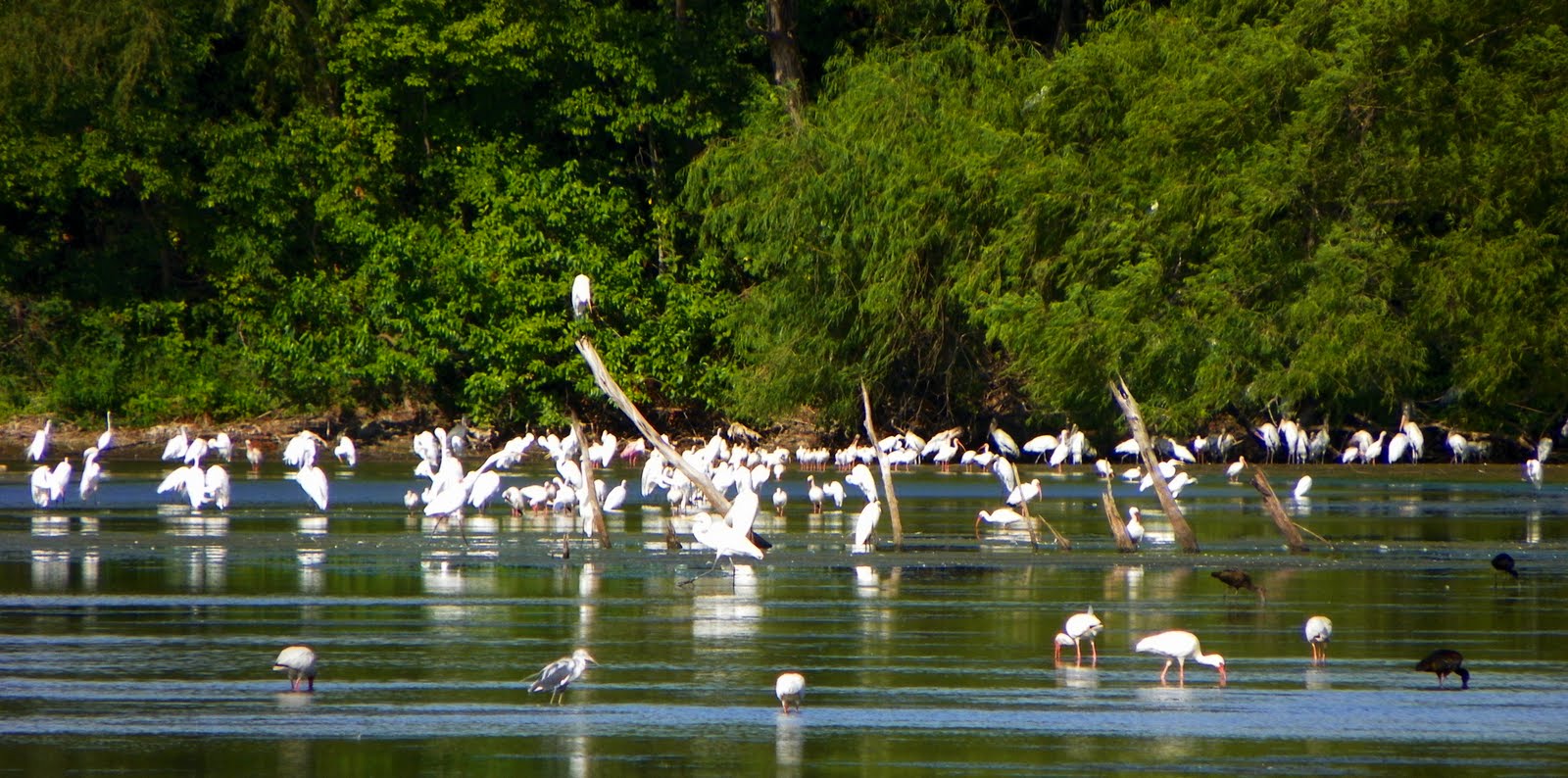
Vast array of Texas wading birds at Lemmon Lake. Wood Storks, Herons, Egrets, White Ibis, White-Faced Ibis


Originally built as a private fishing lake in the late 1800s, it was purchased in the 1980s by Dallas County and then leased to the City of Dallas under a 99 year agreement. The purchase price was $500,000. $400,000 came from the county and $100,000 came as a private donation from the late Bill Barrett a well known Dallas businessman and philanthropist.
Summer sunset over Lemmon Lake at Joppa Preserve July 2011

Since the 1980s, the lake has sat idle, partially silted in and has now become more of a marsh estuary than a lake. Plans as recently as 2001 have called for a dredging and reworking of Lemmon Lake including a division of the lake into two cells for better water management. The neglect and lack of any access to the lake has actually benefited some of the rarest and most endangered birds in the United States.

Passed in 1973 and reauthorized in 1988, the Endangered Species Act regulates a wide range of activities affecting plants and animals designated as endangered or threatened. By definition, endangered species is an animal or plant listed by regulation as being in danger of extinction. A threatened species is any animal or plant that is likely to become endangered within the foreseeable future. A species must be listed in the Federal Register as endangered or threatened for the provisions of the act to apply.
The Act prohibits the following activities involving endangered species:
  • Importing into or exporting from the United States.
  • Taking (includes harassing, harming, pursuing, hunting, shooting, wounding, trapping, killing, capturing, or collecting) within the United States and its territorial seas.
  • Taking on the high seas.
  • Possessing, selling, delivering, carrying, transporting, or shipping any such species unlawfully taken within the United States or on the high seas.
  • Delivering, receiving, carrying, transporting, or shipping in interstate or foreign commerce in the course of a commercial activity.
  • Selling or offering for sale in interstate or foreign commerce.

The Rare: The Roseate Spoonbill (Ajaja Ajaja)

A rare sight in North Texas, Roseate Spoonbills can be seen infrequently in the shallow drying ponds and swamps in the Great Trinity Forest. Spoonbills are traditionally coastal birds and are a regular site along the Texas Gulf Coast. Rare to see them hundreds of miles inland in not only a prairie but also a densely populated urban environment.

This species feeds in shallow fresh or coastal waters by swinging its bill from side to side as it steadily walks through the water, often in groups. It feeds on crawfish, water beetles, tadpoles, insect larvae and very small fish other wading birds ignore.

Texas Roseate Spoonbill at Joppa Preserve


Flight of Roseate Spoonbills


 The Threatened: The White-Faced Ibis (Plegadis chihi)

Texas Parks and Wildlife has listed the White-Faced Ibis as a Threatened Species due to loss of habitat in their range. The White-Faced Ibis population is in slow decline as a result. The federal government is awaiting additional information on them before deciding if they should be given federal status as an endangered or threatened species.

Similar in appearance to the Glossy Ibis, the White-Faced Ibis can be identified by their red eyes, reddish legs and reddish feathers. In mating season, the White-Faced Ibis will develop a white ring around their face. The White-faced Ibis frequents marshes, swamps, ponds and rivers. Like the spoonbill, they prefer small aquatic insects, fish, worms and frogs.

In the Dallas area it can best be described as a casual species, just flying through to points elsewhere. I believe the dry Texas weather in 2011 has concentrated many of these coastal birds into the North Texas since the area has seen more rainfall than other parts of the state.

White-faced Ibis at Lemmon Lake


Federally Threatened White Faced Ibis at Joppa Preserve July 2011


White-Faced Ibis and White Ibis will often fly in flocks together as seen in the photo below.

Flight of White Faced Ibis(dark colored) and White Ibis(white) over Lemmon Lake


The Endangered: The Wood Stork (Mycteria americana)


Although they are listed as an Endangered Species in the United States, the birds are given threatened status in Texas. The Endangered listing applies to Wood Storks who live and breed east of the Mississippi in the Deep South and Florida. Wood Storks are still afforded the protections of Endangered Status here in Texas but since they do not breed here they are given a threatened designation. Wood Storks were once hunted for their feathers and have also lost much of their habitat to swamp draining in Florida. In Texas, the Wood Storks migrate north in the early summer from Mexico to take advantage of drying lake beds and the abundance of fish found in them. There have been only a handful of sightings in the DFW area of Wood Storks. Lemmon Lake is special in that so many can be seen at one time. Wood Stork sightings are more numerous further to the south in the Houston and Corpus Christi areas where the habitat lends itself to Wood Stork feeding tactics.

Wood storks are large water birds that stand 2-4 feet tall and are the only stork in North America. They have wingspans as wide as 5 1/2 feet. They are mostly white, but have a black tail and many black feathers under their wings. Storks are related to ibises, herons and flamingos. They have no feathers on their head and neck, so the black skin underneath shows. This makes wood storks the only tall water birds with black, bald heads. Since they have no muscles attached to their voice box, they are very quiet birds.

Wood Stork in flight preparing for landing


Wood Stork


Wood Stork roost on Trinity River south of Loop 12


These waders feed on minnows in shallow water by using their bills to perform a rare and effective fishing technique. The stork opens its bill and sticks it into the water, then waits for the touch of an unfortunate fish that wanders too close. When it feels a fish, the stork can snap its bill shut in as little as 20 milliseconds an incredibly quick reaction time unmatched by it's prey.

The storks prefer to employ this technique in isolated pools created by tides or falling freshwater levels, where fish congregate en masse. In some areas, such as Florida, breeding begins with the dry season that produces these optimal fishing conditions. Watch the video below, filmed at Lemmon Lake in July 2011 to see how they feed.


Video featuring hundreds of Wood Storks in flight and feeding at Lemmon Lake inside the Joppa Preserve. Also seen in the video are egrets, herons, white faced ibis, white ibis, glossy ibis, roseate spoonbills and cranes:


 Video below of coyotes yipping in the reeds on the far side of the lake. Within 2-3 minutes the coyotes approached the birds on the shore and the water creating a brief exodus to the air


Wideshot view of Lemmon Lake. Wood Storks are in treeline avoiding the 104 degree heat


Lemmon Lake Wood Storks

Notes and location on Joppa Preserve:

Lemmon Lake is a known American Alligator habitat.

American alligators normally avoid humans, but they can become perceived as a nuisance when they establish territories around people. As human populations in Texas continue to expand, there have been an increased number of encounters between people and alligators. Alligators have been known to prey on pets and must be treated with caution. Alligators can be surprisingly quick on land and are capable of running quickly over short distances. I have not seen alligators in Lemmon Lake but have seen one in Little Lemmon Lake, a smaller body of water directly to the north. There is also an active population of coyotes that hunt during the day and a population of Feral Pigs. Please exercise caution if you plan a visit.

Access does not come easy to Lemmon Lake. Ringed by triple canopy trees, some wetlands and a belt of sawgrass 50 yards thick it can be hard to find a way in. I would suggest parking at River Oaks Park or Simpson Stuart Road. From there walk down the paved Trinity River Trail till you find a place for entering the woods. Glimpses of the lake can be seen from the trail. Another more adventurous idea would be to launch a canoe from the Loop 12 Boat Ramp and take the river down to the Wood Stork roosting area, then take-out near Simpson Stuart Road.

Great Trinity Forest Trail at Joppa Preserve


Monday, July 11, 2011

President Sam Houston's Camp On White Rock Creek, Great Trinity Forest


168 years ago July 12-15 1843 Sam Houston President of the Texas Republic and his men camped at White Rock Springs near the mouth of White Rock Creek and the Trinity River. He and his diplomatic corps stayed in the company of the Beeman family who called the fine bottom land home. Unlike most of Dallas, this part of Dallas looks the same as it did when President Houston and his men rode through to make peace with the Indians. White Rock Spring is the sole survivor in regards to historic DFW area springs. Buzzard Springs, Cedar Springs, Kidd Springs, Grapevine Springs, Bone Marrow Springs. All gone. The City of Dallas recently purchased the land surrounding the spring and many other neighboring parcels for a future park. A tip of the hat to the Pemberton family who have kept the land around the spring in its near original condition for many generations. Currently a crude right of way exists between Rochester Park, across White Rock Creek and then down to the future Texas Horse Park to Elam Road and beyond to the Trinity River Audubon Center. A trail is planned through the area highlighting the spring as a focal point.

President Sam Houston circa 1840s
During his final term as President of the Texas Republic, Sam Houston's chief concerns were Indian relations, war clouds on the horizon with Mexico and Texas annexation into the United States. Sam Houston, who had lived with the Cherokees for years as a young man, had a fondness for the tribes and wanted them treated fairly as their lands were taken over by civilization despite their depredations against the settlers in Texas.

For many months Houston sent messages to his Indian friends proclaiming he would hold a Grand Council of the Tribes at Fort Bird(presently in the Mid Cities area) during the full moon of August 1843. Similar to what we might consider a general assembly meeting of the United Nations.  Houston sent Indian Commissioner Joseph C. Eldridge out months in advance of the date to bring the Comanches and others to the treaty council.


White Rock Spring in July, site of Sam Houston's Camp


Map of Texas 1840
It was in July 1843 when Sam Houston and an expedition of about 30 men departed Crockett in East Texas, and began their trek to the Three Forks of the Trinity to negotiate with the chiefs of the Indian tribes.  Their route was well documented traveling roughly on the same route into Dallas that US Highway 175 takes today. This route was an ancient Pre-Columbian trail used by Indians for many centuries as an imporant trade route between the Piney Woods of East Texas, the Plains and Indians living north of the Red River. Scyene and Preston Roads share similar distinctions in Dallas as ancient Indian trails that later became major roads.
Looking south with White Rock Spring in the far treeline beyond at the base of Pemberton Hill

Sam Houston made Indian policy a principal concern of his second administration. On July 1, 1842, he appointed a commission to "treat with any and all Indians on the Frontiers of Texas." The Indians, too, were more open to negotiation after the costly wars under the Lamar administration had reduced their numbers. In August, they agreed to a peace council at the Waco village on October 26, 1842. They failed to attend on that date, but on March 31, 1843, chiefs of nine tribes accepted an invitation to a Grand Council to conclude a treaty of peace. The nations present were the Republic of Texas, the Delaware, Chickasaw, Waco, Tah-woc-cany, Keechi, Caddo, Ana-Dah-kah, Ionie, Biloxi, and Cherokee.

They met six months later and on September 29, 1843 signed one of the few Indian treaties ratified by the Republic of Texas Senate.


A man who was traveling with Houston, an Englishman named Edward Parkinson wrote an account of Houston's journey, mentioning sites of note, and a typescript of his diary is in the collections of the Dallas Historical Society.  Other notable members of the entourage included future cabinet members of President Jefferson Davis in the Confederacy, future Civil War generals, Indian Fighters, judges and few rascals thrown in for good measure.


Parkinson described in his diary the difficulties and trials encountered by the expedition.  The men had to literally hack their way through groves of Bois d'arc trees in the Trinity River bottoms east of present day Dallas before crossing the river, were overtaken by hordes of insects and killed buffalo to sustain themselves. President Sam Houston and his men met with John Neely Bryan on July 14th in what is present day Downtown Dallas near the Old Red Courthouse as they were passing through to Bird's Fort. A couple men from the group were taken with fever and stayed behind at White Rock Spring unable to continue on. White Rock Spring was a great place to stay behind since Dallas at the time was largely a barren plain with little shade in the heat of the summer. They stayed in the company of John Beeman and his family who were the first family to settle in Dallas.


Looking north from White Rock Spring


John Beeman chose the White Rock Spring area off present day Pemberton Hill Rd to settle. John Beeman migrated to the Peters Colony which was part of Nacogdoches County at the time. On April 8, 1842 John Beeman, brought his family to White Rock Creek; building his cabin and planting the first corn in Dallas County. He initially built a fortified "blockhouse" a two story prairie defensive tower house just south of present day Military Parkway. He later moved to the Pemberton Hill area the next year. After annexation John Beeman was elected the first US Congressman to represent North Texas.


View of Pemberton Hill looking east from White Rock Spring
The photo above shows a grove of walnut and pecan trees directly north of White Rock Spring. The single walnut tree just to the left of the road has seen quite a bit of history. The story is that the tree has two spikes driven in it on the trunk. One to note the high water mark of the great 1908 flood that destroyed much of Dallas. A second spike, even higher, noting the high water mark of the 1866 Trinity River flood.


Honey Bee hive inside the walnut tree with the spikes driven in it


Large Alligator Snapping Turtle in White Rock Spring


When Houston arrived at Ft. Bird, several tribes had shown up but did not want to go near the garrisoned fort fearing a trap. Houston moved the negotiations and camps six miles north to Grapevine Springs.  He felt the Springs offered better water, more shade in the summer heat and less mosquitoes.  However the group camped there for more than a month while awaiting the Comanches, and was described by Parkinson as:  "there were some fine though rather monotonous days, only relieved by finding a bee tree or killing our beeves."
Finally Houston realized the Comanches weren't coming and decided to have a council with those in attendance.  Known as a flamboyant dresser, Houston's attire for the occasion was noteworthy.  "Donned in a purple velvet suit, with a huge Bowie knife thrust in his belt, and a folded Indian blanket draped over one shoulder to proclaim his brotherhood with the red men, Houston eloquently promised the chiefs that a favorable treaty line would be drawn beyond which the Indians could live unmolested by white men."

At this time, along with the negotiations with the Indians, Houston was still President of the Republic and having to deal with the Mexican situation and annexation of Texas.  Before the actual treaty was signed, he had to go back to Washington on the Brazos to deal with these issues personally.  To deal with the Comanches when, and if, they arrived he assigned Gen. Edward H. Tarrant and Gen. George Whitfield Terrell. The treaty was signed in the last three days of September 1843.


The Treaty at Birds Fort was a rare instrument: it was actually ratified by the Republic of Texas Senate. Throughout both his administrations, Sam Houston worked to negotiate with the Texas tribes, not only because of his natural inclination but also because the new Republic simply could not afford to be at war both with the Indians and the Mexicans. His policy had already been put into practice when he and John Forbes negotiated a treaty with the Cherokee on February 3, 1836.


President Mirabeau B. Lamar, on the other hand, was convinced that the tribes were conspiring with the Mexicans, and he also believed that the tribes constituted a foreign nation in competition with the Republic. He actively supported a policy of extermination and expulsion, a policy which removed the Cherokee altogether and which helped plunge the new nation into considerable debt.

The Englishman Parkinson in his journal noted that the rough draft for the conditions of the Birds Fort Treaty were discussed and drafted in route including at White Rock Spring.


Below is the last page of the Bird's Fort Treaty 

Bird's Fort Treaty Ratification Proclamation, 1843

Now, Therefore, be it known
That I, Sam Houston, President
of the Republic of Texas, having seen

and considered said Treaty, do, in
pursuance of the advice and consent
of the Senate, as expressed by their res-
olution of the thirty first of January,
one thousand eight hundred and forty
four, accept, ratify and confirm the
same, and every clause and article
thereof
In testimony whereof, I have
hereunto set my hand and caused
the Great Seal of the Republic to be af-
=fixed
Done at the town of
Washington, this
third day of Feb-
=ruary in the year
of our Lord one thou-
=sand eight hundred and
forty four and of the
Independence of the
Republic the Eighth.
By the President
Sam Houston
Anson Jones
Secretary of State

Monday, July 4, 2011

Roseate Spoonbills and Wood Storks at Lemmon Lake Joppa Preserve


Roseate Spoonbill at Lemmon Lake Joppa Preserve Dallas, Texas


Somewhat rare to see coastal birds such as the Roseate Spoonbill this far north in Texas. Exceptionally rare to see the Roseate Spoonbill inside the city limits of Dallas, within a large urban area.  Hunted to near extinction in the early 1900s, the Roseate Spoonbill population dwindled to only 100 breeding pairs in Texas by the 1930s. Their striking pink feathers were popular on women's hats, and hunters from all over the United States competed for spoonbill plumes. In the early 1900s, roseate spoonbills began to recolonize areas along the Gulf Coast and slowly increase in number. Today, threats to roseate spoonbill populations come as a result of habitat loss. Even by 1979, their numbers had only rebounded to 2500 birds in the wild. Currently their numbers have rebounded substantially enough to be removed from Federal protection as an Endangered and Threatened species.


Lemmon Lake at sunset Joppa Community water tower in background


Lemmon Lake Wood Stork


The video clip below was filmed the evening July 3rd 2011 at Lemmon Lake:


As an older lake, over 120 years old, Lemmon Lake once served as a private fishing and hunting lake to well heeled Dallasites at the turn of the last century. Over time, the lake as slowly started to silt in creating an ideal shallow water environment for wading birds, alligators and snakes. Sightings of venomous snakes and alligators are common here.

The Roseate Spoonbill, Ajaja ajaja, (sometimes placed in the larger genus Platalea as Platalea ajaja) is a gregarious wading bird of the ibis and spoonbill family, Threskiornithidae. It is a resident breeder in South America mostly east of the Andes, and in coastal regions of the Caribbean, Central America, Mexico, and the Gulf Coast of the United States.


Spoonbills consume a varied diet of small fish, amphibians, aquatic invertebrates, and some plant material. They feed in the early morning and evening hours by wading through shallow water with their bills partially submerged. As a Roseate Spoonbill walks it swings its head back and forth in a sideways motion. When the bird feels a prey item it snaps its bill closed, pulls the prey out of the water, and swallows it.

Sunset over Joppa


Lemmon Lake is by far the single hardest body of water to reach on public property in Dallas. Remote not just in its geographical location but also in the way the forest has encroached on the lake itself. Triple canopy woods, briar patches, poison ivy clog any route to the shore. Once one gets within 100 yards of the lake itself one must navigate around swampy areas and a 30-50 foot buffer of reeds and cattails before getting an unobstructed view of the lake itself. Evidence of alligators from their tracks and wallows are everywhere in the cat tails. Great caution should be taken walking through this area. The reward of visiting such a place are encounters with birds and animals you will not see anywhere else in North Texas.

Evidence of animals in the shoreline reeds and cat tails can be seen in the photo below:

Lemmon Lake

Can you spot the coyote? I could not, till I accidentally spotted it while looking through the photos I took. Had no idea it was there.

A closer view of the same photo, coyote on shoreline in the right of the photo:

Coyote along shoreline of Lemmon Lake


Closest address is below

5400 Simpson Stuart Road Dallas Texas

Better to travel via foot or mountain bike to this area rather than leaving your vehicle near the dead end of the road.

Thursday, June 23, 2011

Trinity River Alligators


Alligator at Little Lemmon Lake near Trinity River Dallas Texas May 2011

Quite a bit of buzz lately about a near record size alligator that was killed in Leon County halfway between Dallas and the Gulf of Mexico. Dallas attorney Levi McCathern killed a rather large alligator weighing in at a claimed 880 to 900 pounds and 14 feet long(later revised by game wardens to 13 feet 1 inch, animal was seized by the State and those involved charged with a Class A misdemeanor). You can read the original story about it here prior to their arrest:

KXAS Channel 5 story on "Giant Alligator Killed In Trinity River"

Texas Parks and Wildlife says that current record was set in 1998 outside of West Columbia, Texas at 14 feet 4 inches. The world record for the largest alligator was set in 1890 in Louisiana at 19 feet 2 inches. Texas doesn’t have records on file for alligators caught before endangered species protections were lifted here and hunting resumed in 1985, so it’s possible that Texas alligators used to be even bigger.

July 20 update to the original story above about the Dallas lawyer who shot the alligator on the Trinity River south of Dallas 

http://www.star-telegram.com/2011/07/20/3235054/monster-gator-killers-face-charges.html

http://www.statesman.com/blogs/content/shared-gen/blogs/austin/outdoors/entries/2011/07/20/alligator_hunters_charged_by_t.html?cxntfid=blogs_no_limits

http://blogs.dallasobserver.com/unfairpark/2011/07/when_the_hunter_becomes_the_hu.php


A Dallas man and three fishing and hunting guides from Crockett have been charged with taking wildlife on private property without the landowner's permission following a state game warden investigation into the death of a 13-foot, 1-inch alligator killed in Leon County. Named in arrest warrants filed Tuesday were 42-year-old Levi McCathern of Dallas, the hunter who allegedly killed the alligator, and the three guides, Steve Barclay, 47; Sam Lovell, 56; and Ryan Burton, 21. Barclay and Lovell operate a guide business called the Gar Guys. The four men were expected to turn themselves in Wednesday at the Leon County Sheriff's Office in Buffalo.
State game wardens in Leon and adjoining Houston County began an investigation when a man who owns land on the Trinity River in Leon County reported that a large alligator had been killed on his property without his consent on June 11. He also said a second, smaller ‘gator was taken on his property the day before.

As part of their investigation, game wardens seized a 13 foot, 1-inch alligator and an 8 foot, 8-inch alligator.

Taking wildlife on private property without the landowner's consent is a Class A misdemeanor punishable by a fine not to exceed $4,000, confinement in jail up to one year or both. 

In addition, the Texas Parks and Wildlife Department will seek restitution for the two alligators, an amount likely to exceed $5,000.

 The case was investigated by Game Wardens Oscar Henson and Logan Griffin of Leon County and Zack Benge and Eddie Lear of Houston County.

The ‘Gar Guys,’ Barclay and Lovell, are full-time, licensed, bow-fishing guides from Kennard. They specialize in guiding alligator and alligator gar fishing adventures. Their hunting ground runs mainly north of Lake Livingston to the Houston County area. Barclay and Lovell developed the nickname of the “Gar Guys” from a local fisherman who would see their choice of catch and say ‘oh here comes those gar guys.’ After making a 90 minute DVD/VHS video entitled “Let’em Roll” that featured daytime footage of three remarkable excursions in which the duo captured 19 trophy gar with four weighing over 200 pounds, the ‘Gar Guys’ became an overnight success and decided to turn their hobby into a permanent gig.

The American alligator, Alligator mississippiensis, is a rare success story of an endangered animal not only saved from extinction but now thriving  and has made a tremendous come-back over the past 30 years. In 1969, Texas provided complete protection for the American alligator and classified it as endangered after passage of the Texas Endangered Species Act in 1973. Under this protection, along with Federally implemented regulations eliminating unregulated alligator hide markets in the United States, the species has made a full recovery and was delisted from the status of endangered in 1985. The alligator is now a protected game animal in Texas. Special permits are required to hunt, raise, or possess alligators.


The DFW area sits at the far northern edge of the range of the American Alligator as seen below


The winters in the Dallas Fort Worth Metroplex are right on the fringe of what an American Alligator can tolerate. The long periods of prolonged cold and hard freezes really reduce the ability of an alligator population to establish itself. They are still around in some numbers but lack the prolific population boom seen in some other sub-tropic transplants like birds and nutria. The only alligators I have seen here in Dallas are 2 1/2 to maybe 4 feet on the upper end.

In the past, large alligators in Dallas have made the news. In the 1960's JJ Lemmon the owner of a private hunting and fishing club on the Trinity River just south of Loop 12/Ledbetter shot and killed a large alligator at the lake that bears his name to this day:

Dallas Largest Alligator killed within the city limits


I believe this record stills stands for the Upper Trinity River, 9 feet 416 pounds. The article suggests that the alligator came up out of the Trinity River and into Lemmon Lake which sits directly off the main channel of the Trinity River.


Trinity River Alligator at McCommas Bluff Preserve Dallas

I have seen a handful of alligators in the named and unnamed ponds and small lakes that dot the Great Trinity Forest in Dallas. They are very elusive and very hard to spot since they are ambush predators and have a very low profile. I have always seen them near dusk and at quite a distance. The two photos I have posted here including the first photo and the one above are really the only two decent photos I have of Dallas alligators. The light is usually too low and they are too low profile to be seen much less photographed.

Dallas County has gone so far as to place warning signs at Little Lemmon Lake in Dallas and the Joppa Preserve Trailhead about alligators


Alligator warning sign at Little Lemmon Lake


American alligators normally avoid humans, but they can become perceived as a nuisance when they establish territories around people. As human populations in Texas continue to expand, there have been an increased number of encounters between people and alligators. Alligators have been known to prey on pets and must be treated with caution. Alligators can be surprisingly quick on land and are capable of running quickly over short distances.


Alligator warning sign Joppa Preserve Trinity Trail

Both Joppa Preserve and McCommas Bluff Preserve are in southern Dallas County north of I-20. An even larger population of alligators is said to exist in the Goat Island Preserve south of I-20, also in Dallas County.

Unknown to many, Dallas also has a special nature preserve in South Dallas County called the Palmetto Alligator Slough Preserve. It is currently off limits to the public due to the nature of the swampy terrain and extraordinary palm colony. 

For the most part any hunting of alligators is against the law here in Dallas County. The TPWD has strict guidelines on hunting alligators and requires a permit and adherence to strict rules.


Video of dead alligators on White Rock Creek in Dallas

In Dallas you are more likely to see a dead alligator or alligators like in the youtube clip above. This was filmed in mid-June 2011 on Lower White Rock Creek as it approaches the Trinity River. I believe the alligators became entangled in this soccer net and were unable to free themselves. 


Read more about the Texas Parks and Wildlife Regulations on alligator hunting here:


TPWD Alligator rules and regulationsTPWD Alligator Rules and Regulations


I imagine if you are reading this you are not Jerry Jones attorney. You probably don't have the big bucks to hire a guide or a week to take off of your life to trackdown a big lizard to brag about. Have no fear! The Trinity River especially in Dallas has such a sorry reputation as a fishery that many people, the vast majority avoid it like the plague. As a result, many of the State water body records are easy to break, some for taking fish with a fly rod are wide open. The youth water body records for the Trinity River are almost wide open.

All-Ages

Rod & Reel
Bass, Largemouth 9.63 25.00 Sep 27, 1986 Gary Campbell plastic worm 
Bass, Palmetto (Striped X White) 14.10 29.02 Jun 26, 1995 Howard Hall
Bass, Striped 14.50 31.00 Mar 29, 2009 John Jordan pet spoon 
Bass, White 3.72 18.00 Feb 24, 1995 Gilbert Celaya
Bass, Yellow 1.25 13.00 Mar 18, 2011 Teri Cooper shad 
Bluegill 0.14 5.88 Apr 7, 1994 Justin Hardin
Bullhead, Black 1.47 15.15 Aug 19, 2001 Billy Autery Fly Rod, #12 red squirrel 
Carp, Common 11.82 29.00 Apr 1, 1999 Billy Autery 1 oz slab 
Carp, Grass 12.50 31.00 Jun 16, 1991 PaPa Earl
Carpsucker, River 2.10 16.25 Jun 18, 1996 Del Sowders
Catfish, Blue 76.00 45.00 Apr 14, 1991 Richard C. Jordan
Catfish, Channel 9.20 29.75 Mar 23, 2008 Andrew Desousa shad 
Catfish, Flathead 58.00 53.00 Jul 21, 1977 Dean Brown
Crappie, White 2.50 15.40 Feb 8, 1995 Rick Rivard
Drum, Freshwater 1.74 16.25 Dec 8, 1998 Billy Autery slab lure 
Gar, Alligator 200.00 93.00 Apr 14, 2011 Joseph Williams
Gar, Longnose 50.31 0.00 Jan 1, 1954 Townsend Miller
Gar, Spotted 4.60 29.50 Apr 30, 2003 James Hughes hookless lure 
Herring, Skipjack 0.55 11.63 Jul 23, 2010 Danny Eddins Bass assasin 
Ladyfish 0.24 10.50 Aug 25, 2000 Mark LaBurt minnow 
Needlefish, Atlantic 0.15 14.00 Jun 24, 2005 Thomas LaBurt minnow 
Pacu, Red-bellied 8.82 23.00 Jul 20, 2002 Carl LaRue crawfish 
Shad, Gizzard 0.37 11.00 Nov 22, 1998 Billy Autery critter gitter 
Sunfish, Green 0.20 7.00 Apr 17, 1995 Justin Hardin
Sunfish, Longear 0.14 5.94 Apr 7, 1994 John Hardin
Warmouth 0.50 7.50 Feb 8, 1995 Rick Rivard


Fly Fishing

Bass, Palmetto (Striped X White) 6.00 23.00 Mar 16, 2010 Shannon Drawe clouser minnow 


Junior Angler

Rod & Reel
Species Weight Length Date Angler Bait or Lure
Bass, White 2.08 15.00 Mar 15, 2011 Ricky Lucas rattle trap 
Catfish, Blue 1.86 18.75 Nov 23, 2010 Brandon Boone shad 
Catfish, Flathead 56.00 48.60 Jul 9, 2004 Nicholas Goodman worm 
Gar, Spotted 3.00 0.00 Jun 10, 2007 Martini Arostegui
Herring, Skipjack 0.30 9.50 Jul 1, 2003 Thomas LaBurt minnow 
Needlefish, Atlantic 0.15 14.00 Jun 24, 2005 Thomas LaBurt minnow 

Source: Official Trinity River waterbody records

As you can see the record book is quite empty for the Trinity. Fish are quite abundant even between the levees near Downtown. While the fish are deemed to be inedible for health reasons, someone could easily set some records near downtown if they felt the urge.


Here are the official rules for submitting a record fish in Texas:

TPWD record fish rules


Friday, May 27, 2011

Lower White Rock Creek Valley Trails


White Rock Creek runs south from Dallas' best-known land form, White Rock Lake. But for all the popularity of the old city reservoir, the creek that first had the name remains scarcely recognized. Once the water of the creek leaves the White Rock Lake Spillway in dramatic fashion it begins a slow and methodical march towards the Trinity River.


Texas Horned Lizard in Dallas at Devon Anderson Park

Piedmont Ridge Trail Lower White Rock Creek

Lower White Rock Creek, on its way to the vast hardwood bottoms of the Great Trinity Forest, runs nearly unknown through some of the city's best natural areas and most historic neighborhoods. This is the land that the Caddo and Comanche consider sacred ground. This is the land that sustained the first pioneers that settled Dallas. This is the land where Sam Houston and his men camped on the way to work a peace treaty. You do not have to look in a book or read accounts of the sites to imagine what it must have been like. Using these trails you can stand on the ancient sacred ground of the Comanche, wander across the old pioneer Beeman and Bryan homesteads, stand at the spring where President Sam Houston camped. All of it is still there, untouched. Dallas over the last century and a half grew up around it, oddly leaving it in it's original condition.


Purple Coneflower Echinacea purpurea (Asteraceae) in Lower White Rock Creek meadow


Video overview of trails:


The Lower White Rock Creek Trails are comprised of an ever expanding 4 mile soft surface trail network spanning three different City of Dallas Parks. JJ Beeman/Scyene Overlook on Scyene Road, Grover Keeton Park which includes Piedmont Ridge Trail and Devon Anderson Park south of Bruton Road. The JJ Beeman Trail starts near the corner of Lawnview and Scyene near the DART Lawnview Station and continues east to the Scyene Overlook. From there the trail roughly follows an Austin Chalk Escarpment high above the White Rock Creek Valley. One can see the VA Hospital in South Dallas, Duncanville, Hutchins as well as Downtown Dallas. The trail continues through Grover Keeton Park, up Piedmont Ridge, across Bruton and into Devon Anderson Park. 

Scyene Overlook with view of Great Trinity Forest


JJ Beeman Trail Scyene Overlook Trail Junction


Piedmont Ridge Trailhead Grover Keeton Park


Access to the trails are easiest from the Grover Keeton Parking Lot on Jim Miller Road; Devon Anderson Park on Umphress Road or via DART on the Green Line to Lawnview. Scyene Overlook is also just a quick 15 minute or less ride from White Rock Lake.

Location:

North Trailhead for Scyene Overlook:
2800 Renda Street Dallas

Grover Keeton and Gateway Park:
2300 Jim Miller Road

Devon Anderson Park:
1700 Eastcliff

White Rock Creek Trails Map --green dot notes Lawnview DART Rail Station on  Scyene. Yellow dots mark formal trailheads for Scyene Overlook, Piedmont Ridge Trail and Devon Anderson.


Some sections of the trails feature steep switchbacks, loose rocks and off camber surfaces. Caution should be taken when hiking or mountain biking these areas. Technical climbs and descents along with some steep dropoffs warrant diligence if you are riding a mountain bike. Some sections will require dismounts by even experienced riders.  

Devon Anderson Park sign noting distances to Comanche Storytelling Place .2 mile and one of the overlooks .4 mile.

Piedmont Ridge Overlook


Comanche Storytelling Place Devon Anderson Park Dallas, Texas


The Comanche Story Telling Place at Devon Anderson Park has been identified by the Comanche Nation as a sacred holy ground and has been identified as a candidate for inclusion in the National Register of Historic Places. The natural limestone shaped amphitheatre was believed to have been used by Native Americans in the area prior to European settlement. Gateway Park was also the site of an Indian Marker tree, over 300 years old that served as a guide to Native Americans in the area. This tree was lost in 1998 during a thunderstorm.