Sunday, June 10, 2012

Trinity River Wetlands -- The Early Morning Birds Of Summer


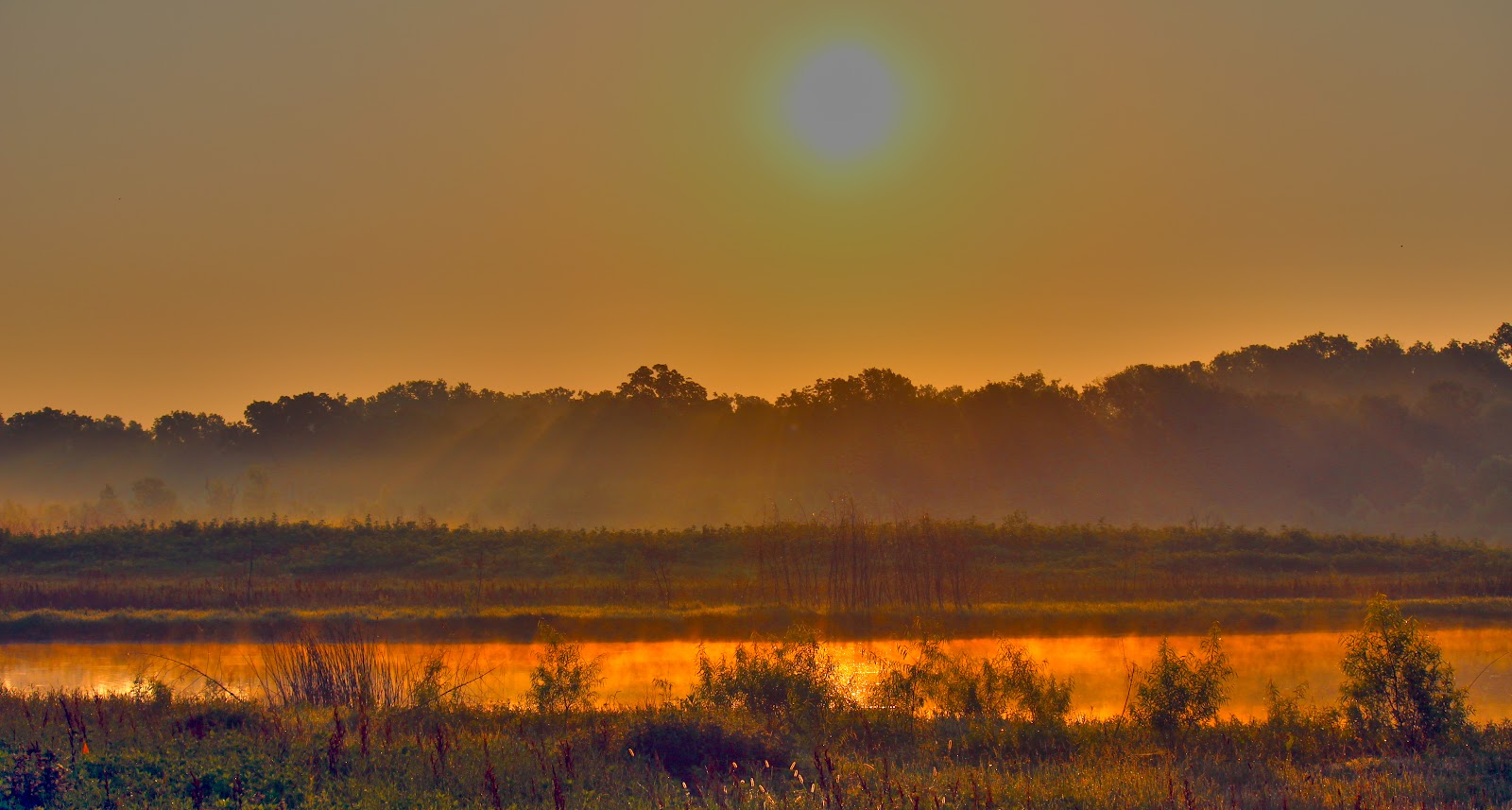
The sun rises early in June. Before 7am it climbs above the Trinity River in Dallas quickly burning off the fog and dew that built up the night before. The early morning is a special time to be on the river and one that few people experience. Myself included!


Joining me at the Loop 12 Boat Ramp are a pair of guys with whom I have hiked with before, Bill Holston(left) and Scott Hudson(right). The photo to the left was taken on the Great Trinity Forest Trail at Little Lemmon Lake. The fishermen in the photo were giving a detailed explanation of the snakes(really big ones) they had just seen minutes before. It was hilarious. Everyone laughing and having a great time. I always run into great people like this in the Great Trinity Forest. Everyone seems to have a funny story to tell.

This early morning portion of our hike was a great lighthearted walk up the Trinity River Wetland Cells near the community of Joppa. The early Saturday morning hike was a primer to a more serious mid-morning hike later in the day which will be in another post.

Bill Holston hiking towards the Freedmen's Community of Joppa, Texas
There is always something special about making fresh tracks in the early morning dew. Two days after a rain with the soil still damp in places we were the first humans to travel up this way in at least a few days. The only tracks we saw were that of coyote, fox, feral hog and beaver. Sitting in the middle of a metropolitan area I'm still amazed so few people visit.

Birds and More Birds

Flock of cattle egrets mustering in the morning fog of the Trinity River
An early morning visit gives one a better look at some of the noctural birds of the river. Below are some of the birds we saw in more or less chronological order moving from Loop 12 north up towards the Union Pacific trestle.

 Yellow-Crowned Night Heron
The Yellow-Crowned Night Heron (Nyctanassa violacea) The yellow-crowned night heron forages for food both in the day and at night. Most of the yellow-crowned night heron's diet is made up of crustaceans like snails and crayfish. It sometimes eats fish, eels, mussels, frogs, tadpoles, aquatic insects, snails, and small snakes. It either stands and waits for its prey to swim by or wades in the shallow water and slowly stalks its prey.


White Ibis


The White Ibis (Eudocimus albus). Highly sociable in all seasons, the White Ibis roost and feed in flocks. White Ibises fly in lines or V-formations, with several quick flaps followed by a short glide. When groups wade through shallows, probing with their long bills, other wading birds such as egrets may follow them to catch prey stirred up by the ibises.

Until recently the White Ibis was an uncommon sight here in Dallas. From late May through September they are now easy to spot along the wetland cells and in the shallow evaporating lakes that dot the Great Trinity Forest.

I always look skyward when these formations fly over. Often mixed in with the White Ibis are White Faced Ibis and Glossy Ibis which are much a rarer sight in the DFW area.


Tricolored Heron
Tricolored Heron
The Tricolored Heron (Egretta tricolor). This one had us stumped. I'll be the first to admit I know very little about birds and count on people like Bill and Scott to fill me in on what flavor of bird we are looking at. Thinking this was a juvenile bird of some kind we moved on. I emailed Jim Yancey a local bird expert around White Rock Lake. He replied that it's a Tricolored Heron which is usually a coastal bird. Unique to see here inside the city limits and quite a treat.


 Indigo Bunting
Indigo Bunting
The Indigo Bunting (Passerina cyanea) Bill and Scott heard the call of this bird from afar and identified it as a bunting but we never saw it. I blindly aimed at the far tree it was calling from and hoped it would appear in a photo. Sure enough it did. They guessed Painted Bunting, in this case it was an Indigo Bunting.

The male Indigo Bunting is a rich, deep blue all over, but may appear dark and blackish in poor light. A popular memory-phrase for the song of the male bunting is "fire-fire, where-where, here-here, seeit-seeit." Indigo Buntings frequent forest clearings and second-growth habitat in the East and Midwest. These are small finch size birds and probably more often heard instead of seen. This bird might have a mate and a nest north of the Linfield Road dead-end(about 300 yards) between the wetland cell and the Trinity River.


 Great Egret

The Great Egret (Ardea alba). The great egret is the symbol of the National Audubon Society and represents a conservation success story. The snowy white bird's plumage made it popular quarry in 19th-century North America. Great egrets were decimated by plume hunters who supplied purveyors of the latest ladies' fashions. Their populations plunged by some 95 percent. Today the outlook is much brighter. The birds have enjoyed legal protection over the last century, and their numbers have increased substantially. This particular individual is a common site on this roost and around the shore of this particular cell. I have photographed in numerous times in the last year or two near the Union Pacific trestle.


Redwinged Blackbird
The Redwinged Blackbird (Agelaius phoeniceus). A common site here in Dallas this time of year, these marsh loving birds perch high on weeds, branches and limbs making their boisterous call. The bird in the photo above is perched on a branch near the Fellows Lane gate and dam. Downtown Dallas serves as a background.

Little Blue Heron

The Little Blue Heron (Egretta caerulea). The Little Blue Heron, Egretta caerulea, is a small heron. It breeds from the Gulf states of the United States through Central America and the Caribbean south to Peru and Uruguay.


There is post-breeding dispersal to well north of the nesting range, as far as the border between the US and Canada.  The particular Little Blue Herons pictured here are at Honey Springs near Joppa. The hibiscus plant to the right is a bit of an oddity and something I have never noticed before. My guess is that it was planted when this area was part of the Sleepy Hollow Country Club.


Wednesday, June 6, 2012

Transit of Venus and Full Moon Rise Over The Trinity


There was a little black spot on the sun today. Venus. The photos of Venus Transit were taken in Dallas, Texas in the Trinity River bottom on the evening of June 5, 2012. The Transit was visible across much of the world but Dallas had an extra celestial alignment that evening. The full moon rise aligned with the arch of the Margaret Hunt Hill Bridge. Separated by 90 minutes, the Venus Transit and full moon rise were an easy 2-for-1.

Transits of Venus are so rare because the planet's orbit is tilted just over three degrees from the plane of the solar system. This means that most of the time Venus passes above or below the sun's disk, as seen from Earth. On average, we see four transits of Venus within 243 years. The events happen in pairs spaced eight years apart, and they alternate whether Venus crosses the top or the bottom of the solar disk. This year, for instance, the planet will transit the top of the sun.

Astronomers first used telescopes to observe a transit of Venus in 1639. But it wasn't until 1769 that dozens of scientists scattered across the globe to make detailed measurements of the event, including the famous voyage of British lieutenant James Cook, who had astronomers collecting transit data from the island of Tahiti during his South Pacific expedition.

Transits of Venus across the disk of the Sun are among the rarest of planetary alignments. Indeed, only eight such events have occurred since the invention of the telescope (1631, 1639, 1761, 1769, 1874, 1882, 2004 and 2012).

I lack the special solar filters needed for safe viewing through a camera so my only chance was to try and capture the sun as it set. For fun, I stood in roughly the same spot where I photographed the solar eclipse bracketed by some cottonwood trees.
Transit of Venus as viewed from Dallas Texas June 5, 2012


Passenger jet passing in front of Transit of Venus, plane was approaching DFW Airport


Under The Bridge Downtown

White Ibis Flock taking flight near the Continental Street Viaduct with Downtown Dallas in the background June 5, 2012
With some extra time to kill between the Transit of Venus sunset and the moon rise I took advantage of the slow drying pools and puddles that dot the landscape between the levees. The White Ibis seen here are supposed to be a rare sight in North Texas. A coastal wading bird that spends most of the time in backwater flats and swamps the Ibis is listed as a "vagrant" or "passing migrant". Quite a few along the Trinity this time of year moving in coordinated flocks through the water catching prey.


Showdown at the water hole
Like some PBS Nature Documentary minus the David Attenborough narrative, the scenes around these drying beds can often get dicey. Above a pack of stray dogs are stalking egrets near the Sylvan Avenue Bridge.

Only a five minute mountain bike ride from the Katy Trail but a world away. This time of year UT Southwestern hosts a large population of wading birds in a rookery located near a parking garage. The adult birds fly the half mile-mile or so from UTSW to the Trinity to feed.

I'll often set a waterproof video camera up in one of these ponds and let it run for an hour or two while I ride the levees. It captures some interesting scenes like the one above of a Great Egret nearly landing on top of it. I guess I should post up some video of that someday.

It's a myth that people do not use the Trinity River levees. Lacking formal bike paths or nice sidewalks for exercise the citizens of West Dallas turn to the levee. In the evenings one can see dozens of people out walking, running or cycling. The guy above is named Jorge. Always decked out in the same riding clothes, he's the un-ironic cyclist. Freightliner trucker hat, pearl snap shirt, distressed jeans and flip-flops he would be labeled a hipster cyclist if he were half his age and were riding a mile north in Uptown. Stay strong hombre!


Moonrise Over The Margaret Hunt Hill Bridge

This particular alignment of the moon only happens in early-mid June and again to a lesser extent 28 days later in late June or July.


Tuesday, June 5, 2012

Last Of the Spring Wildflowers on the Trinity River


With summer at the doorstep the last crop of wildflowers at McCommas Bluff Preserve are making a final brilliant show. The Bluebonnets, Paintbrush, Foxglove and Indian Blanket have given way to Horsemint.

Horsemint goes by a number of common names including Lemon Beebalm, Purple Horsemint and Plains Horsemint. The scientific name is Monarda citriodora. The genus Monarda is named for Spanish botanist Nicolas Bautista Monardes(1493-1588) who named these New World plants that were brought to him by Spanish explorers. Horsemint attracts butterflies like crazy this time of year. On my most recent visit to McCommas Bluff the areas with Horsemint were filled with Black Swallowtail butterflies. Hundreds. Mixed in were Yellow Swallowtails, Monarchs and even a Viceroy or two.


At first glance you might think this is a bumblebee or carpenter bee. Maybe even a cicada killer of some kind. Butterfly nose, bumblebee body, wings of a wasp and a crawfish tail. An odd duck whatever it is.


Monarch Butterfly on Indian Blanket
The butterflies were equally attracted to the seeps and mud along the base of the bluffs. Rich in minerals and salts it was easy to find butterflies among the muddy pools and seeps. Below is a video clip of a Black Swallowtail feeding on the bluffs.


Eastern Tiger Swallowtail


Construction At McCommas Bluff

Construction on the rock armoring project at McCommas Bluff has finally begun. The first two terraces are shown in the photo above on June 3rd. While it looks like they are attempting to blend the rock in with the surrounding bluffs, the continuity of the view is forever spoiled.


Wednesday, May 30, 2012

Airboating for alligator gar, a deer sighting and tropical birds at Joppa Preserve


The guy above is at the Loop 12 Boat Ramp after what he described as a "near fatal encounter" with the McCommas Bluff Lock and Dam on the evening of May 27, 2012. He was alligator gar hunting on this stretch of the Trinity River for the first time and was not aware that the McCommas Lock and Dam straddled the river below McCommas Bluff. He said that it was "1 in 1000" that he survived after getting hung up in the riffles, shoal, logs and concrete blocking the river there. He was pretty angry about it and shaking his head as he secured his airboat.

Signage exists at the Loop 12 Boat Ramp detailing the hazards of the boat ramp ahead but there are not any warnings about the navigable hazards up and down the river. That would include not only the 104 year old McCommas Bluff Lock but the brand new Standing Wave near Downtown. The alligator gar hunter seemed to be an experienced boater, mentioning he does most of his boating below Texoma on the Red River in water an inch deep. He suggested the city, county or Parks and Wildlife should install a sign at the boat ramp of those hazards.


Whitetail Buck At Loop 12
Whitetail Buck at Little Lemmon Lake, Great Trinity Forest Trail
Deer are so hard to see this time of year in the Great Trinity Forest. Most of the foliage is at a peak and sometimes seeing just 10 feet into the underbrush is difficult. The single whitetail in the photos above and below were taken just 3 minutes after I spoke with the airboater and not more than 200 yards away. The location is a small bridge that spans a canal separating Little Lemmon Lake from Lemmon Lake. At some point in the distant past I think this was the original channel for Five Mile Creek.
Deer with a dumped tire, only in the Great Trinity Forest
It's usually during the rut that bucks move around during the day coming closer to humans. So this particular deer out wandering around is something special for this time of year. It seemed to slowly drift off the concrete and back into the woods at a leisurely pace. Which was neat. Whitetail bucks lose their antlers in the winter and start to grow them back in April-May. The buck you see here has about a month of velvet growth so far and might have a decent sized rack of antlers come fall.

I checked with the DFW Urban Wildlife guy to see if this deer matches any of the deer in his automated photo collection and it does not.


The rebirth of Lemmon Lake and the return of the Roseate Spoonbills
Lemmon Lake May 27, 2012


Roseate Spoonbill May 27, 2012 at Lemmon Lake
I had written off Lemmon Lake as the victim of the 2011 drought. Baked to a crisp last summer the soil was literally sterilized of aquatic life by the heat. I thought that while the water would surely return the food chain of smaller insects and amphibians would take years to rebound. I was wrong. The bait fish, crawfish and frog populations are back full force. So are the birds from down south that feed on them.

Getting to a view of Lemmon Lake is difficult. Surrounded by thickets, bramble patches, poison ivy...and that's just the outer belt. Next comes a section of willow swamp, followed by a slog through snake infested 8 foot high reeds. The trail I whacked out of the undergrowth last year so that birders could visit has now become overgrown again to the point where one cannot even see it.  I chose a different bushwhacking route this spring and was rewarded with seeing an early set of Roseate Spoonbills. Hopefully, this is a sign of things to come for June and July with more strange birds of the tropics moving north for the summer.


Video of Lemmon Lake and a roosting Roseate Spoonbill in a willow tree with some Anhingas

White Ibis at Lemmon Lake


These feeding frenzys are interesting to watch. The Ibis organize into police lines, driving forward like a tractor plowing a field. The cranes, herons and egrets follow along either picking through the scraps or staying ahead of the ibis as they drive the larger fish forward. The larger shad as seen inset left are too large for the ibis and are readily picked up by the larger birds.


Where did all the mosquitoes go?
Southern Leopard Frog at Lemmon Lake

Red Swamp Crawfish at Lemmon Lake
I was last at Lemmon Lake in early May. It was a quick visit due to the clouds of mosquitoes in the brush. Within a minute of stepping off the concrete I was swarmed by the insects. My most recent trip...not a mosquito to be seen. I think the unusually large population of Southern Leopard Frogs might have something to do with that. The flooded timber of the winter and spring gave the tadpoles an excellent environment for brooding. This variety of frog is a swiss army knife of insect killing eating spiders, grasshoppers, flies and mosquitoes. Having these underfoot sure makes a trip more enjoyable.

It's interesting that all these photos were taken within 1/2 a mile of each other over about the course of an hour. The diversity of what exists down in that part of the Great Trinity Forest is just eye popping. The scenes of a guy with an airboat, deer, spoonbills, ibis and symphony of frogs are more out of a Florida swamp. Not a forgotten part of Dallas.


Thursday, May 24, 2012

Whitetail Deer In Dallas -- A Cool Link To Share


What are sure to be the very best photos ever taken of whitetail deer in Dallas can be found at the DFW Urban Wildlife website run by Chris Jackson. His website to check out the deer photos can be found here:  http://dfwurbanwildlife.com/2012/05/23/mammals/white-tailed-deer-urban-wilderness/

I got to know him via email a few months ago discussing the Lake Highlands feral pig(s). Lake Highlands Feral Pig . As a result he did some really interesting documentation on the feral pig living in Lake Highlands. Check out the link above complete with video of the pig.

He has quite a bit of know how and specialized equipment for capturing photos and video of wildlife. Using automated motion sensor game cameras placed along game trails and water sources he can capture animals acting naturally.
Whitetail Buck with velvet antlers in the Great Trinity Forest May 2012-- DFWURBANWILDLIFE.COM

This is part of a larger project for him in the Great Trinity Forest. Not to let the cat out of the bag but I think he is trying to get a certain animal on film down there that haunts the woods. One that is a myth, legend and rumor across much of North Texas.

Two whitetail bucks in Dallas Texas May 2012 DFWURBANWILDLIFE.COM
I doubt anyone would run across one of his cameras down there since they are so far off any beaten path frequented by man. If you do happen across one of his cameras just let them be. It's not a poacher's camera. Merely someone attempting something very, very cool.

I'm looking forward to updates on his website to watch these bucks grow their racks through the summer. Maybe he can come up with a population number on how many deer live in the Great Trinity Forest. I think the most I have seen in one place at one time is five.