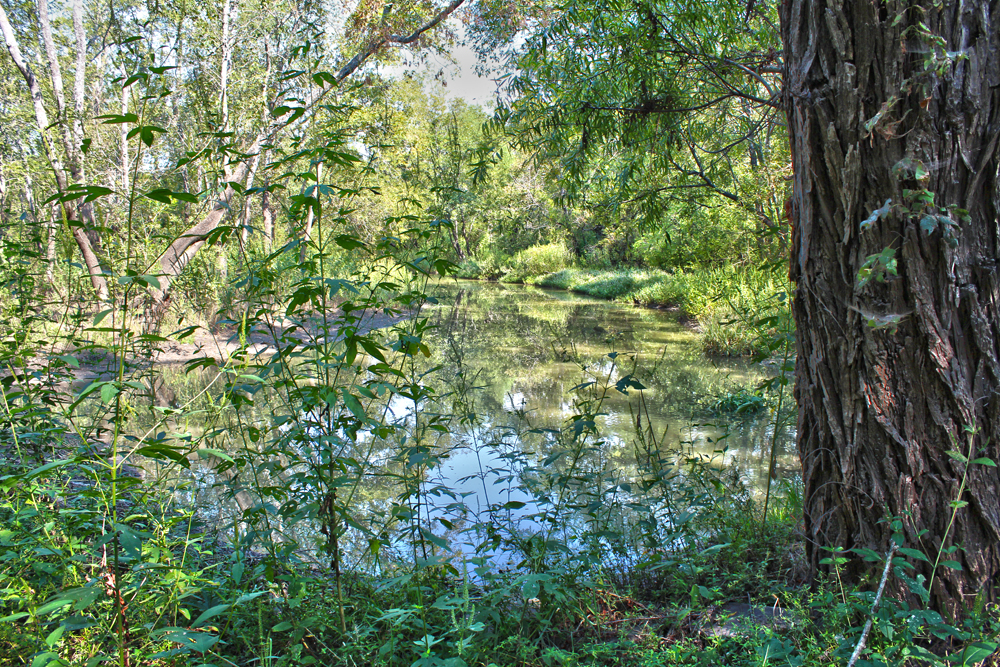
This practical guide takes readers to the best trails found in the Great Trinity Forest, all within easy reach of Downtown Dallas. Destinations include less traveled, low-traffic areas for hiking, mountain biking and horseback riding in the City of Dallas. Joppa Preserve, McCommas Bluff Preserve, Trinity River Wetlands, Texas Horse Park, Dallas Trinity Paddling Trail, Lower White Rock Creek, Sycamore Dixon, Texas Buckeye Trail, Dallas Whitewater Wave, Levee Trails, Rochester Park and more.
Wealthy is he who finds the silver lining in life’s unexpected vistas. That’s the beauty of the contrary nature found along the Trinity River. Photogenic places that belong in a calendar spread for a Texas Hill Country state park. There are a few on the river. Scattered here and there. Pocket places that you can show people and leave them speechless. Take a critic or a cynic of the Trinity River Project to McCommas Bluff and they have a change of heart. So large in scope are the bluffs that standing at the river's edge on one end, you cannot see the other.
McCommas Bluff post construction October 2012
That vista, the relatively unchanged sight that man has viewed for thousands of years was forever altered in 2012.
One of these cliffs is not like the others
You can read the title of this post a couple different ways. The bluffs are finished. I was fortunate to see the bluffs in their natural state before a Dallas Water Utilities Project created a permanent scar on one of the hidden gems of Dallas County. What happened here should serve as a lesson. A lesson to never repeat such an unfortunate project.
McCommas Bluff July 2011 a month before construction started
McCommas Bluff is the only limestone bluff on the Trinity River. There are bluffs made of clay, sand and mud along the river but this one is the only limestone outcropping along the longest river wholly contained in the State of Texas. Registered as a Texas State Historic Landmark, the site was formally made a 111 acre Dallas County nature preserve in 1985. Part of the Dallas County Open Space Program it is a part of two dozen nature preserves in the county and open to the public.
Getting there: 1200 Riverwood Road Dallas Texas
Alternate address for secondary entrance: 7225 Fairport Road Dallas, Texas
The Harry J Emmins commanded by Captain JJ Gray with barges Epps Knight and Charles Lane in tow at City of Dallas Riverfront Wharf, Trinity River, Downtown Dallas, June 1906
The Historical Marker for McCommas Bluff reads:
Navigation of the Upper Trinity River
1893 McCommas Bluff Lock Design
1894 visitors to McCommas Bluff standing along dam crib work
Since the founding of Dallas, many of the
city's leaders have dreamed of navigation on the upper Trinity River,
but none of their attempts achieved lasting success. Fluctuating water
levels and massive snags in the river below Dallas hindered early
navigation. In 1866 the Trinity River Slack Water Navigation Co.
proposed dams and locks for the waterway. Capt. James H. McGarvey and
Confederate hero Dick Dowling piloted "Job Boat No. 1" from Galveston
to Dallas, but the trip took over a year. In 1868 the Dallas-built
"Sallie Haynes" began to carry cargo southward. Rising railroad
freight charges spurred new interest in river shipping in the 1890s.
The Trinity River Navigation Co., formed in 1892, operated "Snag Puller
Dallas" and the "H. A. Harvey, Jr.," which carried 150 passengers. The
"Harvey" made daily runs to McCommas Bluff, 13 miles downstream from
Dallas, where a dam, dance pavilion, and picnic grounds created a
popular recreation spot. In 1900 - 1915 the U. S. Government spent $2
million on river improvements, including a series of dams and locks,
before World War I halted work. A critical 1921 Corps of Engineers
report ended further federal investment. Despite sporadic interest in
later years, the dream of Dallas an an inland port remains unrealized.
1893 Dam crib work July 2011
The Project
The construction project overseen by Dallas Water Utilities began in August of 2011. The purpose was to protect a 72 inch water main that serves as a freshwater supply serving South Dallas, Cedar Hill and Duncanville. The original line was unfortunately built right down or within 100 yards of the Trinity River Channel making it prone to potential erosion issues. In order to protect the line, the Bluffs were to be destroyed, wholesale.
One Juniper Left Standing, which has since been cut down
The footprint of the actual line is only 10-15 feet horizontally at most. I think any reasonable person would not have an issue with protecting a vital waterline to a million people. When that project quickly mushroomed into something larger than a football field it gave even hardened real estate developers I know accustomed to scraping pad sites, a sick feeling.
Gone first were the trees. All the trees were chopped down save one, a large juniper tree seen in the center of the photograph at left. Despite being worked around for a year, it is now absent from the finished project. I assume removed like all the rest. I went down to the site and photographed the rings of some trees that were chopped down in August of 2011. Along the bluffs were ash, post oak and bur oak. Some of these trees, based on their rings were at least 75 years old, some much older.
Juniper
The point to draw from this is that all previous construction projects in the last century at McCommas Bluff, including those in the utility right of way, avoided chopping down these trees. Somehow, someway, someone decided not to take out the trees lining the bluffs. This time it happened and is irreversible.
Post Oak
Looking at the finished product of the waterline project, the vast majority of the trees including the two octogenarian aged trees seen at right, could have been saved. Nothing anyone can do about it now. It's only hoped that there was some
food for thought in future projects that could have saved at least one tree, one blade of grass, something.
Construction site Spring 2011
Not much happened with the site during the winter and spring. It was not until late spring that construction continued, punching large holes in the bluff to provide heavy vehicle access to the river below. I hold no ill will towards the construction company responsible for the project. They were given a job to do and did it according to the plans given. I do pause and give serious criticism to the city officials that green lighted this project. The city should have blocked off construction access to other parts of the preserve as well. Over time the construction area sprawled in size, destroying many of the fragile bluff top areas known for wildflowers in the spring.
To the left you can see one of the exposed utility lines. This is not the larger 72 inch water line. The 72 inch pipe I assume is buried much deeper underground. The exposed pipe in the photo is almost made out of what appears to be cast iron and might have been wrapped at one time with an insulation material which has long since weathered away. This old pipe was always hard to photograph around since it stuck out so prominently from the cliffs. I have wondered why they left this old pipe in place, buried under the new waterline project. It now forms a prominent "hump" feature in the new sarcophagus along the bluff.
Riverwood Road residents standing in one of the access roads built into the cliffs, summer 2012
Water project taking shape by mid-Summer 2012 with first two courses installed.
October 2012
Looking from east bank bluff towards west bank
Looking downstream 1910's era Lock and Dam #1 visible in distant background
Below is some video shot from the old ferry landing site, just upstream from the bluffs. Here you can see the size of the project. Upstream from the bluffs and around the bend is another construction site where a similar stream stabilization project utilizing coffer dams is currently proceeding.
Upstream stabilization project on Trinity River around the bend from McCommas Bluff as viewed from Steamboat Harvey landing site
You Break It, You Buy It
Moonscaped bluff top at McCommas Bluff Preserve
One of the long term legacy issues from this construction is not the bluff face but the marred bluff top seen above. The construction zone slowly encroached across much of the preserve's southern portion, consuming many of the prairie meadows and plants. The level top was used as a turnaround for heavy equipment, a toilet by construction workers and temporary dump for construction debris.
The native soil here is not blackland prairie clay, which was used to backfill the project. The correct soil is a sandy loam deposited eons ago on the Trinity Terrace. These alluvial sands still cover much of Southern Dallas County and provide a unique growing environment known as Post Oak Savannah. The dirt brought into McCommas Bluff does not fit this soil profile at all. If the county were to attempt rebuilding some native environment, 200 truckloads of this aggregate sand would need to be brought in to recreate the soil profile. Only then would the native species like Post Oaks, Bur Oaks, Ash thrive there. They need the moisture holding sand to live on the bluff tops.
It would seem that some sort of mitigation for tree loss is in order here. The amount of trees, foliage and plant species lost here is enormous and stretches far back into the preserve itself to the property line with the Bass family.
There are many residents along Riverwood Road enraged by what happened to the bluff top prairie. I often get an ear full from them when I stop to talk. Some are lifelong residents, lifelong fishermen of the bluff area. They cannot believe what happened.
Poaching
Poacher's Blind at McCommas Bluff Preserve October 2012
McCommas Bluff Preserve Whitetail Doe near Fairport Road
Like a spreading cancerous tumor, poaching has entrenched itself into the bosom of the Great Trinity Forest. Both sides of the river face a widespread epidemic of poaching. The blind above was located not far from the construction area, just 1/4 mile from Riverwood Road on the right of way trail leading towards the Audubon Center. This particular blind is made from fabric panels and staked poles giving the poacher a field of fire facing west southwest. Odd about the location.
With all the ongoing construction at the bluff site and across the river it seems strange someone would hunt in this spot. For the last couple months, the construction contractor had round the clock armed security, one even boasted being armed with an AR-15 Bushmaster. I could not go back into the county owned public nature preserve during this time, I was told, due to insurance issues. So who was poaching back there and for what?
It would be hard to find a better way on the autumnal equinox to conclude the last hours of summer than a hike along the Trinity River. A great way to spend some time with some old friends and meet some new ones. Exploring the homestead trails of Lower White Rock Creek and an historic spring that shares the same name.
Living legend Billy Ray Pemberton on his handbuilt White Rock Creek Trail with Downtown Dallas skyline in the distance
Naturally, who better to lead the hike and historic walk around, than Mr Pemberton himself. One of the few men still turning a plow inside the city limits of Dallas, he is part of an increasingly rare breed of people you don't see often in Texas anymore. Headstrong, self-reliant and driven with a purpose with the rise of the morning sun. He's a philosopher for sure. It does not come out much when other folks are around but get him alone and out in his woods, the deep thoughts come out.
Last Sunrise Of The Summer Over The Wetland Cells
The last sunrise of summer 2012 as viewed from atop Trinity River Wetland Cell "pyramid"
A morning visit to the Pembertons is usually a 2-for-1 visit. A double hike blended into one. The first is usually a quiet morning hike that begins on the other side of the river usually in the Wetland Cells near the Joppa Community or the Nature Preserve that shares the same name. Here the crescent shaped path of the Trinity and hill to the west parallels much the same as the biblical town of Jaffa, now known as Tel Aviv. The stories of freedmen building a town out of the bondage of slavery can also be seen in every facet of the communities spread oceans apart. Fascinating place and somewhat obscure.
View from atop the "pyramid" feature at the Trinity Wetland Cells
To see the crescent shaped path of the Trinity one great place to check out is the "pyramid" feature located due east of Fellows Lane in Joppa. The top of this man made feature built several years ago affords a great view of the wetland chain from I-45 to Loop 12. Out of the flood plain, the half acre sized summit will one day host a picnic area I believe.
Blue Winged Teal Ducks At The Wetland Cells
The water used in the wetland cell project comes mostly from the wastewater treatment plant upstream. It has no smell and I have been told that this water is actually cleaner than the Trinity River itself. Sitting above the Trinity River some 25 feet during normal river flow it only floods when the river experiences prolonged rain events. One interesting note about this place is the fog that seems to develop along the wetland cells even on warmer mornings.
Visiting White Rock Spring
The equinox was a great day to bring together a group of people from all walks of life who are interested in the folks, flora and fauna that make the spring complex in Pleasant Grove. It was a great walk through of local history as told by Mr Pemberton seen above. The photo above was taken at Case Pemberton's cabin site built in the 1880s. The group was just about the right size for such an outing. A great bunch of people I have conversed with via email over the last couple years and I was glad some of us could finally meet face to face. Some were members of the Dallas Historical Society and a member of the Sons of the Texas Revolution. A couple have even struck out on their own and done some of the Devon Anderson, Joppa and McCommas Bluff hikes mentioned here.
The last week of September marks the 169th anniversary of the signing of the Bird's Fort Treaty which brought Sam Houston to North Texas. Signed on September 29, 1843.
It was also a privilege to have local historian MC Toyer join the party. He is the definitive authority on Dallas history, cabins and pioneer genealogy in this part of Texas.
Mr Toyer, seen here standing at White Rock Spring gave a great talk about the background of the spring site, White Rock Creek and Pleasant Grove. So much history happened here on this spot that during our visit we did not get around to discussing the Native Americans who camped here until our return hike from White Rock Creek.
MC Toyer started his talk about the Indian campaigns and expeditions through this area in the 1830s and early 1840s led by General Edward Tarrant and Captain James Bourland. As a result, Bird's Fort was built in present day Euless. From the fort, many veterans of these Indian campaigns who had seen the land, decided to settle the Dallas area using their 640 acre land grants appointed to them as war veterans. Land rich and cash poor, the Republic of Texas paid veterans for their service with land. The scrip was often called Toby Scrip, for Thomas Toby of the Toby and Brother Company of New Orleans, the chief scrip agent. During the republic era, 1,329,200 acres of public land was sold or used directly to retire debt.
Bill Pemberton and MC Toyer at the spring
The Beeman family from Illinois were the first to settle this area permanently. John Neely Bryan and others came and went, in and out of the Dallas scene to follow their fortunes in the California gold fields or real estate speculation elsewhere. The Beeman family stayed. Together as a family they owned large blocks of Dallas land holdings including much of what we now call the Great Trinity Forest.
Big Spring as the Beeman's called it, was on the Big Spring Tract of the Beeman holdings. 320 acres in size this particular tract had two similar tracts nearby called the Prairie Tract and the Cedar Brake Tract. Each tract served a different purpose. One provided great grazing land and farming use. The Cedar Brake Tract provided a source of lumber which was scarce prior to the building of the railroads.
180 acres of the Big Spring tract was inherited by Margaret Beeman, wife of John Neely Bryan in 1856. The Bryan family lived here at the springs from 1867 to 1880. MC Toyer brought along an interesting photo that he believes to be Margaret Beeman standing in front of her home at the spring site shortly after the Civil War. Mr Toyer brought the photo along to see if he could orient the old photo to the contemporary scene. The background did appear quite similar to the present day. Some gravel mining in the area has changed the slope of the terrace over the years so the area where the Beeman cabin was once believed to have stood looks similar but not exact. It would be fun to pursue this further. At the site, since a well was not used at the time, we thought back to how far someone would be willing to walk every morning for a bucket of water.
Big Spring as it looks today
Enter the Pembertons
Corn King Hand Sheller
In 1880 Case Pemberton bought the Big Spring property from Margaret Beeman for $1000 payable in two installments, $400 in January 1882 and $600 payable in January 1883. Case Pemberton ran a dairy operation on his property until his untimely death in the early part of the 20th century. Case Pemberton like many dairymen would deliver milk to town in the morning. Rather than return with an empty wagon, he would fill it with ice, food and other items, then sell them in the afternoons at a small store located at the corner of Lake June and Pemberton Hill. His death came as a result of an armed robbery at his store. After his death, his property, known as Bryan Springs was divided up among his heirs. Mr and Mrs Pemberton live on one such portion of a parcel today.
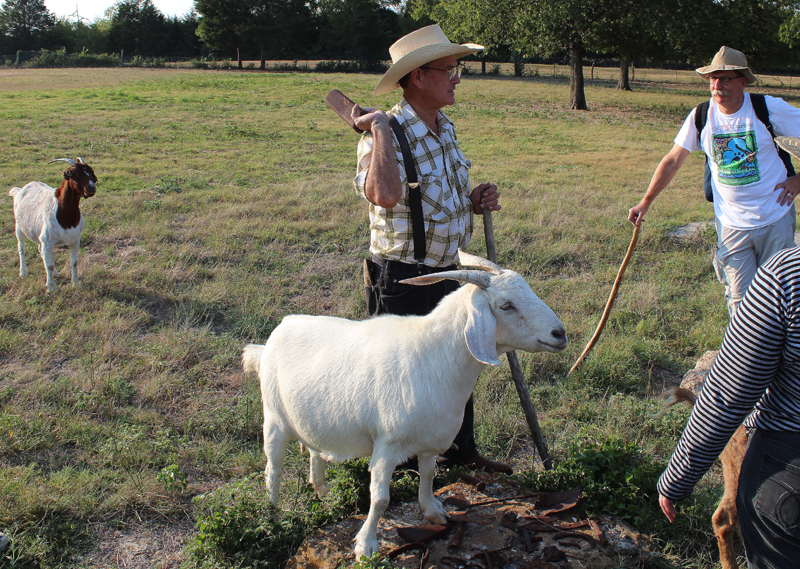
Case Pemberton cabin site, Olympia the Goat foreground
It does not take much to get Mr Pemberton excited about showing off Case Pemberton's farming equipment. One twinkle in his eye is all it takes to pull out his prized Corn King Hand Sheller. I found an old ad for one dating back to the late 1800s. I believe Mr Pembertons sheller is older than the advertisement.
Billy Ray with a copy of the Texas Declaration of Independence brought by Mr Gibson
Looks like the guy in the ad bent over too far and shucked off the bottom half of his tie! You could spend all day just looking at this old farm equipment, things that were probably hauled in overland by wagon rather than rail.
Really easy to get sidetracked at the garage. Which is a good thing. One interesting heirloom after another comes out of it. A piece of cast iron, some old horseshoes, some blacksmithing apparatus. Each has a story to tell. I always try and make a little time to look at one or two of these old things on a visit. That little bit of time often turns into an hour.
Beyond The Spring And Down Into The Back Forty
The Beeman Walnut Tree
Passing from the high terraced North Texas prairie to the river bottoms is marked by the famous Beeman Walnut Tree. Near the base about 18 inches up is a railroad spike driven into the tree in the year 1908 marking the high watermark of Dallas most historic flood. From this spike, still up on the terrace, one can only imagine the mile and a half wide flood ravaged river that stretched from this point clear to the freedmen's town of Joppa to the west.
It's here, down the slope and into the bottoms where the sounds of the city are completely gone. A dead silence where you can hear an acorn drop 100 feet away.
Bryan's Slough and Oak Creek
Down here distant bird calls can be heard a 1/4 mile away and an approaching breeze can be heard before it is felt.
Standing on an active beaver dam looking upstream from Bryan's Slough/Oak Creek
Billy Ray Pemberton and visitors on his old bridle path
Mr Pemberton has maintained the old family bridle path down to White Rock Creek for many years. It follows a series of old fence lines and water features before ending up at the banks of White Rock Creek.
Down here in this remote area the animal prints far outnumber those of people.
The hike here is an easy one from the spring to White Rock Creek. Seen in the picture at right with Downtown Dallas in the background, a companion route could be easily made from the existing Rochester Park / William Blair trails. White Rock Creek has a man made boulder crossing currently in place along the right of way here that makes for an easy dry hop-skip-jump across.
End of the trail along the steep banks of White Rock Creek
Below is a short clip of the White Rock Creek crossing looking upstream. Rochester Park is on the left, Billy Ray's trail would be to the right.
The 2012 Bond Package
I noticed that one part of the 2012 Bond Package up for vote in the coming November 2012 election is a proposal to build a 100 foot deep, 30 foot diameter storm drainage pipe which would drain much of East Dallas and Uptown storm water into White Rock Creek. The video below notes the outlet for the stormwater as the White Rock Creek Outfall.
I cannot find really anything about it online other than this recently posted Youtube video. It gives one pause about what lies in store for Lower White Rock Creek, the Great Trinity Forest and the historic places we visited in this post. It sounds like the floodwaters that originally would have entered the Trinity in the Mill Creek, Turtle Creek and Peak Creek drainages from Uptown through the Arts District, M-Streets, Baylor Hospital and Fair Park, would reroute through Rochester Park and Pemberton Hill.
I wonder where the outflow would be located. Scyene, Second and Bruton all have low bridges that are somewhat prone to flooding during heavy rains. Seems more likely that if an outflow location were selected it would be further south near US 175 or in Rochester Park.
Seems like an ambitious project to relieve certain areas of town from flood waters like Baylor Hospital's emergency room. The cost will manifest itself where all this extra water ends up.
A Special Thanks
A special thanks to the Pemberton family for hosting this event. Their knowledge is something you cannot find in books, online or through a television. It has to be seen and witnessed for your own eyes to appreciate. SYOTT- See You On The Trail
Sharrows are what cyclists call them. Shared Lane Markers, Cycling Chevrons, Yield To Cyclist Markers, they go by many names. A symbol that resembles a bicycle under a roof, stenciled into the road. If you work in Downtown Dallas or frequent Deep Ellum you might have seen them spring up overnight on Main Street, Lamar or even MLK Blvd south of the Fairgrounds.
Bike shared lane marker in front of The Curtain Club Main and Crowdus, Deep Ellum
Sharrow stenciled into the pavement Main @ Exposition Deep Ellum
Dallas has an ever growing infrastructure of dedicated bike paths spread around the city but they all exist in fractured states separated by miles of roads in between. One way to band-aid these trails together is a connect the dots approach using painted icons on the pavement. In theory the stencils generate awareness for cyclists using the roadway. Some critics argue that riding in the road is already a right-of-way right for cyclists in Texas and that the stencils are not needed.
I like them. They mark a somewhat cryptic path from the Katy Trail near the American Airlines Center to the Santa Fe Trail near Fair Park. The roads near Fair Park all twist themselves into a knot and finding the Santa Fe Trail coming from Downtown can often be a challenge. The stenciled pavement helps.
Ludwig Rudine's bicycle and motorcycle shop circa 1913 at 2613 1/2 Elm Street
Riding these streets is nothing new. If anything its a throwback to over 100 years ago. One of the earliest bicycle shops in Southwestern United States and one of the first in Texas was Ludwig Rudine's Rudine and Company bike shop at 2613 1/2 Elm Street in Deep Ellum. Ludwig was a horseless carriage mechanic by trade and transitioned into bicycles then motorcycle service. At the time, bicycles were a popular means of travel in Dallas. Bicycles outnumbered passenger vehicles for a brief period on the streets of Dallas in the early part of the last century before vehicles became more common. As the time, the city of Dallas barely even reached the Fairgrounds, Cedar Springs or even Lemmon Avenue. A bicycle was an easy and quick form of transportation. As the city grew, trolleys and then vehicles took over.
So, what's old is new again........
The plans are to build out stenciled marked streets in connecting loops through Downtown and out Main Street to Deep Ellum/Fairgrounds, another out Lamar Street. Looking around, so far the stenciling exists in the following places:
-Main Street from Lamar all the way through Deep Ellum to the southern terminus of the Santa Fe Trail at Hill Avenue. Getting to the Fairgrounds this way is still somewhat of a jump requiring a ride down Haskell, which is one way. A better route is to ride down to Exposition and Main, ride Exposition to Fair Park.
Cyclists on Main at Pearl, Downtown Dallas
Santa Fe Trail @ Henderson
The goal here is to connect the Katy Trail with the Santa Fe Trail. Doing so would balance two trail systems that have loose ends hanging off to the south. Both are great multi-use paths that if joined together would form a spine of future bike paths.
Known as the SoPa, the Southern Pacific Trail below White Rock Lake
The north end of the Santa Fe Trail terminates at a bridge over Winsted where it merges with the White Rock Lake Trail known as the SoPa, the Southern Pacific Trail. Like the Santa Fe and Katy Trails, this paved path was built in 2000 over an existing rail bed that once ran from Tenison Golf Course to Presbyterian Hospital. Given the 911 Marker Code "SPT" it will retain a different name than the newly created Union Pacific Trail currently under construction from Mockingbird to Northwest Highway.
Union Pacific Trail looking south towards Mockingbird
This newly minted trail still under construction will meet with the Katy Trail Phase IV near the Ridgewood Recreation Center, then continue to the north up through Vickery Meadow. To the south it will tie into White Rock Lake near the Fisher Road Parking Lot.
Union Pacific Trail looking north from Trammel
-Katy Trail down Lamar to the Convention Center is another marked route. This is another decent route that opens up quite a bit once you pass the Convention Center. Headed out this way it's only a five minute bike ride or less to the Santa Fe Trestle Trail. That route, which is unmarked would be Lamar to Cornith, south on Corinth to Riverfront(Industrial Blvd). Hang a left at the big plastic Longhorn.
Shared lane marker at Lamar and Young looking south to the Convention Center
-Martin Luther King Blvd south of the Fairgrounds is the first shared lane street in Dallas. The stencils were placed in April and May from the MLK entrance of the State Fair down to US 175.
Shared lane marking MLK and Robert B Cullum
I thought if there were ever a street that would see the most oil, bus tracks and road grime on it capable of removing stencils, MLK would be the road to do it. In the four or five months that the stencils have been in place they all still look brand new. MLK has a funky lane layout, almost a 60/40 percent lane separation which puts the driver side wheel directly over the stencil. So far, so good.
Heading out the south entrance of the State Fairgrounds the bike stenciling ends at US 175, a few blocks short of Lamar and the MLK/Forest Avenue/Cedar Crest Bridge. I'm not sure why the stenciling ends here but I think it should be extended to the approach of the bridge. The MLK/Forest Avenue/Cedar Crest Bridge has a great sidewalk across it and is the route I always lead bicycle groups across when visiting the Great Trinity Forest and the Standing Wave project.
Shared lane marker at MLK and US 175
I'm not a fan of riding down MLK Blvd. One of the few vibrant streets in South Dallas, the roads and parking lots are usually crowded with cars. I prefer Grand Avenue or Pennsylvania as better alternate routes headed out of the Fairgrounds.
The new Lamar Levee Construction Begins
One new construction project that might make the Great Trinity Forest accessible from the State Fairgrounds area is the Lamar Street Levee Project. I have asked a few people if the final project will allow for recreation activities like hiking, cycling and horseback riding. I got a yes, a maybe and a hold your horses for answers.
Hard to see the signs that construction has started. Tucked in between the Tiger-Tiger Boozarama Liquor Store and the Chicken Shack is a new sign noting the construction entrance.
Lamar Street Levee Map
The Lamar Levee shown above will tie into the current Rochester Park Levee near Bexar Street and then run up the south side of the train tracks to the DART rail bridge near downtown. I have not seen much construction yet other than a fenced off staging area behind Tiger-Tiger on South Lamar and the test drilling site pictured below.
The drilling site sits east of the Highway 310 Bridge and west of the train trestle in Rochester Park. This sits just west of the historic old Miller's Ferry crossing. The new road here cut into the woods just above the riverbank is not long just a couple hundred yards and serves as a test site for soils underlying the future levee site.
It has always been a problem getting around the industrial areas and metal recyclers on Lamar. If the levee offered a workaround the circus there, it would really open up Rochester Park/Blair Park to more people seeking recreation.