Friday, January 4, 2013

Texas Winter -- Predators of the Dallas Woods


Cold and austere, the post Christmas early morning light cast shadows on frozen ground so stiff it resembled old concrete. The previous evening's snow has muffled the urban noise of the city that has grown up around these bottoms. The primate populous of that same city that calls it home has retreated indoors to loaf, channeling a deep seed of cave man DNA not to venture into the cold. During these special times, the rarely seen predators of the woods come forth from their shadows.

There is no better time to see the large carnivorous animals of Texas than after a bone chilling freeze. It seems that the cold drives these animals to hunt and explore more than any other season. Following are some photos taken during that North Texas cold snap between Christmas and New Years. Some are common sights while others are exceptionally rare.


Red Shouldered Hawk taking flight from a pecan in the Renda meadow below Scyene Overlook
A certain fidelity exists among the animals here rarely seen by humans. Where we see simplicity, the reality is complexity. We might see it happen on a small scale out a kitchen window in the morning. Or in a carefully scripted fifty minute wildlife documentary on television. The real world life and death drama played out through window panes or a piece of LCD glass is no match for bearing witness in person.

The frozen climb up the north face of Scyene Overlook
Coyote in Gateway Park
The twenty degree overnight temperatures froze the ground solid here the night before. Locking rocks in place where they lay, turning the small scree slopes of the escarpment on which the trail lies into an easy to walk path.

In the far distance, a shy coyote makes a bolt across a fallow field for nearby Oak Creek. Coyotes are seldom seen, often heard and leave their scat everywhere. Weary hunters, they seem opportunistic in their forays around people. Fuller bodied than the swamp coyotes  a few miles to the south, this Gateway Park yote seems to make meals out of more than just the local fauna. Pet food or garbage left outside are likely culprits. It beat a hasty retreat towards the DART Green Line where it crossed under the tracks using a small culvert for an unnamed creek.

JJ Beeman Trail in the Great Trinity Forest

Red Shouldered Hawk hunting in the Renda Meadow
Red Shouldered Hawk beginning a hunting dive off a power pole in the Renda meadow
A sharp, descending "kerr-yeee" scream announces the presence of the Red-shouldered Hawk as one enters the meadow near Scyene Overlook. Getting to the meadow is a worthwhile hike and sits mere minutes from Downtown Dallas.

Red Shouldered Hawks (Buteo lineatus) seem to be the most efficient raptors in the Great Trinity Forest. Medium in size and quite agile they can thread themselves through floodplain woods and bramble thickets with ease.
Renda meadow raptor

Their diet consists of insects, lizards, snakes and smaller rodents. They will take down another bird from time to time but the bulk of their diet seems to be smaller ground dwelling animals. The Red Shouldered Hawk seen above was hunting field mice in the snow covered meadow. It appeared as though it was watching for movement under the snow then launching a dive to the target.

This past spring I was fortunate enough to see a pair of Red Shouldered Hawks build a nest on White Rock Creek. Checking in once every few weeks I could watch from some distance the different phases of hawk rearing from nest construction to the eventual hatching of hawklets. This particular nest hatched three and raised three to adulthood. I still here them from time to time calling to each other nearly a year later.


Hawks Over Piedmont Ridge


The gusting northwest winds blow strong updraft currents along the White Rock Escarpment. The abrupt hundred foot elevation differential creates an enticing loitering area for some of the largest winged predators in Dallas, the Red Tailed Hawk. Seen at left and below, the hawks pictured were riding the draft up in effortless concentric maneuver. Much like a spiral staircase, each rotation would take them an building story higher in the air.


Some of these hawks migrate in seasonally for the winter from the northern plains, others stay year round.  I imagine the hawks view this ridge of Trinity chert gravel topped limestone as an island of sorts. A place to survey many acres of prime hunting fields.

Snow covered Piedmont Ridge Overlook


The large population of hawks in this area might be the result of the easy to hunt areas on the Grover Keeton Golf Course. The large number of nut bearing pecans here attract squirrels and the cropped grass keeps a stable population of rabbits.

Hawks are too small to predate the largest four legged menace in these woods, the feral pig. Signaled with the installation of traps and a feeder within 50 yards of the Gateway Trail, feral pigs have made the move to Scyene. The DART Green Line fencing serves as an effective barricade against pig migration to some extent. From the looks of the recent tracks near the DART crossing at Glover Pass, some of the pigs are quite large. One can only hope that the widespread extermination of non-target species (deer, bobcats, coyotes and birds) as evidenced near the Audubon Center will not accompany the attempts to eradicate the feral pigs from the Scyene Overlook area.
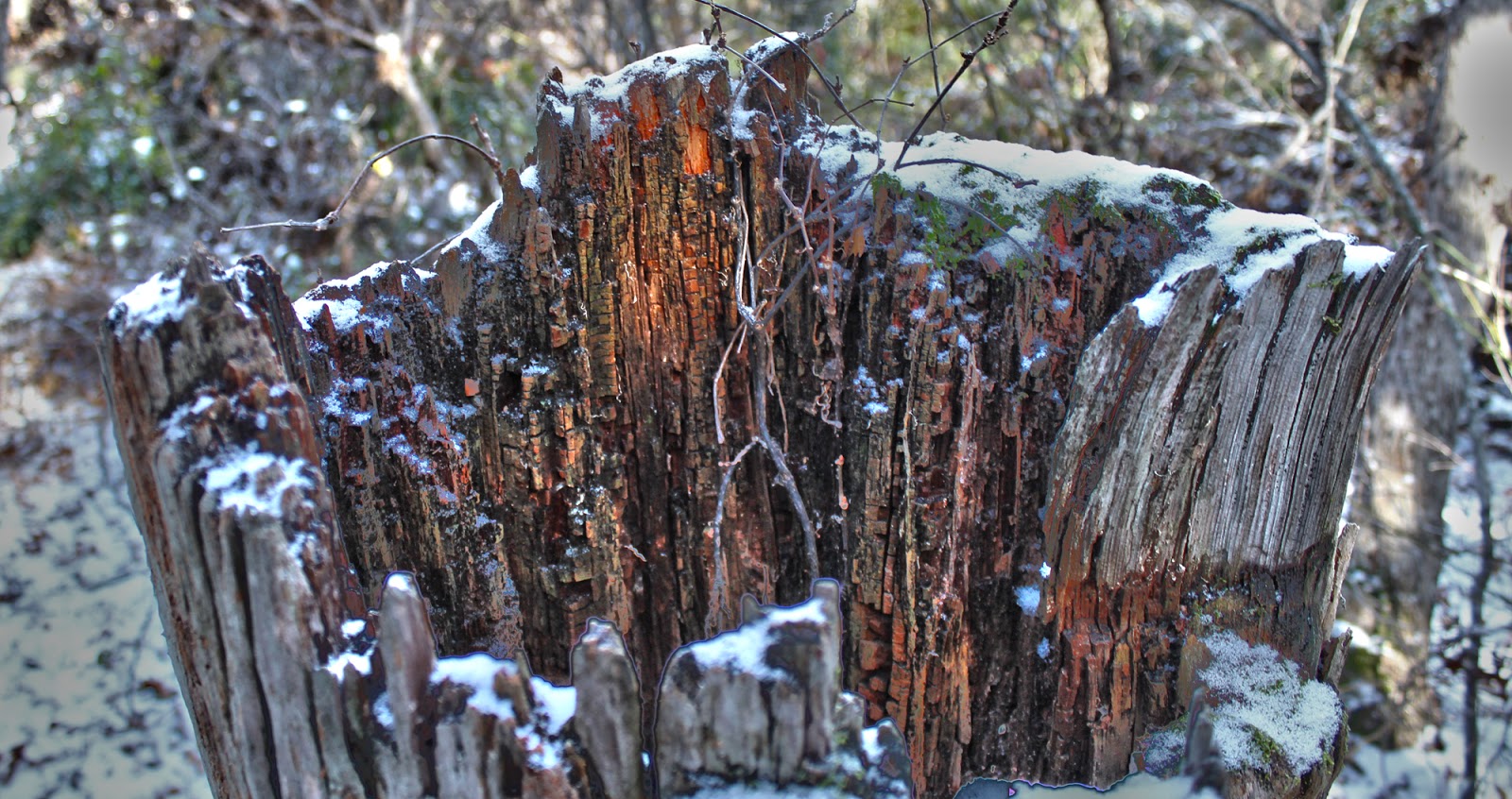
Snow covered juniper stump along the Piedmont Ridge Trail

Devon Anderson Trail
Devon Anderson Trail south of Bruton Road
Red Tailed Hawk being harassed by a Mockingbird
Belonging more to the air than to the tree limbs on which it sits perched, hawks are often the subject of harassment by lesser birds. Like a monkey on his back, the mockingbird makes insulting remarks and curse statements at a bird fifty times in size. Annoyed, the hawk reluctantly takes flight moving to another tree nearby.


Footbridge over the dry gulch in Devon Anderson Park

The Great Horned Owls -- Master Hunters of the night


The fabric of Texas Lore is wound tight with the Great Horned Owl (Bubo virginianus). Modern day Texans are poorer for never having heard one. The booming voice of evening calls to attract a mate resonate louder than a man can yell.

The Native Americans saw the Great Horned Owl as a harbinger of death and bad luck. An owl near their camps while revered by their beliefs was a forboding sign.

The Spanish Conquistadors and missionaries that first colonized Tejas in the 17th Century blended the ancient Caddo stories of owls into their own. Es como los tecalotes; la viveza lo tiene en los ojos. He is like the owls; all his liveliness of wit is in his eyes.

Mexican bandits often thought the Great Horned Owl's call was "Refugio, Refugio, Refugio". Refuge. Refuge. Refuge. Hiding for a night under a tree used by an owl was a sure sign of a remote sanctuary. 

The old Texas pioneer rhyme that dates back to the mid 19th century has similar parallels to them all :A wise old owl lived in an oak, The more he saw the less he spoke,The less he spoke the more he heard. Why can't we all be like that wise old bird?


"Uncommon but widespread" is how many field guides list many winged predators. This applies to the Great Horned Owls especially. Owls are apex night hunters and the preferred technique for Great Horned Owls is to perch on a pole or cliff or other site with a view, watching and listening for prey. Spotting or hearing potential dinner, they launch off and dive in on silent wings to snatch the unlucky critter in incredibly strong and large talons. With two foot long bodies, five foot wingspans and talons with crushing power over 300 psi, Great Horned Owls are one of the few birds that can kill animals larger than themselves.


Hearing a great predator call in the moon lit air of sunset is a rare occasion inside the city limits of Dallas. Seeing one is quite unique given their nocturnal schedules. Getting some photographs of one is even harder to come by. For the intrepid willing to brave the cold, the chance to get some owl photos was a rare chance indeed. Below is some footage I shot of one Great Horned Owl. It was a cloudy and foggy evening after sunset.


Seeing the owl in the fork of a tree, I placed a camera and tripod some hundreds of feet away. Then left the area. Over the course of the next twenty minutes it made territorial calls a number of times, calling for a distant mate. Around the 1:50 mark or so the distant return calls of the second owl can be heard in the far background. Towards the end of the clip, the owl leaves to join the other. I have not seen many Great Horned Owl videos on the internet. Nearly all seem to be of owls in captivity. Quite entertaining to hear the owl hooting 500+ yards away knowing down in the woods your camera is catching it all.

Much of the groundwork for knowing about this particular pair of Great Horned Owls was done by Robert Bunch, a professional photographer of note based in the Dallas area. His willingness to share his find and donate personal time for chronicling birds in Dallas is exceptional. His website features some of his great wildlife photos Robert Bunch Photography. I had heard owls many times previous to this in the Great Trinity Forest and caught fleeting glimpses of them but never seen one so close. Joining Robert was another great photographer Geryl Mortensen of Birds Afield. He made waves last winter with his Texas Snowy Owl photos that caused quite a bit of buzz. Both those guys are outstanding photographers and seem like exceptional people to boot. A pleasure meeting them both. I'm a two bit idiot with a camera compared to what they bring. Really nice to meet ethical folks with an appreciation for keeping an unobtrusive distance to wildlife.


Urban Bobcats - The Bobcats Of White Rock Lake
Bobcat at White Rock Lake December 30, 2012
The bobcat (lynx rufus) is the most common wildcat in the United States. Their name comes from their short bobbed tail and is easy to spot from some distance. Varying in color and size, they can take on a gray milk color or a more exotic leopard pattern like the one seen in the photos here. With the magnified toolset of a house cat many times over, the bobcat is an apex predator across the North Texas landscape. Only an unfortunate run-in with a bullet or a car bumper stand in the way of their demise as adults.
Bobcat at Sunset Bay, White Rock Lake, Dallas, Texas near the CCC Statue

Roughly the size of a medium dog, this particular bobcat was seen at White Rock Lake about an hour before a cold cloudy sunset on the last weekend of 2012. Blending in well with the dormant grass it moved virtually unnoticed across a couple acres of open ground at Sunset Bay near walkers, runners and cyclists.

White Rock Lake bobcat marking scent on brush next to the Sunset Bay offices

Like many cats, this bobcat appeared to be on a daily patrol, marking territory with facial scrapes and urinating on brush. There is more than one bobcat in this immediate area and claiming territory of your own is an important job duty for any cat. Looking at the facial features and overall girth, this bobcat is most likely a younger individual maybe the result of litter last spring.

The bobcat like others I have seen at the lake have found a way to coexist with people in a non-threatening manner. Their prey diet consists of rodents, waterfowl and small game that live around White Rock Lake. Seeing a cat this size along the hedges here would give a dog owner a reflective pause before letting a pet run off leash. No need to worry. The cats seem to have a healthy respect for humans and their canine companions. They keep their distance and so should you.

Comparing a bobcat to a mountain lion ........


Poor light, long distances and excitement can often confuse your eyes into seeing something that is not there. The illustration above shows the main differences between the larger mountain lion and the bobcat. 3 feet long for a bobcat, 7-8 feet long for a mountain lion. Similar coat colors, similar markings.

Comparing cougar, coyote and bobcat tracks, Courtesy TPWD


Despite claims of mountain lions in the Dallas area, the tales of big cats are just that. Concoctions of rumors, third hand accounts and a healthy dose of misinformation. Even the prints of large dogs are misidentified as mountain lions all the time. The prints above illustrate the similarities and marked differences between the animals. It's unclear how someone could not tell the difference but it happens all the time.


It's a paradox to often find images such as these in the most violent and impoverished neighborhoods of Texas.  Places that many reading this will never visit for fear of the people who call it home. I wonder what it will take to change that.

Sunday, December 23, 2012

The Great Trinity Forest's White Rock Creek -- The Bois d'Arc Trail in William Blair Park


There was a time when the barbed wire hung here enclosed the finest Swiss milking cows in all of Texas. The native wild rye grasses produced perennial champions of best tasting milk contests twenty years in a row at the State Fair. The Bois d'Arc fenceposts are the only addition to the Great Trinity Forest that old dairy left behind. Standing as silent sentinels for over a century they have weathered every storm and flood Dallas as a city has seen. In the dust bin of history these needle in a haystack old fence lines on White Rock Creek serve as testament to a time when this wild land was briefly tamed for a different use. Given half a decade the river took it back.

For The Price Of One Hundred Million Dollars
In late 2012, talk has been of taming the bottoms here once again for new uses. Promised world class facilities sure to rival that anywhere else in the known universe.

Many millions of dollars were spent to remove the old world class facilities from our memory. In an age old folkloric motif modelled on the story of Shechem, past mistakes were seceded back to the river never to be used again. An effort that Roman general Scipio Aemilianus Africanus who is heralded as salting Carthage would be proud of. So complete in dismantlement than only random fossilized golf balls remain.


The social and economic headwinds blow strong through this part of Dallas. The payoff of big ticket revitalization projects in the last ten years have yet to trickle down to the most important beneficiaries. The residents. I hear their frustration. Some of it is heartbreaking.

The promise of a brighter future is all one can hope for in a place many have written off as hopeless. The razing of Turner Courts and the new replacement taking the same footprint are met with guarded caution. We'll see.
New Turner Courts Projects as viewed from the Buckeye Trailhead December 2012


For The Price Of A Roll Of Flagging Tape

Reflagging the Bois d'Arc Trail

The river not only reclaimed that 36 hole golf course near Joppa but also the trail on the opposing side of the river. Erased. The Bois d'Arc Trail through Rochester Park(newly named William Blair Park) roughly follows the path of these old fenceposts down the west bank of White Rock Creek. The roughly mile and a half long trail eventually terminates at the confluence of White Rock Creek and the Trinity River on a knife edge briar patched peninsula.

Eastern Wahoo Euonymus atropurpureus
The undulant course of White Rock Creek slowly fights it's way through the last mile of Trinity River Bottom, hesitant to give up it's own water to the larger river beyond. Following the bank along the creek here is a maddening chore even for the most dedicated hiker. The ever thickening greenbriar thickets block travel through many of the sharp turns and suggests traveling at a fifty yard distance beyond.

Bois d'Arc Trail(click to enlarge)


The river reclaimed this trail in 2012. A series of large flooding events in the early part of the year coupled with little human use vanished the trail. A previous visit nearly a year ago is chronicled in a previous post here: William Blair Park The Perimeter Trail The GPS data for that hike is still relevant and can be found on the Garmin website Perimeter Trail and Miller's Ferry. Coordinates 32.734445, -96.739459 Google Map for Trailhead
Complete trail map of known trails in Rochester Park/William Blair Park
The low frequency of trail traffic coupled with the flooding events have obliterated the eastern half of the trail system. It's not a bad thing. Nature took it back. In many cases neglected trails often fall into disrepair and erode. This leads to more problems. The Trinity River simply overgrew these trails. Hiking their shadow is still easy although the trailhead is now very hard to find.

Trailhead as it looked in August 2010
Finding the trailhead in 2012 is not as easy as it was in 2010 when the above photo was taken. The grasses have since reclaimed the trail and the flagging tape has long since faded.


Same spot in the woods as it looks in 2012. In an effort to make the hike more accessible I brought a roll of flagging tape along to remark this route. The route is not hard to follow keeping the creek to the east and within sight making ones way cross country in dry weather is a pleasant walk. Subject to flooding and prolonged drying periods this is a great trail in drier winter weather.


The fiberglass arrow post
Perhaps the only man made trail marker on this route is a fiberglass post, pointing towards the direction of White Rock Creek's mouth. If one were to make a left instead of a right, the route leads out on an omega shaped bend in the creek which can mislead some.  In the future, this easterly route might serve as a worthwhile link to White Rock Spring which lies some distance to the east from this spot.

The banks are very steep here and finding a crossing point has proven difficult. I'm sure there is a good ford crossing along the creek in this stretch but I have not pursued the goal of finding one.
Fresh beaver felled sapling on the high bank above White Rock Creek
The novelty of walking down White Rock Creek free of fences and flood debris is one that few experience. The walk is quite easy and would be an acceptable place to bring dogs and children along.
The peninsula at the mouth of White Rock Creek

Reaching the trail junction of the Bois d'Arc Trail and the Buckeye River Trail the less trodden path takes one out on a peninsula formed by the mouth of White Rock Creek joining the river. The greenbriar vines are quite thick here and sure footed steps are required to insure safety from the steep drop offs on either side. This was also trimmed back on the recent trip there and should now be more manageable.

Mouth of White Rock Creek looking downstream
The elevated view from the peninsula is worth the hike. A view few will ever see.


The trail from the mouth of White Rock Creek towards the Buckeye Grove does not meander far from the Trinity River. Passing some of the larger Bur Oaks, Pecans and Cedar Elms that were once used as shade trees by the milking cows of Metzger's Dairy.

Standing in the Buckeye Grove, Great Trinity Forest
The trail constricts as it approaches the Buckeye Grove. Surrounded by several acres of thick Chinese Privet the Buckeyes might be hard to spot this time of year unless one knows what to look for. The Buckeyes annually bloom in the middle of March and are often some of the first spring flowers on the Trinity. A must see.


This time of year, around Christmas, the Eastern Wahoo Tree makes it's own color on the river. Known as "The Burning Bush" the brilliantly colored leaves and seed pods offer some color in what is an otherwise muted winter setting. The tree of note is just north of the Buckeye Grove and can be easily seen from some distance through the woods.


The unpaved Buckeye Trail eventually links up in this area with a concrete trail built several years ago to accommodate those visitors needing ADA access. How someone with a wheelchair or hoverround rascal scooter can negotiate the climb over the levee to access the concrete trail beyond remains a mystery to me.


Buckeye Trail from 2003

Buckeye Trail as it looked ten years ago
Before being bulldozed and paved over, the old natural surface Buckeye Trail was a great hike. Gated by a grove of cedars at the entrance the trail opened up into a nice long walk peppered with trees to the river.


The paved Buckeye Trail

The once open and canopied view of the old Buckeye Trail is now somewhat blocked by Giant Ragweed that grew up on their side of the trail after bulldozers cleared a large swath of forest for a 6 foot wide path. The latest plans from the city envision a similar trail, called the AT&T Trail near a future planned golf course bearing a similar name. That trail if built using the same construction standards as the Buckeye, would remove over half a million square feet of virgin hardwoods. Unlike the former grazing areas reclaimed by the river, the AT&T Trail would run through an area never logged or farmed. Something to think about.

View from the end of the concrete trail at one of two Buckeye Trail overlooks.


For The Price Of A Cup Of Tea


Last season's corn cobs for fire starter. The historic June hailstorm's dead fall limbs for fuel. An old guitar. A box of tea. A slow to heat coffee pot that gives you enough time to stump chat about the land, the weather and next year's crop. The simple pleasures in life that have no price. 


Under a grove of pecans and walnut trees that have fed man and beast alike for centuries Billy Ray Pemberton sits with his bible, guitar and mug; strumming songs of yore and songs he wrote himself. Subjects range from the land, his friends and thoughts on the world that surrounds him. Soft spoken in conversation, his true storytelling is done through his guitar. The richest man in town.


Freedman's Town of Joppa -- The contrasting Christmas lights of a home on Fellows with the muted colors of the Great Trinity Forest beyond

Monday, December 10, 2012

First North Texas Snowfall Blankets The Great Trinity Forest


If you blinked, you might have missed it. A brief moment in time before a morning dawn when the hangers on of summer meet old man winter for the first and last time. Here the late season wildflowers in the pocket meadows dotting the Great Trinity Forest have eluded the brief frosts of November. Dodging frosts here and there these summertime plants have held out until....today. Rarely can you find nature punctuating the end of a growing season as much as a snow.
Ratibida columnifera Prairie Coneflower -- Mexican Hat in the Great Trinity Forest
Other than the rare occasion of a late spring snowstorm dusting bluebonnets, Texas just does not see summer fast forward into winter overnight. The well worn sayings of yesteryear parroted by tv weathermen "if you don't like the weather in Texas, just wait, it'll change" often ring hollow. Overused, when it does actually happen the event often goes unnoticed.


The Great Trinity Forest, one of the larger urban forested areas in the United States is so close to downtown that one can see the sights here for a brief half hour at dawn and not even be late for work. Such was the case this particular morning in mid December. Few realize that.


Centaurea cyanus Cornflower
The light dusting of snow left with the first rays of morning sun. Gone faster than a morning frost I would say. For those brief few moments though, it was quite special.

Compositae Solidago altissima Goldenrod

  Symphoricarpos orbiculatus Coralberry


Odocoileus virginianus White-tailed Deer
Leaving the way I came, my path crossed with a large mature whitetail buck. The cold snaps seem to invigorate the deer during their annual rut and this particular morning was no exception.

The deer has cleared out a small area on the forest floor about the size of a kitchen table where he marks his territory. The dance he does half resembles that of a Pamplona Bull and a prize fighter ghost sparring with his own shadow. The scent left behind is a calling card for does and for other bucks to tread lightly.


The buck was so pre-occupied that it had little time to even notice me. It was a Monday after all. A long week of work lay ahead for both of us. Few such places exist like this in Texas, where a couple Texas residents can look at each other with a nod on the way to work.

This is one of those special places. Where the post cutter's wagons never reached. Where the land was too soft for a bulldozer to clear cut. Too far from a paved road to build a house.

The winds of change rarely shift here. When they do it is always for a quick buck at the expense of the river itself. The post cutters, farmers, cattlemen, river bargemen, gravel men, golf course owners and landfill operators. They were here. Once. They came. They lost. They packed up. The river always wins. Always.