 |
| The colorful male Painted Bunting Passerina ciris at Gateway Park Dowdy Ferry. Dallas, Texas |
The New World French Explorers called this bird the Passerin Nonpareil which loosely translated into English means "without equal". The Painted Bunting. The swamps and wetlands those French once claimed for their King Louis XIV in what is now Louisiana centuries ago are filled with the summer song of the bunting. A bird whose loud call is only second to that of their vibrant color. According to Native American legend, when the great spirit was giving all the birds their colors, he ran short of dye so he gave the very last one, the Painted Bunting, a coat of many colors made from dabs of whatever was left.
 |
| Painted Bunting in flight |
Painted Buntings live in semi-open habitats with scattered shrubs or trees. Birds from the south-central U.S. breeding population use abandoned farms, strips of woodland between overgrown fields, brushy roadsides or streamsides, and patches of grasses, weeds, and wildflowers. Individuals of the coastal Southeast population breed in scrub communities, wooded back dunes, palmetto thickets, edges of estuaries, hedges, yards, fallow fields, and old orange groves.
There are two distinct breeding populations in the United States. A population in Florida through the Coastal Carolinas and another in Texas and Louisiana. The two groups were once one, habitat loss has separated this species much like that of the Endangered Wood Stork.
 |
| Dawn breaking over the trees of a marsh meadow in the Great Trinity Forest July 2013 |
The east coast populations winter in shrubby or grassy habitats in Florida and the northern Caribbean. Birds from the south-central United States winter in similar habitats in southern Mexico and Central America. I imagine there is an old plantation in the Yucatan that looks similar to all this Trinity River Bottom that the birds hang their hat in during the winter months.
 |
| White Ibis feeding in a Great Trinity Forest swamp July 2013 |

The small caliper trees in this area down near Dowdy Ferry and I-20 serve as ideal habitat for the birds whose numbers are quite large this year. A walk north up the dirt road from the Dowdy Ferry park towards McCommas Bluff Preserve will yield many sightings and songs of these birds.
The rarity of seeing a Painted Bunting is not the population being so few. It's the hunt for the habitat that they relish. Find their favorite environment and they are thick like flies. In Dallas we simply lack the habitat for such birds. Mostly that has to do with our annual rainfall in North Texas and to a lesser extent the amount of development inside the floodplain and transitional areas these birds enjoy so much.
Male Painted Buntings engage in a visual display including fluttering around like a butterfly or in an upright display, body-fluff display, bow display and wing-quiver display. These displays are used in conflicts with other males or in breeding displays for females, with females rarely engaging in displays. Occasionally, males may physical clash with each other and may even kill each other in such conflicts.

Below is a textbook display of a male Painted Bunting from start to finish, in the full ritual of a courtship dance.
 |
| Male Painted Bunting diving off of a tree perch to a gravel road below, beginning the mating ritual |


The land down here has very few clearings and openings. Covered with acre upon acre of Giant Ragweed during the summer, not many places fit the bill for a display of such type. Thus, a gravel road that parallels the Trinity River serves that purpose.
 |
| Satisfied, the male Painted Bunting finishes his dance and flies back to a nearby perch |
Indigo Bunting
 The more common bunting seen in this part of the Trinity River is the Indigo Bunting Passerina cyanea.
Indigo Buntings are actually black; the diffraction of light through their feathers makes them look blue. This explains why males can appear many shades from turquoise to black.
They are more common now than when the Spanish first explored Texas. This is due to an increase in their favorite habitat of woodland edges, such as power line clearings and along roads. The Trinity River Wetland Cells, the Trinity Trail around Simpson Stuart and the powerline right of way near Big Spring are all excellent places to see the Indigo Bunting in abundance.
An interesting fact is that they migrate at night, using the pattern of stars nearest the North Star to guide them.
 |
| Male Indigo Bunting |
The Mouth of Five Mile Creek
 |
| Channelized Trinity River and the channelized mouth of Five Mile Creek as viewed from the Dowdy Ferry Horse Trail |
 |
| Dowdy Ferry Trail Map |
Address for the Southern Gateway Park/ Dowdy Ferry @ I-20:
2067 Dowdy Ferry Road Dallas, Texas
 Park is open sunrise to sunset and features an old gravel pit turned fishing lake, complete with a fishing pier, picnic gazebos and restrooms.
A separate parking area near the dirt trail head has trailer parking, hitching posts and water troughs available for livestock.
No motorized vehicles allowed, no hunting, no guns.
Built with horses in mind, I'd like to call it the "Horse Park For The Rest Of Us". A place where anyone can visit, ride your horse, a mountain bike or take a walk. Wooded and shaded nearly the entire distance, this is a nice trail to wander on in dry weather.
 |
 |
| Overlook of the Dowdy Ferry Trail at the Trinity River |
The opposing bank to the river here on the west side is punctuated with thousands upon thousands of dumped vehicle tires that create an enormous artificial sand bar of rubber just downstream of the Five Mile Creek mouth.
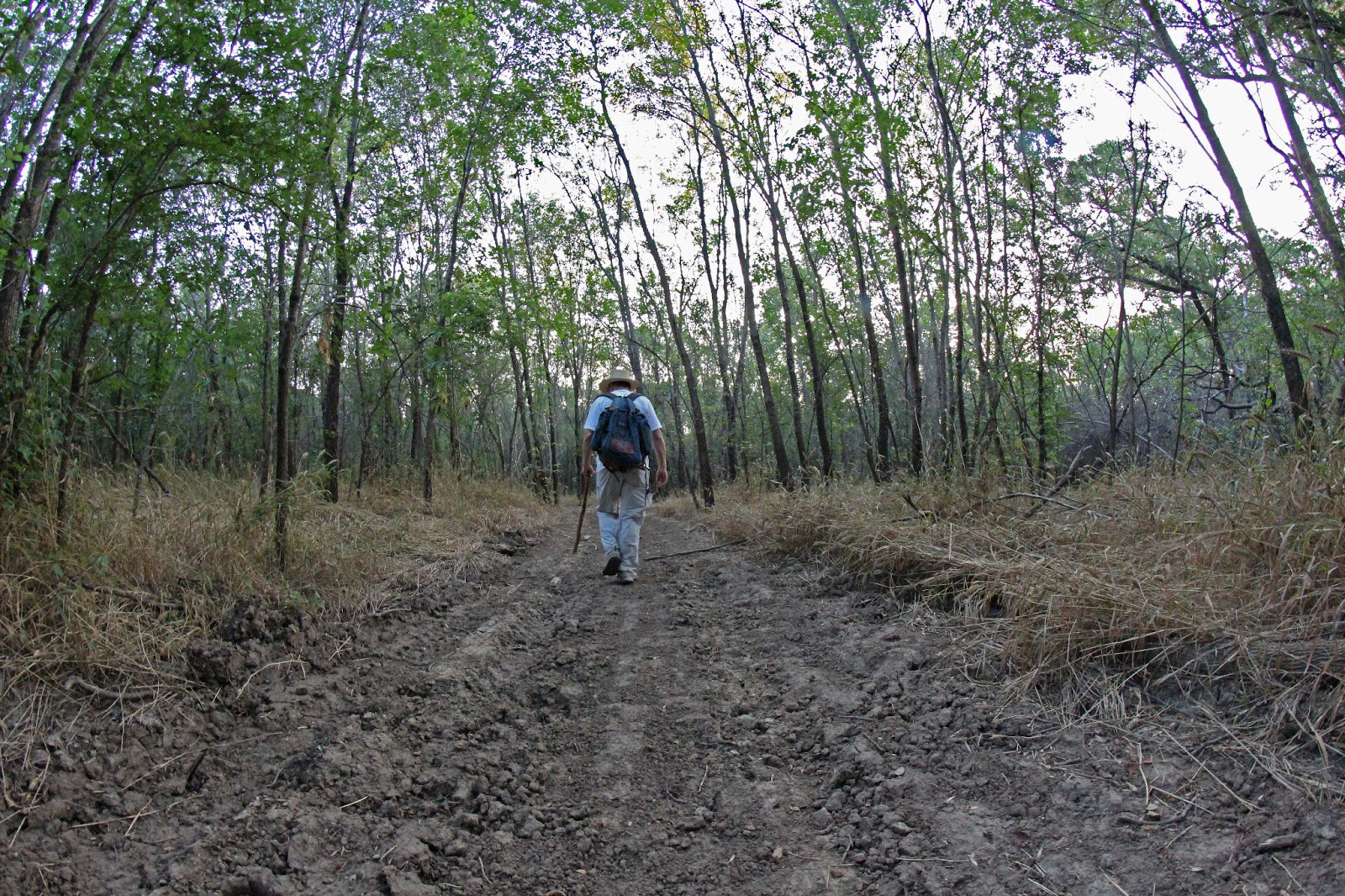
I have visited this area a number of times in the past several years. It is prone to holding water for extended periods of time and can remain very muddy even through dry periods. I would use caution on this trail after rains as the trail surface will be permanently impaired by trail users who do use it in muddy conditions.
Time will tell if the rough cut trail will weather the test of time and periodic flooding of the river. Maybe the oddest thing regarding the trail here is an area with recently purpose planted Dogwood trees. Way out in the middle of nowhere and caged in with chicken wire. Odd choice but what do I know?

 Dog Friendly
 People always ask me where they can take their dogs out hiking in the Great Trinity Forest. This would be high on the list of places to walk with a dog.
Just be mindful of horses out on the trail and yield to those on horseback.
The guys pictured at left were seen near the Lockkeeper's House at McCommas Bluff Lock and Dam #1. They had ridden up from Hutchins and were headed up the river first to Joppa(pronounced "Joppie") and then up to Cadillac Heights.
They were looking for places off the pavement to ride that were easy on their horses and away from any road traffic.
Guys like this really form the soul of the river. The Trinity has one, you know. People who have grown up here, lived their whole lives on the river and know it better than I ever could. They learned the river from the generations before them. It's always fun to learn who they are kin to and where they live.
 |
| The unfinished and sloppily constructed McCommas Bluff gabion that forever ruined the view of McCommas Bluff |
Up A Creek

This section of Trinity River was channelized in the early 1970s to straighten the river in anticipation of ocean going barge traffic for the planned Trinity River Project.
The canal project was a total bust. The river never saw barge traffic in North Texas, the turning basin planned for the Trinity River eventually became the McCommas Bluff Landfill.
Five Mile Creek at one time had a natural channel that once emptied into the Trinity River miles to the north, near Loop 12 and what is now Little Lemmon Lake. Over the last century, the course of the creek was drastically changed to a more southerly course with every revision.
Five Mile Creek's current mouth is an ugly cuss of a place, more of a drainage ditch than a creek revered by so many upstream. Although the creek is now neutered and channelized it still adds a vast amount to the biodiversity of the Great Trinity Forest. The high water floods of Five Mile when coupled with the Trinity River deposit vast amounts of silt onto the Dowdy Ferry Park area making it fertile soil for tree growth. The east bank of the river here has many large Bur Oaks that thrive in bottoms such as this.
 |
| Near the headwaters of Five Mile Creek in southwest Dallas. |

 |
| Biologist David McNeely |
 |
| Historian MC Toyer surveying an upper reach of Five Mile Creek |

The water here has near perfect clarity and has only the thinnest of algae films on the bottom.

With the water so clear, the aquatic life expend an enormous amount of energy in attracting a mate with the coloring of their body. The wild color combinations and patterns rival that of the Painted Buntings further down the creek at the mouth with the Trinity River. The fish colors here are far more brilliant than any fish on White Rock Creek in North Dallas and might only be eclipsed by small populations of isolated fish in Hill Country chalk creeks.
 |
| longear sunfish (Lepomis megalotis) |
One of the most colorful of native Texas fish the Longear Sunfish is so named for an ear flap that is elongated, especially on breeding males, and has a light margin. The back and sides are usually olive to brown, becoming yellowish orange on the venter. Breeding males have numerous metallic blue spots on the back and sides and wavy blue longitudinal lines on the head. The venter becomes brassy orange, as do the interradial membranes on all vertical fins

In the warmer months of spawning season longear sunfish are generally found in shallower, warmer waters near the sources of streams which have pools with a flowing current. They prefer streams with a hard bottom of clay or gravel with clear waters and they usually stay in or near aquatic plants. Although more abundant near the sources of streams, they can be found in streams and rivers of all sizes and are also found in lakes. Compared to other members of the sunfish family, longear sunfish are better at getting food in moving waters than still waters. This may explain why longear sunfish are more abundant in streams than lakes compared to other members of the family. They cannot tolerate cloudy water. Throughout the 20th century their populations have been reduced in areas where their native streams have suffered increased cloudiness.
 |
| Red Shiner, Stoneroller and Mosquitofish |
 |
| Red Shiner Cyprinella lutrensis |
 |
| Green Sunfish Lepomis cyanellus |
Below is a different perspective on Five Mile Creek, an unattended underwater camera left for some time in one of the pools of the creek. In the clip, the Longears, Green Sunfish and minnows all are going about their business.
 |
| Segment of the Five Mile Creek Trail that will eventually connect to the Great Trinity Forest |


