Tuesday, September 10, 2013

Wood Storks On The Rebound -- The Rare Species Returns To The Great Trinity Forest

Wood Storks in Dallas, Texas, photo taken by James Cartwright, August 1936
Some seventy seven years ago, a man named James "Jim" Cartwright took a small camera out fishing with him to an old bow on the Trinity River turned fishing club named Lemmon Lake. Out there one afternoon he took a photo of some strange looking birds that had flown in and were milling about on the grassy shore. Wood Storks. Late last year one of his descended relatives contacted me and I was given some of his old fishing photos from the lake. My interest gravitated to one photo in particular an old scratchy Wood Stork photo dated "August '36 Rod and Gun". That particular bird species in the next few decades would see its very population dwindle to almost nothing and faced the very real threat of extinction.

Wood Storks at Little Lemmon Lake, Joppa Preserve, Great Trinity Forest, Dallas, Texas August 2013

The 97th Meridian slices through North Texas as an imaginary line that exists only on drawn maps. In this locale, that line serves as a freeze/frost line in the winter separating brutal cold from the mild. In the fall the line is marked by great fall foliage to the east and barren brown to the west. In the spring, the great powerful fronts and dry lines rip off the plains to form thunderstorms.

During the summer, the 97th serves as an avian boundary of sorts for many wading birds that are common to the east and rarely if ever seen to the west. This is the time of year when the faint glow of a setting sun is oft punctuated behind the crests of ever rising thunderheads in the distance. In late summer 2013 as the seabreeze laden winds of the Gulf meet the hot winds off West Texas plains, the birds of the tropics find themselves at home in the Great Trinity Forest. The photos shown here were taken in late summer in a couple evenings when the weather quickly turned from sun to clouds to heavy storms and back to clear skies again.

I suppose it comes as a surprise to many that a bird of as rare a feather like the Wood Stork plans a summer vacation stay inside the city limits of Dallas. The record books of sightings of the species in our fair city draw a blank as to the migration of the bird. Not for lack of birds but for lack of perhaps sets of human eyes on the watch for them.

The Great Trinity Forest with its patchwork of wetlands and shallow ponds provides ideal habitat for wading birds. Just perfect. One such place known to attract such birds over the past few years is Joppa Preserve located south of Loop 12 and along the west bank of the Trinity River.

The wildlife laden areas of Joppa Preserve by modern standards is still difficult and remote to reach. The standard first time approach to the place is to clumsily step off the pavement into a mass of greenbriar thicket and poison ivy wondering if you will ever return. With the reward of remoteness to such a place comes the understanding that self-reliance is cornerstone of the visitor experience.

It's the gift of knowledge that surrounds this place. The deep hidden history of a spot. It seems that Dallas only offers parks with less adventure, no aura and no exploration, a quality of it's presence diminished is the product as a result. Joppa Preserve is not a cookie cutter park. It stands alone as one of the last great wild areas of North Texas.

The Wood Storks seen here in Joppa Preserve hail from the Mexican state of Campeche, western Guatemala and points south from there into the Amazon. They fly to Dallas as part of "dispersal" which occurs after their young have finished nesting. They leave the coast and head inland in search of habitat and food.


Wood Stork (Mycteria americana)


Wood storks (Mycteria americana) are large water birds that stand 2-4 feet tall and are the only stork in North America. They have wingspans as wide as 5 1/2 feet. They are mostly white, but have a black tail and many black feathers under their wings. Storks are related to ibises, herons and flamingos. They have no feathers on their head and neck, so the black skin underneath shows. This makes wood storks the only tall water birds with black, bald heads. Since they have no muscles attached to their voice box, they are very quiet birds.

Wood storks use the massive beak as their source of food gathering.  The feed in water no deeper than their beak and catch a variety of things in their bill which they then toss their head back and swallow.  This technique is known as “grope feeding”.  This because the stork does not use vision in food collection, but instead does everything by touch.  The reflex of the bill after it touches food is thought to be the fast of any reflex in the vertebrate world. When it feels a fish, the stork can snap its bill shut in as little as 20 milliseconds—an incredibly quick reaction time.


Below is a video clip shot in August 2013 of a Wood Stork flock working the middle of Little Lemmon Lake for prey

Their diet has been known to consist of fish, crayfish, salamanders, tadpoles, shrimp, frogs, insects and an occasional snake. Storks also use their feet to stir the bottom when collecting prey.  This technique startles the food from the vegetation into the beak. Some think that the water turbulence caused by this action simulates the water movement of a feeding frenzy, and can attract fish to become prey. 


Wood Storks were once hunted for their feathers and have also lost much of their habitat to swamp draining in Florida. In Texas, the Wood Storks migrate north in the early summer from Mexico to take advantage of drying lake beds and the abundance of fish found in them. There have been only a handful of sightings in the DFW area of Wood Storks. Joppa Preserve is special in that so many can be seen at one time. Wood Stork sightings are more numerous further to the south in the Houston and Corpus Christi areas where the habitat lends itself to Wood Stork feeding tactics. 

 A Threatened Species

In late 2012 Endangered Species Status for Wood Storks was downgraded to Threatened in the United States. The birds are given a statewide "Threatened" status in Texas. The Endangered listing applied to Wood Storks who live and breed east of the Mississippi in the Deep South and Florida. Wood Storks are still afforded the protections of Federal Threatened Status here in Texas but since they do not breed here they are given a lesser designation.


Passed in 1973 and reauthorized in 1988, the Endangered Species Act regulates a wide range of activities affecting plants and animals designated as endangered or threatened. By definition, endangered species is an animal or plant listed by regulation as being in danger of extinction. A threatened species is any animal or plant that is likely to become endangered within the foreseeable future. A species must be listed in the Federal Register as endangered or threatened for the provisions of the act to apply.  The Act prohibits the following activities involving endangered species:      

-Importing into or exporting from the United States.
-Taking (includes harassing, harming, pursuing, hunting, shooting, wounding, trapping, killing, capturing, or collecting) within the United States and its territorial seas.     
-Taking on the high seas.    
- Possessing, selling, delivering, carrying, transporting, or shipping any such species unlawfully taken within the United States or on the high seas.     
-Delivering, receiving, carrying, transporting, or shipping in interstate or foreign commerce in the course of a commercial activity.     
-Selling or offering for sale in interstate or foreign commerce
The United States breeding population of the Wood Stork declined from 20,000 pairs in the 1930's to about 10,000 pairs by 1965, and to a low of approximately 5,000 pairs in the mid 1970s.  Nesting primarily occurred in the Florida Everglades. The accepted explanation for the decline of the Wood Stork is the reduction of small fish necessary to support breeding colonies.  This population reduction is attributed to loss of wetland habitat as well as to changes in water hydrology from draining wetlands and changing water flow by constructing canals, levees and gates to alter water routing in southern portions of the United States.

Juvenile Wood Storks seen with tan-yellowish bills
Wood storks have a unique feeding technique and require higher fish concentrations than other wading birds.  Optimal water conditions for the Wood Stork involve periods of flooding, during which prey (fish) populations increase, alternating with drier periods, during which receding water levels concentrate fish at higher densities coinciding with the stork's nesting season.

This year it was rather interesting to see young Wood Storks in large numbers at Little Lemmon Lake. The young birds can be easily spotted by their yellowish-tan light colored beaks.


The Wood Stork , Bald Eagle and many other species of migratory birds owe their current existence in the United States to the determined, last-ditch efforts carried out under this legislative milestone. But attempting to pull species back from the brink of extinction can be an expensive and contentious proposition.  Even today, despite considerable conservation gains in the past few years, many challenges still threaten to drive species away from healthy populations, and onto the endangered species list.

The past half century has borne witness to dramatic changes in the quality and quantity of wildlife habitat. Throughout the United States, Mexico and South America, wetlands continue to be drained and filled, forests cut and fragmented, and grasslands developed for home construction. Many of these changes are not what they appear. While forest and woodland cover in some areas has actually increased, the quality of those habitats compared to the original woodlands may not be similar at all because of changes in vegetation composition and artificially abundant predator populations.  Other less intrusive land use practices have upset the natural balance as well.
As any ornthological minded person knows, some species are exceptionally rare, some are fairly common, and some can be found on almost any visit to the field. The differences one sees in species abundance occur naturally.  Natural events, like weather, predators, disease, and food and habitat availability, have shaped these patterns of species abundance for many centuries. In recent years, however, human activities have disrupted many of those natural events, resulting in a change in the shape of the environment. No place has seen more of that than the Trinity River.

The Trinity River As A Wildlife Highway

Wildlife, both fleet footed and on the fly, use the Trinity River as a main artery of travel from the parched uplands northwest of Fort Worth, clear to Trinity Bay on the Gulf of Mexico. It has likely been that way for hundreds of thousands of years, a route implanted upon the DNA of the species who frequent the river. Wood Storks are most likely no exception to that process.
Wood Storks at Little Lemmon Lake during a heavy thunderstorm

For continued survival of the United States population of wood storks, currently occupied habitat, roosting, and foraging environments must be protected from further loss or degradation.  A prerequisite for complete recovery of the population is the restoration and enhancement of suitable habitat throughout the variety of environments used by this species.

The very survival of the Wood Stork runs through places like Joppa Preserve and the Great Trinity Forest. An unlikely point of concern as so few people alive even know it exists. It has not been much of a going concern since the old Trinity Rod and Gun Club days when Jim Cartwright drowned worms here in the 1930s. Times change though and so do plans for development.
Little Lemmon Lake and Lemmon Lake are but just two of the dozen small ponds and marsh wetland areas in the Great Trinity Forest that give these wading birds forage area for food and habitat. There is grave concern at the moment that the dozen or so water bodies across the Trinity River to the east near the Trinity River Audubon Center will be impacted by a new planned golf course called the Trinity Forest Golf Course.

The AT&T Trail Construction, Habitat Loss For The Wood Stork?


The AT&T Trail construction starts very soon, a concrete trail that will traverse one of the only undeveloped parcels of virgin hardwood bottomland left inside the city limits. It will also cut along the southern bank of "Pond T", what the friendly folks at the Audubon Center call the "Secret Pond". This pond serves as a virtual refuge for dozens of species of not just birds but river otters, beavers and deer. The impact of a new trail will degrade this special spot and have a negative impact on foraging Wood Storks.
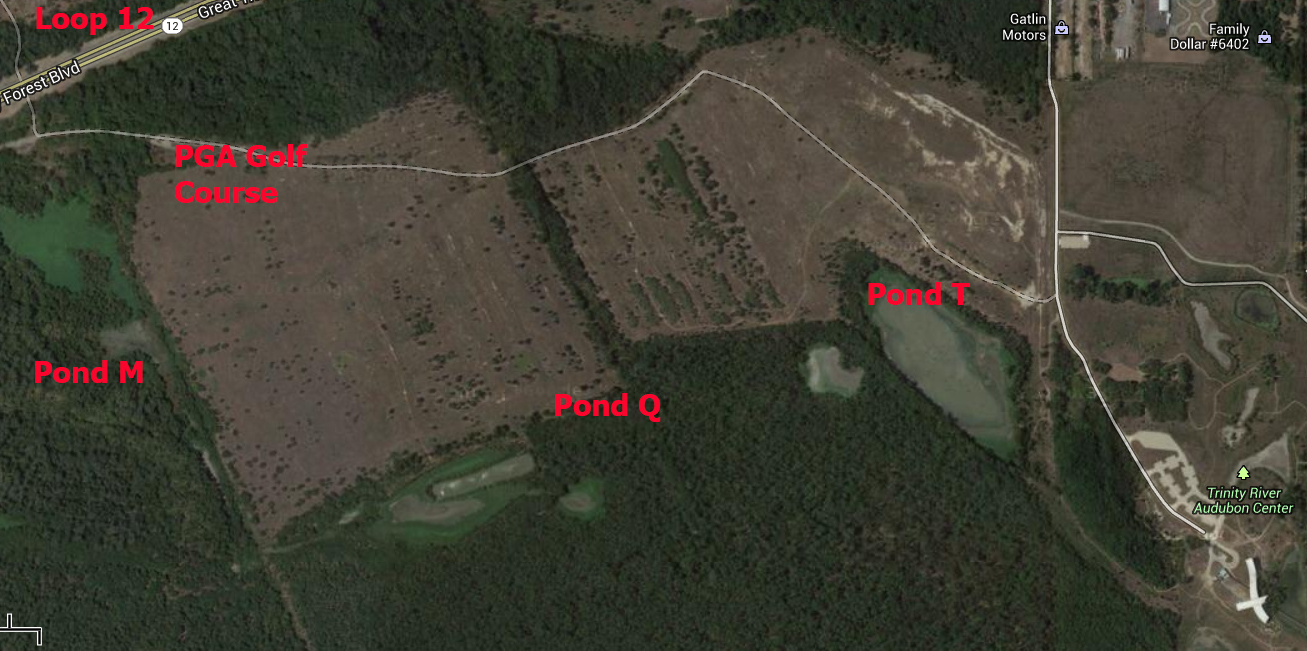
Pond T, aka the "Secret Pond" which is one of many pocket ponds and lakes in the Great Trinity Forest
It seems odd that a place like Dallas would be such a touchstone for the survival of the Wood Stork. These old ponds are just the ideal habitat for them and every year more and more make their way up from the south. How can a trail be built in this area or a golf course developed without impacting the Wood Stork is an answer no one seems to have.

If we use Little Lemmon Lake as an example, the hydrology of such a water body is really unique inside the city limits. The lake sits just low enough so that the annual flooding events of the nearby Trinity River "overbank" into Little Lemmon. The fish, fry and aquatic life from the river regenerate the dry lakebed and transform it from a playa into a small lake teeming with life. As the weather dries and the punishing Texas sun works on evaporating the lake, wading birds flock in by the hundreds.

These are not the birds one might see at White Rock Lake. Sure intermixed are some Great Egrets, a few Herons but the other species are eye popping in diversity. Not seen anywhere else inside the city limits.

Most would stand jaw agape at seeing a Wood Stork ski in to visit with a flock of White Ibis. Just seeing the White Ibis for many would be a treat, watching a Wood Stork interact with them makes it so much more special.

Maybe the problem with the place is no one can take credit for what is going on here. No one can stand on a soapbox and say they are responsible for the habitat here or have somehow enhanced it to attract such wild birds. A freak of a natural place that the hand of man never had anything to do with. Imagine that.
Here the shorebirds, Sandpipers, work the mudflats along the shore with Black-Necked Stilts and Ibis beyond.

Two juvenile White Ibis center, two adult White Ibis on the margins at Little Lemmon Lake
Sandpipers in flight at Little Lemmon Lake
Take for instance the adult Black-Necked Stilt, Himantopus (mexicanus) mexicanus. Males and females are nearly indistinguishable, although the plumage on the backs of some females can be more brown than black in color. Stilts are remarkable because their legs are longer in proportion to their bodies than those of any other bird species except the flamingo.  The North American black-necked stilt is distinguished from the European black-winged stilt by the white spot above its eye. 

Don't see too many of these in Dallas, they often stick to flocks of other species, attracted to the very shallow water so many of them prefer.

Many of the birds here are fresh off the saltwater flats and coasts to the south. On occasion in the right light, the White Ibis can take on a pinkish shade of white, a hue, from the high amounts of saltwater crustaceans they consumed in the weeks before.


Wood Storks, Neotropic Cormorants and a Snowy Egret at Little Lemmon Lake
Hanging on by a fragile thread, the rare places left inside the city limits of Dallas that attract such wildlife seem to be in real peril from planned development. These smallish ponds and drying beds are the real endangered species of note. Oh so rare and important to so many species of birds, the world over, who seek out the water here for habitat. It would be a tremendous loss to the city as a whole, we would all be poorer for it, if the planned development here impacted the wildlife in any way.
Little Lemmon Lake as the storms clear after an evening thunderstorm

Sunday, September 1, 2013

Fireworks Over Dallas -- Megafest Summer Finale Over The Trinity River

Firework shells exploding over the Trinity River September 1, 2013
I suspect many a Dallas resident was bumped out of bed in the wee hours of September 1st 2013 by the rumbling concussion of six inch firework shells. The loud sounds of course were slightly unadvertised and I imagine caught many unaware. The fireworks were associated with the conclusion of Megafest, a conference attended by some 50,000 people from 40 nations organized in large part by TD Jakes pastor of the Potter's House, Joel Osteen and Oprah Winfrey.


Fireworks fired inside the levees with a backdrop of Downtown Dallas are somewhat rare. I imagine it might be another couple years before another one, maybe a dedication event for the yet to be constructed Margaret McDermott Bridge replacement for I-30

Video of Fireworks Show in conjunction with the Megafest Conference in Dallas Texas, midnight hour September 1, 2013, in the Trinity River Bottoms


The venue for the fireworks was Trammell Crow Park on the Trinity River. Located on the north bank of the Trinity River between the Sylvan Avenue and Continental Ave Bridges in Dallas. Currently, both bridges are closed for construction making the once popular Trammell Crow Park an isolated and hard to reach place. You cannot drive there. It's either a very long walk or mountain bike ride in. Travel by bicycle really is the best way to get around down here. Without worry of where to park, one can easily travel along the levees and floodway without fanfare.
A Black Crowned Night Heron hunting in the reflection of Reunion Tower's lit ball

Filling the void of an empty park are the native wildlife who seem to always take advantage of less peopled areas on the Trinity River. The ponds, shallow pools and occasional flood waters of the Trinity River in this area afford wading birds a great place to feed. Seen in the photos here are birds of the night, the Black Crowned Night Herons. With large eyes and a low profile, they agitate the mud drawing prey to the surface.

The mile distant Reunion Tower provides an ever changing color reflection on the water here, making for an interesting backdrop.
Great Egret and Mallard Duck in the night light reflection of Trammell Crow Park, Dallas Texas


 The Megafest Firework Show In Dallas Labor Day Weekend
Large exploding shells rattle the early morning

The fireworks were billed as a finale to an 8pm-10pm concert at the American Airlines Center. The pyrotechnics were planned to start at 10-10:30pm. Given the circumstances, dependent on the conclusion of a concert the fireworks did not start till after 12:30am.


 The brief show lasted under ten minutes. It had a variety of shells and a parachute shell of some variety that slowing drifted north with the slight southerly breeze.


Friday, August 23, 2013

A Renewed Plan for a Trinity River Trail Downtown -- Into The Wild With The Downtown Dallas Coyotes

Coyotes hunting rabbits under the Continental Street Viaduct near Downtown Dallas, August 21, 2013


It's a scene out of rural Texas. A coyote jump-hunting cottontail rabbits on a sun-soaked evening as the sun begins to set. A predator versus prey game that plays out countless times in a day across the state.

The work done here by the coyotes is one of pride and pleasure. You can see the smile on their faces as they jump from one clump of grass to another rousting a hiding rabbit from one hiding spot to the next.

The pancake flat grassland here is not one of a far flung rural farm, it sits in the heart of Dallas within view of the Old Red Dallas County Courthouse and almost underneath the Margaret Hunt Hill and Continental Street Bridges.
Coyote bounding through high grass in the foreground, the old silver and red silos near Trinity Groves loom in the background

Coyotes are highly adaptable and can survive in urban areas as long as food and shelter requirements are met.  In urban areas coyotes will feed on almost anything including garbage, pet food, small cats and dogs, and other wild animals such as rodents, skunks, raccoons and birds.  Coyotes typically hunt alone, however they may hunt in groups when food is abundant. 

These particular coyotes have been here a number of years. I can recall the night shift watchmen during the Margaret Hunt Hill Bridge construction comment on the coyotes who casually made their rounds in the evenings. The coyotes have learned that the day shift of construction workers would toss their lunch scraps around the job sites under the bridges. The coyotes here patrol the sites in the early evenings, going from one work site to the next.
A coyote trotting along a newly cut dirt road and proposed new hike and bike trail alignment between the Sylvan Avenue and Continental Street Viaduct
Coyotes sightings this close to Downtown Dallas are rare only because so few visit the area.  In areas where they are hunted and trapped, coyotes are extremely wary of humans.  However, in urban areas where they are less likely to be harmed and more likely to dis-associate people with danger, they simply give humans a wide berth.


Busy bee with the Margaret Hunt Hill Bridge arch in the background
Coyote attacks are extremely rare.  In recorded history only 30 coyote attacks on humans have been recorded.  Three million children are bitten by dogs each year. A child is millions of times more likely to get attacked by the family pet than a coyote.  The vast majority of coyote attacks in the United States are the result of a coyote attacking a small dog or cat and the pet’s owner trying to stop the attack by getting between the animals.  When the pet’s owner gets between the animals, the coyote will bite the pet’s owner.

You are more likely to get attacked by a swarm of killer bees than bitten by a coyote.


2013's Renewed Promise of a Trinity River Trail in Downtown

Coyote yipping for her mate in a sea of grass
Coyote meandering towards the new Sylvan Avenue Bridge Project

The look of open fields and a sea of grass might look different in the near future. Just this past week there was news from City Hall of a renewed promise for building trails inside the levees near Downtown Dallas. More can be read about the details in an article by Robert Wilonsky in the Dallas Morning News here: http://cityhallblog.dallasnews.com/2013/08/dallas-has-a-new-alignment-for-long-planned-trail-along-the-trinity-river-and-now-it-actually-runs-along-the-river.html/

The coyote, seen at right is standing on the proposed route, it is standing near the lip of the Pavaho Pump Station outlet canal and where the proposed route according to the Dallas Morning News Map would run.


Currently a dirt road already exists, cut late this spring that serves some unknown utilitarian purpose. Most likely in bridge construction or pipeline maintenance of some sort.

Quite a few people ride the new dirt roads down here. They are 90 degree, perpendicular off-shoots to the older levee roads and give a unique perspective to the river.
New gravel culvert and road west of the Continental Viaduct


One of the gripes of the levee road access is that it never gets you to the river. Separated hundreds of yards from the trees and river bank, the river itself always seems like a distant mirage.
View from the Continental Street Viaduct looking west with the proposed trail alignment as seen currently as a dirt road
Potential view from the proposed alignment of the new trail
The 2011 Trail Idea
This is not the first try at a trail between the levees. Many may recall a plan headed up this time of year in 2011 by city councilpeople Angela Hunt and Scott Griggs. Their simple idea was to build soft surface trails near Downtown Dallas inside the floodway.

Known as the Trinity Trail Project, it actually became a reality for a short time. The details of that are here http://teambetterblock.com/blog/2011/08/26/trinity-trail-project/. I actually rode the miles of trails cut inside the levees. That was a well thought out and unfortunately temporary path. I think those involved in that effort can see the fingerprints of their hard work in the new project. The local mountain bike group DORBA purchased a tow behind mower for that project, one that was never used. It is headed to two new projects on the Trinity River at Goat Island Preserve and Riverbend Preserve in Southern Dallas County. Those new trails, will use that mower than never saw use between the levees.

 The 2012 Trail Idea

Where the sidewalk ends. The west end of the concrete trail/road poured in the fall of 2012 that stretches from I-35 to the Trinity River Standing Wave and Trestle Trail
 In late October of 2012 a concrete bike trail, technically a road, was built from near the Corinth DART Station at the Santa Fe Trestle Trail due west along the base of the levee stopping just east of the I-35 Bridge. Taking only a week to build, this ribbon of concrete replaced a dirt access road.

As seen in the Fall of 2012, the recently paved section of the concrete trail-maintenance road with the Corinth Street Viaduct in the background
 Lots Of Construction -- Lots Of Bridge Work

Drilling piers for the new Margaret McDermott Bridge August 21, 2013
I guess the trick is how all these new trails can be built with years of upcoming bridge work and construction. Currently, in the summer of 2013, the bridge work for the I-30 replacement bridge, the Margaret McDermott Bridge.
Rendering of the Margaret McDermott Bridge
Margaret Hunt Hill Bridge, August 2013
When the first Santiago Calatrava Bridge was under construction, access anywhere nearby was quite difficult due to the large construction footprint. I imagine that the new Calatrava bridge might even be larger in scope due to the width of the I-30 replacement.


Given the number of construction vehicles, concrete trucks and semis trying to make the grade in and out of the levees, it was a real trick to navigate it on a bike.

With so many bridges currently under construction, closed for repairs or having trolley tracks installed, riding from the north side of the Trinity to the south on a bike is a real pickle at the moment. 


Houston Street Viaduct being retrofitted for a trolley line serving Oak Cliff
Piles of brand new trolley rails stacked along the Houston Street-Zang Blvd connection in Oak Cliff
The Houston Street Viaduct, Continental Street Viaduct and Sylvan Avenue Bridges have long been the most well traveled routes for cyclists and runners between Downtown Dallas and Oak Cliff. Presently all are closed. That requires using a makeshift lane on the Jefferson Street Viaduct to cross the river. Access from that bridge is somewhat limited to the river levee trails itself, requiring a double back on a closed road at the moment. Hopefully that improves soon with the winter 2014 opening of the Sylvan Avenue Bridge.

Full moon crowning the Margaret Hunt Hill Bridge as seen from the levee, August 21, 2013

Sunday, August 18, 2013

Big Boy Locomotive Stops In Dallas Great Trinity Forest

Union Pacific Big Boy 4018 along the railroad tracks near Rochester Park that serve as the western boundary of the Great Trinity Forest
For almost fifty years the one million pound plus Big Boy 4018 locomotive stood as a silent and immovable monument in Fair Park. Fifty years of Texas-OU Weekends, Cotton Bowls and concerts it stood in stoic silence. That changed August 18, 2013 as it began a 50+ mile journey from Fair Park in Dallas, Texas to a new home in Frisco, Texas.

The first five miles of the journey took it down the western edge of the Great Trinity Forest through Dixon Circle Park, Rochester Park and within view of the Buckeye Trail. For a few hours on a bright Sunday afternoon, Big Boy sat among the trees, a view not seen for decades.
4018 Big Boy in Dallas Texas near White Rock Creek awaiting clearance to continue to the Bon Ton neighborhood August 18, 2013
As a non-revenue producing trip for the railroads, the revenue producing freight trains and even Amtrak passenger trains were given priority over the 4018 move. That caused a series of delays in what turned out to be a rather photogenic if hidden spot among the trees and White Rock Creek. Thousands of people lined the route from Scyene through Rochester Park, BonTon, Lamar and Corinth crossings.

Rear axle of 4018 Big Boy shimmed above the track
With such a large and heavy locomotive, turns and Y junctions are nearly impossible. The only way to accomplish the trip was to raise the rear axle of 4018 until it had passed some distance towards Downtown Dallas where the rails did not have abrupt turns and Y junctions.


The Big Boy locomotives are some of the largest locomotives ever built. Often called the last of the big freight locomotives, Union Pacific built 25 of the Big Boys in the early 1940s. Alco, the American Locomotive Company developed the colossus with a 4-8-8-4 wheel arrangement, a service weight over 500 tons and a length of almost 132 feet . This giant was known respectfully as "Big Boy" and the name stuck, becoming the symbol of the world's largest steam locomotive. Without the tender, the Big Boy had the longest engine body of any reciprocating steam powered locomotive.

The locomotives were designed to haul coal mostly over the mountains in Wyoming and Utah. They remained in service in Utah and Wyoming for two decades and each one nearly racked up over one million miles in their lifetime.

#4018

Only 8 of the 25 Big Boy locomotives remain. 4018, the locomotive seen here was built in December 1941 and saw service for decades in Wyoming and the Green River Valley. It burned the same low grade coal it hauled making fueling the massive locomotive an easy task.

4018 was decommissioned in 1962 and donated to Fair Park in 1964. The route it took to Dallas was through Wyoming, Missouri and then into Dallas via the Santa Fe Railroad. That final section is now the Santa Fe Trail in East Dallas between White Rock Lake and Fair Park.