Sunday, November 17, 2013

Honey Springs on the Trinity River -- Off The Beaten Path

Honey Springs Branch, Historic Joppa Freedman's Community, Dallas, Texas

The big rambling farmhouses that once commanded the views of this place were the focal points of now long gone pioneer family homesteads. Far ranging in scope and size, the Miller and Overton farms dominated this part of Texas for the latter half of the 19th Century. Reliable water was always a draw for early Texas settlers and the creeks and springs that dominate much of Oak Cliff and South Dallas served as a focal point.

Honey Springs was one such place, a complex story of water that is an interwoven yarn with the history of Texas itself. An underdeveloped ethos runs through this place that has allowed for small pockets of the once heralded Honey Springs to remain in a natural state.

Green Heron at the mouth of Honey Springs Branch and Wetland Cell G in the Chain of Wetlands, Great Trinity Forest
The lure of finding the actual springs themselves started with the mouth of Honey Springs Branch where it enters Wetland Cell G at the Chain of Wetlands, just north of Loop 12 in an area called the Great Trinity Forest.

Be forewarned that the point blank, hard playing, hard living lives of the people here never vanished. The rough and tumble range fights with Texas Rangers and Indians over this very land might be trumped by the contemporary violence that is still seen today.

Honey Springs

The foggy and complex human history of this place tends to cloud what is one of the best looking little creeks in Dallas. The hickory, walnut and pecan grow tall in here beyond the backbrush of the formal riverbottom.

The confusion of where the historic flow of the spring was once sourced stumped the best of them. 

Author Gunnar Brune wrote an encyclopedic account of natural springs and seeps in Texas based first on work done in the 1970s and later published in a stand alone guide that commands a king's ransom on Amazon. The couple thousand dollars for your own copy might be worth the expense if one were interested in tracking down some of the more obscure springs of the Lone Star State.

The book misses the mark when it comes to Honey Springs. It lists the source of Honey Springs as a spot near the Lisbon Cemetery in the former pioneer settlement that goes by the same name near Mentor and Gracey streets, a stone's throw from the VA Hospital.

Fair enough. It's a hard place to find. The deep history of this place goes back many generations but no one ever saw fit to put pen-to-paper writing it for posterity. Much of the happenings here were taken to the graves of the witnesses to it. The seemingly mundane hauling, plowing, fixing and mending of things left the place a century ago and now most likely will never have another voice to tell what went on here.

The real location of Honey Springs cuts through the community of Joppa (pronounced Joppie by locals) who claim the left bank of the Trinity as their own. The tinge of old campfire smoke still permeates this place. With the onset of autumn many residents use wood to heat food and stay warm.
A vacant lot in the Freedman's Community of Joppa under a half moon lit time exposure at night. November 2013
A tough nut to crack if you want to befriend folks in Joppa. Joppa's cornerstones remain as they were founded. Self-sufficency, and fidelity to family and community. They are slower to warm to a stranger than a cold pot of beans on coals. Once they get some trust in you, they are your best friends. Their proclivities get them slant wise with code inspectors or the local SPCA chapter from time to time, often when the rains don't come and the price of hay skyrockets. I most likely came to know many when the drought of 2011 hit the small family ranchettes here and the inability to source hay.

Springs of Texas notation on the Battle Axe found at Honey Springs
The name Honey Springs was first uttered most likely in some long forgotten Caddoan language of the Native Americans. Like many springs in Dallas County, the surrounding land was used for centuries by Native Americans dating back thousands of years. Honey Springs and a couple smaller creeks had many thousands of Native American artifacts recovered from their banks in the 19th century, evidence of a long lived population in this area.  Those cultural splendors were lost to gravel mining in what were suredly vast into the reaches of history and time.

The oldest historic artifact that can be linked to Europeans in this area was a metal battle axe consistent with Spanish exploration in Texas. The provenance of the axe was never linked to any expedition. The notation of the find is listed in Gunnar Brune's book as seen above in the passage.

The De Soto expedition was the first group of Europeans to explore this part of Texas in the 16th century. Led by Luis de Moscoso de Alvarado, the Native Americans the Spanish encountered here in North Texas spoke Caddoan and were called Canohatino by the French trappers pushing north along the Red River in the 17th century. It is believed this group eventually absorbed into the greater Confederacy of Caddo speaking groups (Yojuane, Kichai, Tawakoni, Taovayas, Iscani and Wichita). This Caddo group is what lived in North Texas through the late 18th century.

Wood Ducks in Honey Springs Branch
Mallards
From the late 18th Century onward, North Texas was invaded by the Apache and Comanche. By 1660 both tribes had horses and expanded their range into North Texas. The Comanche were a Shoshonean group originally residing along the Upper Yellowstone and Platte Rivers. Beginning in the early 18th century they began a southern migration into the Great Plains. Here they drove a wedge between the Apache in the west and the Wichita to the east. By the early 1800's the Comanche Nation stretched as far south as Austin, west to Raton Pass and east to Texarkana. Feared but few in number any Comanche history here was written in the blink of an eye. The real history is that of the Caddoan people who lived along the creeks here for many generations.

The Native Americans to this area were always quick to show visitors the spring here in what is now South Dallas, a place known for good reliable water and large numbers of hollowed out trees with honey bearing beehives.

Honey Springs on a circa 1920 map
Honey Springs is near the junction of the Missouri, Kansas, and Texas railroad tracks and Honey Springs Branch, about five miles south of Dallas. Dugald McFarland was the original grantee of the land grant. The first settlers to remain in the area arrived with William Perry Overton from Virginia in 1844. Indians pointed out the two springs and abundance of wild honey in the area, and the settlers named their community Honey Springs.  No organized township existed at the site until 1886, when the Missouri, Kansas and Texas Railroad came through Honey Springs. A section house was built there, which became known as Honey Springs Station. Honey Springs received mail from Lisbon, three miles west. Outgoing mail was hung on a pole for the conductor to grab as the train went by, and the incoming mail pouch was thrown from the train. Honey Springs had a population of fifteen in 1910. In 1937 Honey Springs voted to incorporate in order to avoid annexation by Dallas. In February 1946 the town voted to dissolve its corporation, and on December 18, 1946, Honey Springs was annexed to Dallas.

Bees are still attracted to Honey Springs Branch. Here at the mouth of where Honey Springs Branch flows into Wetland Cell G, the Corps of Engineers has planted American Lotus also known as Water Chinquapin.

American Lotus was a mainstay of Indians in the Americas and it is basically found east and south of the Rockies plus California. While the root, shoots, flowers and young  seeds are edible, it was the root the Indians counted on to get them through the winter.  The popularity of the Nelumbo lutea no doubt has also led to its many common names: Yellow Water Lotus, Yellow Lotus, Alligator Buttons, Duck Acorns, Water Chinquapin, Yonkapin, Yockernut and Pondnut. Many of them refers to the plant’s round, dark brown, half-inch seeds. Even its name is about the seed. Nelumbo is Ceylonese and means “sacred bean.” Lutea is Latin for yellow.
Bees at the mouth of Honey Springs gathering the pollen from an American Lotus
The Water Chinquapin is not a day lily, it is a two-day flower, the blossoms open one day, close for one night, open the second day then the petals drop off. The center of the flower grows and gets about three-inches big. It develops a seed pod with around 20 seeds and looks like a shower head.
Acorn size seeds inside the seed pods of a Water Chinquapin at the mouth of Honey Springs

The deep water of the Chain of Wetlands, keeps nearly all wading birds from feeding in the cells themselves. Forced to the margins one of the only places they can stalk prey is the shallow mouth of Honey Springs Branch and Cell G. Here at the mouth with a prominent beaver lodge, birds like the Green Heron can fish with relative ease.
Green Heron perched on a beaver lodge at the mouth of Honey Springs Branch
The Green Heron is sometimes called the Green-Backed heron. It is a smallish heron that is about the size of a large crow. It is a foot and a half to two feet in length. The green heron has a dark head with a small black crest. Its back and wings are dark gray-green to dark gray-blue. Its neck is rust colored. It has a dark bill and its legs are orange or yellow.
Green Heron

Although secretive and skulking while creeping slowly through its wetland habitat, the Green Heron (Butorides virescens) is actually one of North America’s most recognizable wetland birds. Difficult to approach, these Green Heron photos were taken early in the evening approaching with the sun in the eyes of the bird and utilizing the streambed of Honey Springs as concealment. Crawling on hands and knees through the muck helped get low for the depth of field afforded by the unique stand of lotus in this spot.

American Wigeon male
The natural course of Honey Springs originally entered the Trinity south of Loop 12. Over the decades with agricultural development, a golf course and then Loop 12's embankment, Honey Springs was forced into some strange alignments before finding where it enters the wetlands today.
Members of the Trinity River Rod and Gun Club with Dallas Police Department at Little Lemmon Lake during the filming of the movie Bonnie and Clyde
That constant water supply was a vital component to the success of the Trinity River Rod and Gun Club and their waterbodies, Little Lemmon and Lemmon Lakes that stretched from present day Loop 12 down to Simpson Stuart Road. Above is a photo of Dallas Police officers both uniformed and in costume along with Trinity River Rod and Gun Club members at Little Lemmon Lake during the filming of the movie Bonnie and Clyde. Photo is looking north with Little Lemmon Lake just beyond the trees.
Wood Ducks in Honey Springs
Overtons and Millers

William Brown Miller
The meandering creek bed takes twists and turns here up through the ash and oak to Joppa. It's a spot of tangled wilderness that unties shoelaces and trip hazards underfoot as one heads up the rise. During the summer months the buntings and dicksissels sing at the edge of the taller trees here. In the winter, the bare trees are primed hunting roosts of hawks and kestrels. Setting off through the high grass and occasional Ironweed will take you into the deep wooded thickets and onto land once owned by the Overton and Miller Families.

North Carolina native William Overton came to settle this land in 1844 and was one of the first pioneers to settle the west bank of the Trinity River. Originally, he was granted the land along Turtle Creek in the area around present day Uptown. He left Texas for a time during the '49 California gold rush and upon return to Dallas swapped a family member his Turtle Creek land for that around Honey Springs.

Willam Brown Miller was one of the original pioneers to settle this part of Dallas County. Born in Madison County Kentucky in 1807 Miller was the second of seven children born to John and Mary (Brown) Miller, native of Kentucky. In 1834 he began a dry goods business in Alabama. It failed in 1836, he moved to Tennessee to farm for ten years. In 1847 he moved to Dallas County, purchasing 562 acres and building a home on the Van Cleave Survey.


American Wigeon male
At the conclusion of the Civil War, Dallas still lacked a railroad or a navigable river for commerce. With very few formal bridges of any kind over the Trinity, ferry crossings were important to the lifeblood of Dallas. Everything had to be hauled overland by oxen pulled wagons or horse teams. An early goal of the Dallas business community was to gain water transport along the Trinity River.

19th Century ferry crossing on the Trinity River
The problems associated with this effort included fluctuations of the river and the many snags that infested the channel. The first effort in this respect came in 1866, when the legislature chartered the Trinity Slack Water Navigation Company to provide improvements required for navigation from Galveston to Dallas. The company never started work on the project. That same year Miller formally chartered his own overland ferry enterprise on the Trinity River, the Honey Springs Navigation Company and the Honey Springs Ferry Company.


American Wigeon female
In October 1866, William Miller formed the Honey Springs Ferry Company. Below is a copy of the company's article of incorporation which was created during the first Texas Legislature under Reconstruction.
Incorporation document for Honey Springs Ferry Company
It was not by chance that the first  railroad in Dallas passed this way, William Miller had much to do with it. The act of incorporation for the Galveston and Red River Railroad which was its original name authorized it to reach the Red River from the south by any route necessary to Coffee's station(near current day Denison). Some tentative plans would have passed it many miles east of Dallas. Advocates of the Dallas route finally won. William Miller at the time held $50,000 in the railroad stock which probably swayed the vote. He also donated $5,000 worth of his own land for right of way to entice the rail line to be built through Dallas.

Grave of Albert Conner, founder of the Honey Springs Cemetery

After the Civil War, Miller's Ferry was a vital crossing point. Tying together Dallas, Hutchins, Corsicana and Galveston. Lying east of the Austin Road, Miller's Ferry was an important shipping road to reach the coast, East Texas lumber and coal seams near Corsicana. It was a cash cow of an operation and was the lifeline of the Dallas economy until the railroads reached Dallas in the 1870s.   An important crossing such as this needed the best men to run it. With high unemployment after the war and relative stagnation of the economy, William Miller could have chosen one of a thousand capable men to oversee his ferry operation. The man Miller handpicked was Henry Critz Hines. Really it was more of a business agreement among men who viewed each other as equals. As a result, Hines became one of the first African American entrepreneurs after the Civil War. Not just in Dallas or Texas or even in the South. In the whole of the United States. In addition, you will find very few freed slaves who so soon after the war were able to make a living from a customer base that was largely anglo.  Henry Critz Hines also founded Joppa, one of the best preserved, if not the best preserved Freedmen's communities left in the United States.
At Honey Springs Cemetery. The child in the t-shirt with the yellow number 6 and his taller brother in the SMU shirt are both Hines descendants.
 Joppa was founded in 1872 by Hines and freed slaves from the Miller Plantation. Here they carved trees out of the forest for cabins at first, replaced by shotgun houses, some of which are still standing today. Many of the original Joppa residents were freedmen who immigrated from East Texas plantations. The attraction of Joppa was the safety of living near a large town like Dallas while maintaining the agrarian lifestyle they knew from earlier times. Other freedmen communities in Dallas such as Deep Ellum and State-Thomas had residents more comfortable with city life.


Honey Springs Cemetery

The Honey Springs Cemetery sits on Bulova Street on the old Overton farm. It's a quiet place buffered by high privet brush on 3 sides with a grove of Post Oaks running southeast to northwest towards the railroad tracks. The current cemetery was once a parceled lot of the Coming Home Cemetery aka Homecoming Cemetery and Honey Springs Cemetery. Seems that reading through some of the plots here that the cemetery while African American in nature divided itself into where one resided. Honey Springs for those in Joppa and Homecoming Cemetery for those living on the north side of the river.

Personal sacrifice went into the lives buried in this hallowed ground. Like those first freedmen who settled here, Joppa's cornerstones remain as they were founded. A pride in family and community. The broad brush strokes painted by many outsiders to South Dallas lump the bad with the good. Many of the residents down here have carved themselves out a place in the world to call home. A quiet but proud neighborhood, cut off from most of the metropolis that surrounds it.

Red Shouldered Hawk perched at Wetland Cell G, looking for a meal, treeline of Joppa in the distance, Honey Springs


That quiet life for many in Joppa allows the wildlife just beyond the treelines to slowly rebound. As the leaves of autumn begin to fall and the first patchy frosts nip at the edges of the woods many of the winged predators down here stalk their prey.

This common forest-dwelling hawk is often seen soaring and calling loudly and repeatedly. It may be the most vocal of American hawks, but since a Blue Jay can imitate a Red-shouldered Hawk remarkably well, care must be used when identifying this bird by voice alone.
Red Shouldered Hawk carefully stalking a meal
This hawk generally hunts from a perch, waiting for its prey to reveal itself, and then swooping down to snatch it from the ground or water surface. The Red-shouldered Hawk is found in woodlands near water in the eastern half of the United States.

Here after a brief evening storm a very wet Red Shouldered Hawk carefully walks the edges of Wetland Cell G tip-toeing through the short grass in a very deliberate manner playing a careful game of catch.

Who has who. A Red Shouldered Hawk's attempt at catching a crayfish has the bird being caught by large crustacean claws
Eating crayfish

Red-shouldered Hawks eat mostly small varmits, lizards, snakes, and amphibians. They can be found hunting from perches below the Great Trinity Forest canopy or at the edge of a pond, sitting silently until they sight their prey below. Then they descend swiftly, gliding and snatching a vole or chipmunk off the forest floor. They also eat toads, snakes, and as seen here crayfish.


Crayfish, most likely sent into the grass after the heavy rains just minutes before were taken down by a dozen by the hawk that evening. One after the other, carefully stalked and eaten. A learned trait by the hawk no doubt. A rare treat to see such a thing.

Tuesday, November 5, 2013

Trinity River Project Chain of Wetlands -- American White Pelicans and Waterfowl On The Fly

American White Pelican at the Trinity River Wetland Cells, Dallas Texas, November 2013

As the days grow shorter and the temperature begins to drop the chain of wetland cells in South Dallas often host a random mix of feathered visitors from afar. The Trinity River makes a gradual bend here, a slow graceful bow as it picks up the mouth of White Rock Creek and several unnamed tributary creeks that drain the old communities of Joppa, Pemberton Hill and Fruitdale.

The mouths of these tributaries harbor ancient stands of trees for which no man ever saw any use. As a result those trees now tower far above the traditional second growth woods of ash and pioneer species that dominate much of what is called the Great Trinity Forest. Roosted by Wood Storks in the summers and Cormorants in the winter, these trees serve a vital function as wildlife habitat.

Roseate Spoonbills and Avocets, Little Lemmon Lake, November 2013
The steep channel of the Trinity and the muddy banks here are a mere sideshow attraction compared to the wildlife using the wetlands above. 

November is a transition month for wildlife in the Great Trinity Forest. The land based animals shed their noctural activity and can often be seen in broad daylight. The whitetail deer enter their customary fall rut, the feral pigs openly forage under the pecans and walnut trees along the river.

Most interesting though is the changing of the guard with the bird life on the river. Even if you are not ornthologically inclined, the random birds down here can often combine to stump novice and schooled scholar alike. The mix of Roseate Spoonbills from Central America with American White Pelicans from the Grand Tetons in the same pond together really shows Dallas as a brief crossroads of bird migration.


Pelicans landing at the base of Old Central Expressway Wetland Cell E; I-45 traffic seen beyond


It was a cold summer for the Northern Plains in the United States this year. Those cold temperatures delayed the nesting season of northern ducks by many weeks according to the experts. As a result, eggs were laid later than normal and duckings were slow on the calendar to mature. As of early November many of the over-wintering birds customary to the Chain of Wetlands are still filtering through the Great Plains.
Male Northern Shoveler in non-breeding plumage November 2013
In years past, the majority of male Northern Shovelers would already be sporting their robust breeding plumage. This year very few have their colors grown in. Nor are they in North Texas to any degree.
Pre-dawn light at the Chain of Wetlands, Freedman's town of Joppa to the left, Trinity River to the right. Cell F seen in photo

Dallas Floodway Extension and the Chain of Wetlands

The Chain of Wetlands is a $120 million dollar project funded with roughly $25 million in funds from the 1998 Trinity River Project bonds and $90 million dollars in federal funding.

The Lower Chain of Wetlands consist of ponds D, E, F and G. The ponds were constructed downstream of the Central Wastewater Treatment Plant and stretch from roughly I-45 to Loop 12.

E, F and G are shown at left with yellow lines representing dirt roads that criss-cross the cells.

In theory the wetlands are designed to reduce water surface height within the river bottom by adding over banking capacity along the west side of the Trinity River from the north end of the Cadillac Heights neighborhood to Loop 12.

Access to the Wetland Cells is easy. One can park at the Loop 12 Boat Ramp lot on Great Trinity Forest Way. Then walk up the embankment of the divided road, entering the Wetland Cells via the old Sleepy Hollow Country Club parking lot. Currently the gate is broken at the Sleepy Hollow entrance, the weld failed on the padlocking portion of the gate. Speaking with the city, they decided to allow access to the Wetlands via the large parking lot. Naturally, without barricades to prevent further access it has become a 4x4 offroad venue of sorts.


Many of the vehicles over the course of a few high speeds laps start as brand new vehicles and are quickly reduced to piles of junk, suggesting they are stolen. I could imagine very few owners of new GMC Yukons would drive 40-60mph down dirt roads and taking liberties with sending it airborne. Watch your back if you are on foot or on a mountain bike out there as the vehicles are not expecting foot traffic.

The other parking option is in the Freedman's Town of Joppa, where Fellows Lane dead-ends at a bar gate. Like the bar gate near Loop 12(Great Trinity Forest Way) this entrance has also been undermined to some degree. Though the gate is locked, one can navigate through the vacant lot to the west and then into the Wetland Cell 4x4 roads. This footprint of vacant lots will eventually become a gateway park for Joppa into the Wetland Cells.


Best time of day to see birds, universally, is at dawn. If you can get down into their habitat before they awake for the day, the chances of having some quality time with birds dramatically increases. The 4x4 vehicle antics drive the birds away later in the day, morning is the best time to see them here.

Mallards at Wetland Cell G
Blessed with frequent fall rains and prolonged muddy conditions, travel through the chain of wetlands impaired vehicle access which allowed the birds in late October and early November to really load up in the more secluded areas of Cells E and F.
Master Naturalist Bill Holston and Scott Hudson watching hundreds of Cormorants fly over Cell F

Some of the most inaccessible areas in the Chain of Wetlands feature towering cottonwoods that line a stretch of river near the mouth of White Rock Creek. In the autumn, hundreds of migrating Cormorants roost in the trees there. If one gets down into the wetland cells at dawn, you can watch the spectacle of them leaving for the day en masse.

In the early morning the area is quiet enough to hear the beating wings of a hundred Cormorants over head, a methodical beating unlike anything else. Many visitors to White Rock Lake a few miles to the north can see something similar but the noise of the birds is all but drowned by the noise of the city.

American White Pelicans in Cell F
The stars of the show on such a crisp morning are of course the pelicans. Seen above preening and preparing for a morning of fishing. The social birds are very well organized and use large family groups and pods to form feeding parties.

From a great distance one can view the large birds. No need to crowd them as they afford descent sighting at long range.

The best approach to watch feeding birds like this, is no approach at all. Find a good spot with the sun at your back and let the birds come to you.

American White Pelicans in the Chain of Wetlands
American White Pelican

The American White Pelican Pelecanus erythrorhynchos is one of the largest birds in North America. It is second only to the Trumpeter Swan in overall height and second only to the California Condor in wingspan. Some of these pelicans have wingspans of 9 feet making them battleship size birds of the sky that rapidly fill a camera viewfinder.

American White Pelicans fly gracefully, spreading their wings and sliding onto the water on their feet as they land. Flight is usually in linear formations or forming a "V." They flap and glide and may soar on days when they can take advantage of updrafts.

American white pelicans don't dive, as do their relatives, brown pelicans, but they are strong swimmers and have subcutaneous air sacs in the region of their breast that give them buoyancy. They are gregarious birds, always found roosting, nesting, or foraging in groups.


Many would assume that White Pelicans are birds of the saltwater and make some kind of wayward migration inland in the fall. The truth is that these birds in Dallas might never see the ocean in their lifetime. They spend their summers in Canada and the Rocky Mountains.

Wetland Cell F
On occasion, one or two birds will show up to North Texas banded. Using a good spotting scope or long camera lens one can read the numbers off the band and look it up in an online database. Those bands show that the Dallas pelicans for the most part, spend their summers in an area bounded by Yellowstone National Park in Montana, the Grand Tetons of Wyoming and lakes in Eastern Idaho.

In the northern part of their range they feast on trout for the summer, making quick work of fish in shoal banks and lakes. Some consider the pelicans numbers as unsustainable to the trout fishery in that neck of the woods and are looking at options to reduce their population.
Breakfast bell is ringing, time to eat
The birds nest and raise young on these mountain lakes and rivers during the summer and as harbingers of fall usually make it down to North Texas by October 15th. In 2013, the first noted arrival of a pelican in Dallas was September 6, 2013 at White Rock Lake with the majority following a month later.
White Pelican at Wetland Cell E

The majority of the overwintering pelicans in Dallas move around from waterbody to waterbody. They might spend the night in the Wetland Cells, spend the afternoon at White Rock Lake and then depart for Lake Ray Hubbard towards sunset. There have been Audubon Society members who have been able to follow the movements of the larger flocks from one lake to the other with great success.
Wetland Cell E loaded with pelicans, cormorants and ducks. In the background is Old Central Expressway and beyond I-45
If they are there, one of the best spots to view pelicans is Wetland Cell E. The subdivided cell only a few acres in size features a prominent peninsula that juts from the east bank.
Bill Holston quietly approaching the shoreline as pelicans work together to drive fish towards the shore
The pelicans seen above work in picket lines, coordinated, driving fish in front of them towards the shore. Cormorants follow close behind, diving as they go to pick up stragglers.

The driving of not just baitfish but even larger game fish like bass and catfish often reaches a fevered pitch as the pelicans trap the quarry near the shoreline.

Seen at left, a pod of pelicans move in to the brush gulping water as the drive. Unlike many birds, the pelicans are not wholly selective of what they are fishing for. Their pouches filter through many gallons of water per minute, effective in the siphoning off of water leaving only fish behind.
Gadwall Ducks, White Pelicans and Cormorants headed right for us at Cell E

A cormorant at Cell E has caught a fish almost too large to swallow and attracted a host of jealous onlookers
Some of the fish caught are surprising in size. Looking through the photos shot at Cell E, a number of large shad, bass and catfish were caught by the cormorants in addition to crawfish from time to time.
Female Gadwall, Female Northern Shoveler a Male Gadwall, Great Egrets await patiently in the background Cell E
The water in the Chain of Wetlands is too deep for wading birds. The stair stepped submarine topography of the cells is designed to move water, provide flood protection and absorb nitrates and phosphates from the effluent discharge used to fill the chain of lakes. The wading birds and their habitat don't fit into the plans so birds like the Great Egrets seen above must get creative in foraging for food.


Great Egret making a succesful plunge for a sunfish in the Wetland Cells
Red-Tailed Hawk at Cell E, agitated and protesting the visiting birds in her territory. This hawk has been a constant fixture between Cell E and the Trinity River for years. Loud and talkative it often puts on a great airshow
I imagine the birds will just need to wait for a dozen or so solid flooding events to overtop the project here that will gradually over time silt in some of these areas creating a vast archipelago of dotted habitat for these birds.
Near the Fellows Lane entrance looking south towards Cells F and G

Many of the duck species in the coming winter months will gravitate towards the east side of Cell G where special aquatic food plots are growing for them. The peninsula and fractured nature of the cell provide cover for the birds and habitat for the winter months ahead.

In the coming year, cells A, B and C will be constructed just south of the Standing Wave and near Cadillac Heights. 

Two male Gadwalls and female Gadwall (lower bird with orange bill)
Unlike White Rock Lake, many of the birds are not here on a day-to-day basis. They use the chain here as a way station and a revolving habitat where they spend part of their time. It attracts some species rarely seen other places around Dallas given the southeastern proximity to the edges of some flyways.

If you are interested in seeing the wetland cells and learning more one of the best ways to safely experience the area is to join the Trinity River Bird Count. The next one just happens to be November 16, 2013 at the Fellows Lane entrance to the Wetland Cells. More information can be found at the Trinity River Bid Count Website here:

http://trinityriver.audubon.org/trinity-bird-count

And the calendar

http://www.trinitybirdcount.com/calendar.html

John Bunker Sands Wetlands a little further down US 175 offers a similar experience with a unique set of exhibits that describe wetland cells, birds and wildlife. They are open the 1st and 3rd Saturdays to the public. If you have not been you should go. More information on their website here:
http://www.wetlandcenter.com/


Monday, October 28, 2013

Running Wild With Urban Feral Hogs In Dallas -- The Trinity River Forest Trails

A dozen feral pigs crossing a hike and bike trail in Dallas, Texas Trinity River Trail October 2013
The vast expanse of territory inside the boundaries of Texas contains some of the most diverse environments found anywhere in the world. From the picturesque canyons of the North to the fertile alluvial areas along the South coast, the country vastly changes in every form of geology, ecology and habitat known to man. The constant in all of this, from the rugged mountains of Big Bend to the far sandy beaches of the Sabine are an ever expanding menace to the state, the wily feral pig.

Once the plague of rural farmers and ranchers, feral pigs have started a slow but continual march into suburban and even urban areas in the state. Dallas is one such city, with the Trinity River serving as a natural wildlife corridor which neatly bisects the metropolis. The river greenspace serves as a wildlife highway, allowing near unrestricted access for pigs to meander freely from one zip code to the next along the floodplain.

Were it not for the destruction that feral pigs cause here in Texas, the sight of a dozen feral pigs crossing Dallas newest concrete bike path would be quite amusing. For those not familiar with feral hogs it would be a chance to laugh and joke about the critters as they mosey through the woods unaware of nearby humans.

The reality is that the damage they can unleash is monsterous. Not just costly to repair in terms of dollars, the unseen damage is that to the native plants and animals that call the Trinity River home. A single pig family can damage the Trinity River Forest in ways that can take decades for nature to repair.

It's rather unfortunate that pop culture has sensationalized feral pigs into some super-strong zombie beast that will kill your pets and burn your house down. It's not that way at all. It has become commonplace that most visits to the Trinity River that I will have hog encounters. Not a big deal for me, nor should it be a big deal for anyone reading this. They are an unnatural invasive species of the woods not man-eating monsters. If one were claiming to having been attacked by pigs or having ones pants shredded or feeling the need to carry a pistol in your waistband for protection, well, you'd be labeled a fool. You'd be a laughing stock. A legend in your own mind.

Feral Pigs (Sus scrofa)

Feral pigs, also known as wild hogs, wild boar or feral swine are an Old World species and are not native to the Americas. The first wild pigs in the United States originated solely from domestic stock brought to North America by early European explorers and settlers. Many years later, Eurasian wild boar were introduced into parts of the United States for hunting purposes. In areas where domestic pigs and Eurasian wild boar were found together in the wild, interbreeding occurred. Today, many hybrid populations exist throughout the wild pig’s range.
A feral pig casually dining on a breakfast of plant roots in the Great Trinity Forest
Double stuffed colored oreo pig in Dallas October 2013
In Dallas especially, the feral pigs show the true inbreeding of former domesticated pig genetics and the "wild boar" species hunted on exotic game ranches. Dallas sees many "oreo" colored feral pigs the traditional trademark of a Hampshire domestic breed. Many generations previous to the current pigs, I would guess that domestic Hampshires were turned loose or escaped, then bred with Eurasian wild boar stock to give the rough color markings.


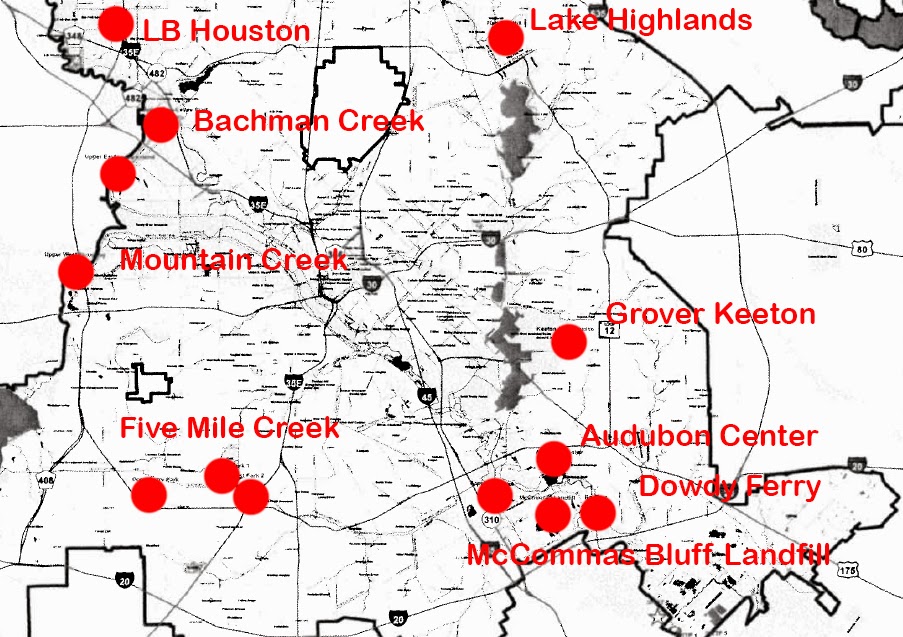
Feral Pig Hotspots According To The City of Dallas
Feral Pig Hotspots noted in the City of Dallas RFP for the 2013 Feral Hog Abatement Program
Feral pigs cannot fly. Nor can they navigate unscathed across the vast network of freeways and interlocking interstates inside the city limits of Dallas. How they move so freely around town is a secret of the animal world. The map above is from the 2013 Feral Hog Abatement RFP Packet. I have highlighted the hot spots noted in the packet. At a glance, the problem appears to be city wide and patterned to look like a wholesale invasion of immense size. Nothing could be further from the truth. The random dots are not random at all and make more sense if one overlays the wildlife corridors that exist in Dallas.

Major wildlife corridors for land base animals in Dallas, Texas
Wildlife corridors run from rural parts of Dallas County straight into the heart of Downtown. The width of the Trinity River Floodway coupled with a lack of development in the flood plain allows animals like deer, coyotes and pigs to travel up and down the Trinity River and tributaries with great ease. Few fences exist other than the Wastewater Treatment Plant. No matter, the animals can easily ford the river to go around the fences. Smaller wildlife corridors like Prairie Creek, Elam Creek, Turtle Creek and Bachman Creek can be used as avenues for travel too.

Lake Highlands- The outlier for the data is Lake Highlands and the random pig or two seen there. Some idiot is releasing pigs there. Someone who does not understand the topography of White Rock Lake, the Spillway fencing or inability of a feral pig to traverse the Arboretum, Forest Hills Neighborhood and Flag Pole Hill before safely making it to the confines of White Rock Creek north of Northwest Highway. Not possible. Pigs can go amazing places across all that area unnoticed and without hitting all the bottle necked corks in the terrain is simply not possible for a pig.

The Lake Highlands feral pigs are solitary and juveniles of small size. Pigs like that never leave their family unit called a "sounder". I have discussed this with a few wildlife biologists and they all think independently that someone is catching pigs elsewhere and releasing one or two at a time north of Northwest Highway and south of Walnut Hill. They need to be caught and thrown in jail.

White Rock Lake Feral Hog
Who dumped this pig? Not my video below:
http://www.youtube.com/watch?v=sH9CIDxeyhs

This juvenile feral pig is scared out of it's head near Mockingbird and Buckner, March 2013. It was killed by a vehicle impact at the corner of Northcliff and Buckner shortly after. Until recently I had only seen a cell phone photo of the feral pig, dead, photo taken by a Dallas Police Officer who showed it to me some days later. This was a feral pig that some human turned loose. Why they would do such a thing is unknown.

Dallas Trinity River Pig Problem

The real concern is what unchecked damage feral pigs are inflicting on the more fragile areas of what the city calls "The Great Trinity Forest". This 6,000-10,000 acre chunk of land(depending who you ask) has some real gems of native wildlife and rare plant species. Pigs love eating all of it which can cause some real trouble.

Feral pigs are “opportunistic omnivores,” meaning they’ll eat most anything. Using their extra-long snouts, flattened and strengthened on the end by a plate of cartilage, they can root as deep as three feet. They’ll devour or destroy whole field of sorghum, rice, wheat, soybeans, melons and other fruits, nuts, grass and hay.
A feral pig eating the seeds of Johnson Grass at Joppa Preserve
Calvert Collins of KDFW Fox 4 reports on the Trinity River pig problem in August:

In the Great Trinity Forest very little acreage is under cultivation to any extent but natural food plots and habitat destruction are a real issue. They compete with the native wildlife, including the white-tailed deer, squirrels, and waterfowl, for food and territory. Hogs may also change plant community composition favoring exotics through disturbance and seed dispersal. They may also affect soil structure, soil nutrients, input of nutrients to streams, and stream invertebrates via their rooting, defecation, and urination.  Hogs are very selective in their choice of foraging areas and will often pattern their rooting in certain spots.

High reeds acting as a shoreline screen for a photographer shooting birds at Joppa Preserve

The ongoing damage at Little Lemmon Lake, Joppa Preserve in the Fall of 2013 is a prime example of feral pig rooting damage. As seen below, the pigs have moved into the southeast corner of the lake and uprooted a large area of reeds and aquatic plants. The pigs are most likely after freshwater mussels, crawfish and grubs in addition to the tubers and roots that grow in this environment.

50x50 foot square area of damage to the lakeshore of Little Lemmon Lake October 2013

The reeds here serve as a breeding ground for tree frogs in the summers and provide a buffered screen for smaller animals to live. It will take years for the reeds to grow back from what was probably only an evening or two of rooting by feral pigs.


Algae blooms, oxygen depletion, bank erosion and soured water have all been attributed to the wallowing behavior of feral hogs, reducing the availability of water sources for livestock and wildlife.

Wallowing in either mud or dust is a common activity among mammals, birds and reptiles, but wallowing in mud is especially notable among pigs and piglike animals, as well as among large mega-herbivores with relatively hairless skin, such as elephants, rhino's, hippo's, water buffalos and warthogs.

Hog wallow at Little Lemmon Lake October 2013
The damage caused by feral swine is further magnified if the definition of damage is broadened to include the potential for transmission of diseases to domestic livestock. Feral swine can harbor a number of diseases transmissible to livestock and/or humans. The pork industry in the United States has nearly eradicated swine brucellosis and pseudorabies, but feral swine serve as a potential reservoir from which these diseases can be transmitted back to domestic stock.


The very real threat of feral hogs transmitting disease has prompted the future city owned Texas Horse Park to install a remote activated cell phone feral hog trap. Watch more about it here Wireless trapping technology at the Texas Horse Park

As demonstrated above, President of River Ranch Charities Wayne Kirk shows archeologist Tim Dalbey a smartphone app that controls the trap at the nearby Horse Park. The photo shows a 2am alert to an animal in the open stockade. In this case, the animal was a stray black lab dog and the trap door was not activated.


If You Encounter Feral Hogs

Feral pigs are as smart or smarter than many dog breeds. They have better noses and sense of smell than any dog and an adult can run 30mph for brief periods. They also have lackluster eyesight and poor hearing. Coupled with a complete focus on foraging for food 6 inches from their nose, they might not hear or see a human if approached from downwind.
Feral pigs are not much more than renegade livestock. The largest pigs are male boars and are solitary. As long as you give them some room and let them know you are present, they will leave the area. They are non-confrontational and will always get out of your sight very quickly.
Pig Sounder at Joppa Preserve

Female pigs known as sows and their babies run in family groups called sounders. Since a female sow can have two litters per calendar year, the sounder is usually multi-generational with a mother, maybe some of her siblings, newborn babies and then some from pigs from the previous litter which one could consider tween or teenaged feral pigs.

If you encounter a large family sounder, just be quiet, still and observe from a distance. As long as the sounder stays together they are not a danger to humans. Really, you could walk right up to them and nothing would happen other than a brief scattering of pigs.
Atmos pipeline crew on the Trinity River Trail October 2013
Always good conversation talking with others down on on the Trinity. Guys like work crews are a great source of information about area wildlife, animal encounters and eager to share odd happenings. No problems with pigs from these guys. Or mountain lions, chupacabras or bears for that matter.

Generally nocturnal on the Trinity River, pigs are most often seen in the hours around dawn or dusk. Be aware of your surroundings, enjoy yourself and you will never have a problem.

A Reminder: Hunting Is Illegal On City of Dallas Land,  Dallas County Nature Preserves and Parks


As far as I can tell, through phone calls, exhaustive open records requests and conversations with the Dallas Police Department, no one is allowed to hunt on City of Dallas property. No one. Beaten this
issue into one that has become a dead horse with the poaching here. The NO HUNTING issue applies to even lowly feral pigs which are not even game animals in the State of Texas. Unlawful discharge of a firearm and/or hunting with airguns, bows, spears, arrows, knives on the Trinity River in parks and public lands is strictly forbidden. Game Wardens are now very aware of the situation at hand here and are ready to enforce the law if needed.

If you want to hunt pigs, great! There are plenty of farms and ranches just down the river, many are only a 10-20 minute drive south of I-20 that will gladly let you hunt pigs, birds and even deer. The classified section of the Dallas Morning News and Craigslist have numerous hunting leases available if so inclined. http://www.dallasnews.com/classifieds/ and Craigslist Hunting Leases

Want to shoot guns on the river, great! Head over to the Elm Fork where a legal gun range will let you punch holes in paper, static targets and even clay pigeons for cheap. Their website http://www.elmfork.com/. Cheaper than a trip to jail, which is what shooting guns down in the Great Trinity Forest will get you.