|
| Under the ancient Bur Oak on March 29, 2014 in the Great Trinity Forest with the complete lineage of title ownership represented at Big Spring Billy Ray Pemberton; Pemberton Family (1880-2004), City of Dallas Assistant City Manager Jill Jordan; City of Dallas (2004-Current), Mike Toyer; Beeman Family(1842-1880) who were original grantees to the land when it was Nacogdoches County, Republic of Texas |
It is a rare look at the complete 172 year lineage of land title at Big Spring. Most land in Dallas swapped land owners a score of times in that time frame. At Big Spring there are but a simple three.
At the base of a hillock in North Central Texas one finds a rather remarkable place intertwined with a rich case study of Texas lore that could have a country songwriter tongue tied over lyrics. Standing humbly among the elms, pecans and walnuts is the largest and tallest of trees as far as the eye can see, The Big Spring Bur Oak. Now an officially recognized historic tree by the
Texas Historic Tree Coalition.
As Mighty Oaks From Little Acorns Grow, So Do Mighty Ideas
 |
| The iconic Bur Oak of Big Spring, now officially titled The Big Spring Bur Oak by the Texas Historic Tree Coalition |
Larger than all of France there are a half dozen versions of Texas-es
you could grow up in. From the hard hills of the Hill Country to the
Gulf flats or the pine woods of the east. In Dallas, our version Texas is
Blackland Prairie and Post Oak Savannah. Known more as the Cotton Belt than for large trees, finding true giant trees in North Texas is a tough order to fill. Finding one with a historical provenance narrows the list further.
 |
| King Carlos III of Spain |
North Texas is tough on trees. Few places on the continent are more
exposed to high winds, long droughts, sudden floods and irregularities
of climate than the Dallas area. To make it in the long haul of life as a
tree one needs water, shelter and a nurturing environment to set to seed. Few places like that exist in Dallas. All the right elements come together though at one of the only natural springs left in Dallas County. Big Spring.
Bur Oaks in Texas can grow to impressive heights. The Bur Oak is one of only a handful of decidous trees in Texas that can grow to
heights in excess of 100 feet.
Nearly pest and disease
free as a species it is one tough tree. In Texas, Bur Oak is rarely dominant and is primarily
restricted to floodplains, bottomlands, or other riparian areas.
The Big Spring Bur Oak tree is believed to have taken root when Texas was known as New Spain. At the time, King Carlos III would have owned all of Texas as reigning monarch of the Spanish Empire.
The footprint of the oak's limbs are larger than that of a tennis court. With branches thicker than most tree trunks the rock solid tree has not only stood the test of time but the test of human development as one of the largest metropolitan areas in the United States grew around it.
 |
| Big Spring Bur Oak inundated in flood waters of the Trinity |
When Dallas was founded, Big Spring and the Bur Oak was as wild of a frontier in the 1840s as ones imagine could ever dream. It was during this time that the recorded human historical record of the site began with many generations of two families calling Big Spring and the Big Spring Bur Oak their home. To a large degree they only saw themselves as the caretakers for the place and never felt that they owned it. Merely they saw themselves are the protectors and preservationists of such a place long before the term entered the modern lexicon.
About the Bur Oak species:
Bur oak
Quercus macrocarpa sometimes spelled Burr Oak is one of the most majestic of the native North American oaks. It is a large sized deciduous oak of the white oak group that typically grows 60-80’ and less frequently to 125-150' tall with a broad-spreading, rounded crown. Acorn cups are covered with a mossy scale or bur near the rim, hence the common name Bur Oak. It is native to a variety of habitats in central and eastern North America. Best growth occurs in bottomland soils where good ground and good water supply exist. As mentioned, Bur Oaks are very disease and drought resistant. The natural enemies of many other oak species in Texas do not usually affect the Bur Oak species.
Location:
Big Spring and the Big Spring Bur Oak sit in Southeast Dallas County Texas at 32°43'49.06"N 96°43'15.49"W, in the neighborhood of Pleasant Grove and the subsection of an area called Pemberton Hill, south of US 175 and west of the 900 Block of Pemberton Hill Road Dallas, Texas 75217.
 |
| Big Spring |
One of the only natural spring sites left in Dallas, the naturally discharging Big Spring maintains a steady temperature and predictable flow year round with crystal clear and clean water. It discharges over eight millions of clean water into the Trinity River Watershed annually. With an average ph of 6.7, mineral rich and low dissolved oxygen content the water points to an aquifer not of modern origins. Carbon dating in 2013 resulted in a sample dating to 590 +/- 30 BP(1360 AD).
 |
| Bryan's Slough(Oak Creek) dotted with native hibiscus and palms |
The outfall of Big Spring reaches a first-order stream named Bryan’s Slough (Oak Creek) which empties into White Rock Creek and eventually the Trinity River some one mile distant. At roughly 405 feet above sea level, the spring sits upon a slope that modern geology calls the Trinity Terrace. The Trinity Terrace is a series of orange and brown-yellow Pleistocene gravel deposits a top a layer of Austin Chalk, a cretaceous age limestone common to Dallas County.
 |
| Roseate Spoonbill in a beaver pond on Bryan's Slough |
The Pleistocene is the geological epoch which lasted from about 2.5 million to 11,000 years ago, spanning the world's recent period of repeated glaciations. Coupled with much wetter weather than today, the Trinity River was vastly larger, carrying large loads of sediment across a valley that extended from Fair Park on the north bank to the Dallas Zoo on the south in Oak Cliff.
The spring, slough and riparian nature of the environment create large swaths of undisturbed habitat for beavers, otters and migratory birds like the Roseate Spoonbill seen at right.
 |
| The year round resident Red-Tailed Hawk in one of the pecan trees near the Bur Oak |
The Family Tree
When most people talk about showing you their family tree they take some folded yellowing papers from a desk drawer. For Billy Ray Pemberton his family tree is out the back door and two pastures down a hill. Take your house shoes off, put on your boots and hit the back gate.
 |
| Billy Ray Pemberton standing proud wearing his signature Indian Arrowhead bolo tie |
The walk down the grade from the Pemberton Farm is a trip through history. The current Pemberton Farm owned by Billy Ray and his wife Zada sits a stone's throw from a road bearing their family name. Pemberton Hill. There was a time around the turn of the last century when many folks lived on roads carrying their own name. The Pembertons are surely one of the few to carry that on.
 |
| Bill and Zada at a 4th of July family party at Big Spring |
The quarter mile walk to the spring starts in 2014 and goes back through human history over one thousand years. I explain to newcomers that the history of this land is a story of water and what it takes for man to get it. Up at the contemporary Pemberton Farm water comes as easy as turning a faucet. Using municipal water from the city water supply and indoor plumbing it is as state of the art as the city affords other residents.
The Pemberton land commands the highest piece of ground along Pemberton Hill Road. In the crystal clear skies of late March one can see Fair Park, Downtown Dallas, the high ground of Fruitdale and Oak Cliff command the view to points west.
Most folks would never imagine having a natural spring, Native American site and thousands of acres of riverbottom behind their home. For the last forty years or so Billy and Zada Pemberton have enjoyed just that.
 |
| Texas First Lady Rita Clements with Billy at Big Spring |
The modern day Pembertons often downplay their own history at Pemberton Hill. Historical accounts of their forefathers and other pioneers dominate conversation. The truth is, Billy and Zada have single handedly done more to preserve the Big Spring Bur Oak and the area around it than anyone else. Ever.
Like those before them, they raised a family, entertain grandchildren and watch over the land that the generations before toiled in, fought for and carved out of what is still today a true wilderness.
From political dignitaries to local celebrities, the Pembertons have graciously hosted a wide range of interested people to visit. A very few Dallasites could ever claim such a wide ranging guest list.
 |
| A young Billy Ray telling school children about the walnut tree at Big Spring. At right, a 2013 photo at the same spot. Billy is still using the same posture on the tree as he recounts floods and family history as told through nature |
 |
| The flower packed Coyote path down near Bryan's Slough March 29, 2014 |
 |
| Billy Ray on horseback at the Cantrell Farm, future Texas Horse Park |
Only the faintest of paths exist down here. Narrow little game paths just wide enough for the coyotes and foxes who make their nocturnal rounds after sunset. All roads don't lead to Big Spring...but all game trails do. Heavy timbered brakes of ash, willow and swamp privet dominate a place so quiet one would not imagine they were inside Loop 12. It is the rarest and most special of places left of it's kind in Dallas.
Walking down the slope towards the Bur Oak and Big Spring takes us not just down the hill but back through time. We come across the homestead site of Billy Ray Pemberton's grandfather, Edward Case Pemberton.
Edward Case Pemberton
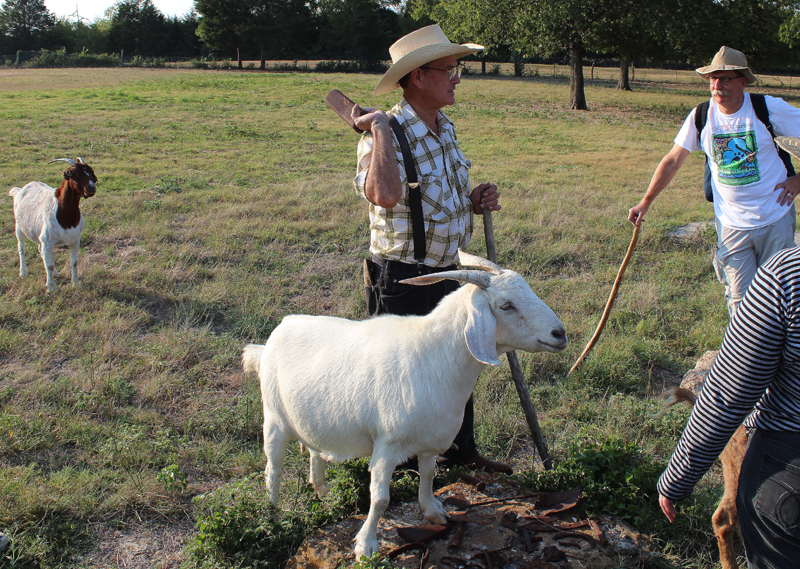 |
| Bill with his goat Olympia standing at his grandpa's home site |
Here through the faint lines of sewn winter wheat and early season grass stands the foundations of the old home. The faint traces of a house, windmill and blacksmith foundry that served as a farm headquarters for a dairy operation run by the family. It's heyday was back in the era of Big Grass. Large pastured fields ripe with grass nearly year round that fed a cattle operation that brought some of the best milk to Dallas.
In 1880 Edward Case Pemberton bought the Big Spring property from Margaret Beeman for $1000 payable in two installments, $400 in January 1882 and $600 payable in January 1883.
 |
| Billy Ray hollars in a hush tone to alert a group of Master Naturalists to a pair of Killdeer seen standing on the concrete piers to his grandfather's old windmill in March 2014 |
 |
| A flock of Master Naturalists observing birds on the Pemberton property |
Edward Pemberton grew a family here in a cabin of over a half dozen offspring. He kept a store down the hill to the north, where Pemberton Hill and Lake June now intersect. The centennial of his passing is this year, 2014. He met an untimely death at the hands of a robbery at his store, murdered through an open window.
His homesite used windmill powered water pumps in a well to supply water. As one goes further down the hill, the technological advances of how man obtained water are slowly left behind.
 |
| The Pemberton family anvil, once used by Edward Case Pemberton, still in use today by his grandson Billy Ray, seen here cracking walnuts. |
Edward Case Pemberton purchased the land in the 1880s from Mrs Margaret Beeman Bryan, widow of John Neely Bryan, who many consider to be the founder of Dallas. It's just a shade further down the hill from the Edward Case Pemberton residence where one would most likely find the old Beeman Cabin that stood here a century and a half ago.
The Beemans
 |
| Mike Toyer, descendant of Dallas pioneer John Beeman, lounging in front of his handmade from scratch mobile cabin at the Pemberton Farm on March 29, 2014. This was inside the Pemberton Farm, the woods beyond the foreground fence are part of the City of Dallas future Big Spring Historic Landmark and Conservation area |
 |
| MC Toyer in coonskin cap at the unveiling of John Neely Bryan's grave marker |
It would be an odd sight to some, seeing a cabin on wheels perched in a field. To me, I saw it as a dream fulfilled, a Beeman back in a cabin at Big Spring. Many not might be aware of the significance of such a sight. A long studied project by Mike Toyer to roll his cabin to the edge of the Pemberton Farm and sleep for the night.
 |
| Pioneers of the Trinity, Beemans, Cochrans, Hunnicutts |
An expert on carpentry and especially log cabins, Mike Toyer is most likely the hands down expert on Dallas County log cabins and especially the lore and legends associated with the famous John Neely Bryan cabin that sits on the courthouse square in Downtown Dallas. Few native Dallasites can tell you the intricacies of Dallas history en plein air better than him.
Cabin talk is always a hot issue at Big Spring. Where the location might have been, the construction and what happened to the remains of the structure.
Water was most likely drawn from the spring by bucket and hand at the time. The cabin site was close enough to the water for the distance to not be a burden. The state of the art was that of the well made bucket back then.
 |
| AC Greene |
One story goes that in the 1970s, historians AC Greene and Barrott Sanders surveyed the place and took some of the old logs they thought belonged to the old cabin. Gone for good to points on the compass unknown but to God.
Good country, this place seems to have been. On what must surely have been the very finest day yet of the year 2014 , one could without much imagination see the pleasant nature of such a place as a home. It was here that Margaret Beeman Bryan and her husband John Neely Bryan lived around the time of the War Between The States.
 |
| At the Trinity River Audubon Center, Margaret Beeman is pictured with her husband, John Neely Bryan on a timeline wall of events in the history of the Trinity River. |
 |
| Billy Ray Pemberton and MC Toyer surveying White Rock Creek |
The Beemans are an important family in North Texas history.
John Beeman was the man who set many firsts in Dallas. He owned the first wagon. He was the first farmer. The first married man with a wife to formally settle. The first with children. The first true homestead. Helped build the first ferry across the Trinity. When Texas became part of the United States in 1846, he was the first elected representative.
 |
| Scott Beeman, Margaret Beeman Bryan, John Neely Bryan Jr |
John Beeman owned three 320 acre tracts just east of White Rock Creek and south of what is now Scyene Road. He named them Big Spring, Prairie and Cedar Brake. Each served various purposes, from some he could graze cattle, others harvest timber and other areas grow crops.
On President Sam Houston's visit to North Texas in the summer of
1843 it was a relative of John's, JJ Beeman who guided Sam Houston's Treaty Party from their
overnight camp at Big Spring up White Rock Creek to John Neely Bryan's
cabin in what is now Downtown Dallas.
Margaret Beeman Bryan inherited 160 acres upon her father John's death, half of the 320 acre Big Spring Tract and that is where she and John Neely Bryan lived from 1866 to 1877. She then sold the land to Edward Case Pemberton and his descendants.
Native Americans
 |
| Worn pieces of rock in a contemporary bowl of terra cotta, found around Big Spring, many of which are worked pieces of rock by Native Americans who once lived at Big Spring |
A wide swath of a Native American archeological site once covered the terrace upon which Big Spring sits. Professional archeological digs have recovered artifacts that will one day tell a story of ancient human occupation over millennia at Big Spring. Over the last hundred years, through utility right of ways, easements and some gravel mining, the site, officially called 41DL72 slowly diminished in size. Remnants of the site still exist undisturbed.
Left behind are the tools of their trade used in processing animals and plants for food. The oldest chapter of human history at Big Spring has yet to be written. The secrets are locked in the ground awaiting proper scientific excavation and study.
The Native Americans had their own pottery, fragments of which have been recovered by the city contracted archeology company in 2013. The Native Americans used these vessels for gathering water out of Big Spring or possibly their bare hands.
Big Spring -
Preservation Efforts To Save The Bur Oak and the Spring
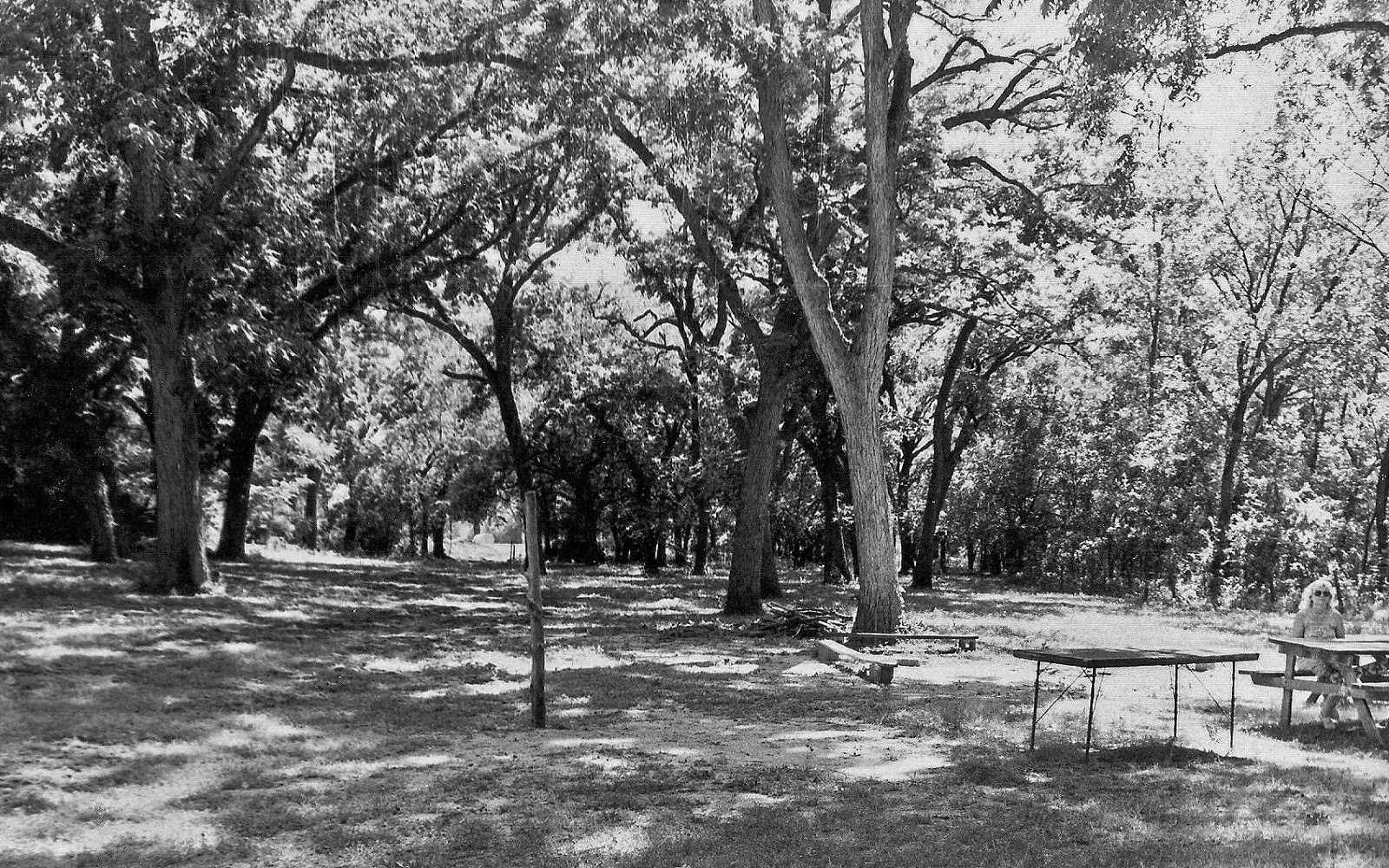 |
| The huge trees that once shaded much of Big Spring before a city sewer line cut through the area in the 1980s |
 |
| Pembertons gathering under the trees circa 1970s |
For decades Billy
Ray Pemberton and his wife Zada Pemberton have been the quiet caretakers of Big
Spring, tending to the mowing, downed limbs and the occasional tire that floats
by when the Trinity River floods. No
cleaner piece of land exists in the Great Trinity Forest than here. The
Pembertons are why this place is so special.
He and his wife Zada have fought harder for the preservation of the land
here than anyone who came before them.
Upon the death of Billy Ray Pemberton's grandfather in 1914, the family farm was divided half a dozen ways between the heirs of the estate. Over the decades the land became more fractured in size and scope. Billy Ray and his wife still live on the piece of land that was his grandfather's homeplace.
In the late 1980s the City of Dallas planned a large sanitary sewer line through the area. The plans would have demolished The Big Spring Bur Oak and the natural spring that flows there. The Pembertons made passionate pleas to the City Council at City Hall meetings, wrote letters and called with great gusto to anyone who would listen. They on their own, were able to have the sewer line moved some distance west to save the spring. The black and white photo above shows what the area once looked like before the sewer line went in. Much of it was clear cut for the sewer line.
 |
| 360 degree Panorama of the Big Spring area, standing a top the sewer box west of Big Spring (click to enlarge) |
Other than some early 20th century gravel mining and the 1989 sewer line, the absence of human disturbance has left much of the ecological functionality of Big Spring intact indicating that preservation and management of the site should be somewhat of a “hands ‐ off” or “less ‐ is ‐ more” approach. This will allow the natural processes to continue undisturbed. Continual monitoring and assessment of Big Spring will allow decisions to adaptively develop or hone site specific management.
Billy Ray Gets Some Help
 |
| Billy Ray Pemberton listening to conservationists and city employees discuss what should come of Big Spring in August 2013. |
In 1846 Sam Houston gave a speech on the floor of the United States Senate entitled
A Tribute To The Indians "As
a race they have withered from the land, Their arrows are broken, and
their springs dried up;......Ages hence, the inquisitive white man, as
he stands by some growing city, will ponder on the structure of their
disturbed remains and wonder to what manner of person they belonged."
Dallas is fortunate to have a handful of very dedicated private citizens
who fit the bill of what Sam Houston spoke of so long ago. Nowhere does
his speech ring more true than the woods surrounding Big Spring in the
Great Trinity Forest. The Yeoman's work here over the last year to
discover the centuries of history and the combined preservation efforts
will have a far reaching legacy for generations to come.
Through some very
hard work Big Spring will become an official Dallas Landmark. Believed
to be the first natural landmark in the City of Dallas, landmark
designation is traditionally given to buildings, places and physical
things. This new landmark, still in just the formative infancy of the
process will be unique in what it represents, a rare natural spot ripe
with the complete story of Texas at ones feet.
The first honor to be bestowed at Big Spring is the historical tree dedication by the Texas Historic Tree Coalition.
Tree Dedication Ceremony At Big Spring
 |
| Assistant City Manager Jill Jordan accepts the Texas Historical Tree Coalition award on behalf of the citizens of Dallas, March 29, 2014 |
The hard work for recognizing the tree began in late fall of the year before, September of 2013. There among the tangle of moonscaped trees and debris bulldozed for the scraped Texas Horse Park pad sites was the old remains of a Post Oak that once sat on the property. The Post Oak is thought to be a casualty of the former tenant and poor stewardship practices.
 |
| Sean Fitzgerald on the chainsaw with Tim Dalbey working the pile in the background, at the Texas Horse Park |
 |
| A well cut tree cookie harvested from the Post Oak |
The stark contrast of landscapes between the construction next door at
the Horse Park and that of the serene Big Spring landscape are readily
apparent in 2013-2014. The idea was to harvest tree slices from the trunk, "tree cookies" as they are called. The tree was most likely more than 150 years old and witnessed the first
surveyors, Texan explorers, pioneers and settlement of this very spot.
The Beemans, Bryans, Pembertons, Kirbys, Jenkins, Cantrells and Jassos
made a living under this tree as it served as part of their farm and
ranching operations over the better part of two centuries.
The rainfall, the weather, the heat of the summer and the cold of the
winter that all those families saw over the last two hundred years are
recorded in the tree trunk of that old tree.
Growth rings, also referred to as tree rings or annual rings, can be
seen in a horizontal cross section cut through the trunk of a tree.
Growth rings are the result of new growth in the vascular cambium, a
layer of cells near the bark that is classified as a lateral meristem.
This growth in diameter is known as secondary growth. Visible rings
result from the change in growth speed through the seasons of the year,
thus one ring usually marks the passage of one year in the life of the
tree.
Many trees make one growth ring each year, with the newest adjacent to
the bark. For the entire period of a tree's life, a year-by-year record
or ring pattern is formed that reflects the climatic conditions in which
the tree grew. Adequate moisture and a long growing season result in a
wide ring. A drought year may result in a very narrow one. Alternating
poor and favorable conditions, such as mid summer droughts, can result
in several rings forming in a given year.
 |
| Tim Dalbey giving a talk at a November 2013 Texas Historic Tree Coalition meeting about the tree rings of the Post Oak and the relation to the Bur Oak at Big Spring |
It is a story unto itself how something like a tree slice can end up in a carpeted meeting room near Downtown Dallas. The effort to recover, document and connect the dots of the importance of such a place, such a tree, such a history. The November 2013 meeting of the Texas Historic Tree Coalition was one that saw the formal nomination of the tree with a dedication planned in Spring 2014. Trustee Bill Seaman gave a formal presentation and nomination at the meeting.
The Texas Historic Tree Coalition
http://www.txhtc.org/ from their website is a "non-profit, local citizens’ group advocating the recognition and celebration of significant and historic trees. Our goal is to find, research and honor the stories these living legacies have told, and continue to tell, for generations."

It was a picture perfect, cloudless late March afternoon in Dallas when the tree was formally dedicated and recognized as a Texas Historic Tree. Well attended by dozens of people, the ceremony recounted the historic background of the site, the large Bur Oak and the long stewardship of the Pembertons in their protection and preservation. In attendance was a broad collection of city hall officials including Willis Winters, head of Dallas Parks and Recreation, Michael Hellmann, Assistant Director of Parks and Recreation, Sue Alvarez, Program Manager for Stormwater Management and Sarah Standifer, Assistant Director of Trinity Watershed Management. They all have worked very hard at tackling the tough issues at Big Spring and working to protect the spring as a resource for future generations.
 |
| A beaming Billy Ray being applauded by the crowd gathered at Big Spring under the Bur Oak. Left to right, Assistant City Manager Jill Jordan, Billy Ray Pemberton and President of the Texas Historic Tree Coalition Mary Graves |
Above is a long overdue round of applause for Billy Ray Pemberton. Seen at left in the photo is Jill Jordan who accepted the Big Spring Bur Oak award for the citizens of Dallas, as presented by Mary Graves, President of the Texas Historic Tree Coalition and Trustee Bill Seaman. Profound and precious moments like this are what make Texas so great of a place to live. A beaming Billy Ray shines brighter than the sun.
 |
| Mary Graves, Billy Ray Pemberton, Jill Jordan and Bill Seaman standing in front of the Big Spring Bur Oak holding the official decree and certificates for the tree |
 |
| Satisfied smiles across Big Spring. Left to right, Photographer Sean Fitzgerald, Staff Writer for the Dallas Morning News Roy Appleton, Attorney Eric Reed, Attorney/ Master Naturalist Bill Holston |
The work goes on at Big Spring. Water testing, historical research, plant surveys and a bedrock of education that can be enjoyed by all Texans.
It was a privilege to attend such a unique ceremony, the first of what one hopes are many for Big Spring. A great moment to reflect on what the
tree signifies. More than the height, size and shape of such a grand oak.
The decades of the Pembertons hard work are representative of the finest traditions of Texas and should be seen as a legacy that we as Texans can work hard to continue.
On
behalf of all Texans how proud we all are Bill and Zada Pemberton and
how much you mean to us all. In these times of uncertainty and change to
the Trinity River you bring our hearts to soar. You remind us of the
strength and endurance of the Texas spirit.