Sunday, May 25, 2014

White Faced Ibis and Migrating Wading Birds at Joppa Preserve

The Texas White Faced Ibis a State Threatened Species in Dallas, Texas May 23, 2014
Certain shorebird and wading bird species are the first push of migratory Central and South American birds through the Great Trinity Forest every year. They are only seen for a brief time as flock after flock stop to refuel for a day or even just an evening in the small ponds and wetland habitat along the Trinity River.

White Faced Ibis silhouette in the fading sunset light May 23, 2014
The birds in many cases have flown the entirety across the Gulf of Mexico over water from the Yucatan to the mouth of Trinity Bay, non-stop. Others have flown across the Andes and the Sierra Madre working their way up the tidal pools and mud flats of the Pacific. Here they are, for a brief moment in time, in Dallas.
Little Lemmon Lake full of shorebirds
The drier than normal spring in 2014 has been harsh on many aquatic species and waterfowl. What is poor for some species is great for others. The mudflats of the half empty ponds and small lakes like Little Lemmon Lake in Joppa Preserve provide near perfect habitat for these birds.

White-Faced Ibis in full breeding plumage Dallas, Texas May 23, 2014
Rare birds call this place a brief home, a roadstop motel of a place.

One such species, listed in Texas as a Threatened Species, the White Faced Ibis is a very rare sight to Texans.

 The White-Faced Ibis is a long-legged wading bird with reddish eyes and a long, slender, decurved bill. Plumage is chestnut colored with green and purple iridescent. During the breeding season, a white feather border can be seen around the base of the bill along with red lores and legs. Juveniles lack the white on the face and the red legs.


To Dallasites the bird is very rarely if ever seen. A "life bird" for many who keep a checklist, seeing one in the wild would be a year's highlight for many birding types.


The White-Faced Ibis is threatened due to habitat loss. It needs wetland areas exactly like those in the Great Trinity Forest to thrive.

The shallow wading pools in short grasses, flooded marsh and lowland areas are their prime habitat. Very few of these places still exist. It's a real gem to have places like that here in Dallas.

Appreciated by few humans but adored by wildlife, the next year or two will tell the tale whether or not changes to the Trinity Forest will be impacted by construction plans.


American Avocet Recurvirostra americana

With its unique coloration, long legs and elegant profile, the American Avocet is striking among North American birds. The Avocet is a migratory shorebird that is characterized by a long, thin upcurved bill with distinctive black and white markings on its back and sides

The American Avocet or Recurvirostra americana is a long legged shorebird in the stilt family. It is considered a large shorebird at eighteen inches in length.  The Avocet is charecterized by a long, thin bill that curves upward, more so in the female.


Year round it has a distinctive and signature black and white stripped pattern on its wings and back.  During the breeding season the head and neck are a pinkish-tan.  During the winter they turn more white.


American avocets prefer open water and marshy summer habitats such as lakes and ponds throughout the central plains of the United States, including the Rocky Mountain region and Canada.

During the winter avocets  migrate to saltwater or brackish areas of the central and southern California coast, Baja California and the southeastern Atlantic coast as well as throughout Mexico and the Caribbean. Year round populations can be found along the South Texas coast and the southern California coast.


American Avocets forage while wading in shallow water by sweeping their curved bills back and forth along the surface of the water, or they can use their bills to probe into mud for insects or crustaceans. They may feed in flocks, and may dabble for food in deeper water.


Avocets are important members of their ecosystem; because of their food habits they likely have a regulatory influence on insect and crustacean populations, and they are an important food source for their predators. They also have an influence on the plants they eat as they often broadcast seeds into new areas.


Currently protected by the US Migratory Bird Act, American Avocets are making a comeback after over-hunting in the 19th and early 20th centuries. The main threats to American Avocets today are habitat loss and degredation.


Foraging With Migrating Shorebirds

Wilson's Phalarope in foreground and Lesser Yellowlegs in background
Plate by Alexander Wilson circa 1807

Often called the "Father of American Ornithology", Alexander Wilson 1766-1813 was instrumental in the early scientific study of birds in what is now the Southern United States. His sketches and plates were some of the first that featured the American Avocet, Lesser Yellowlegs, Roseate Spoonbill and various small shorebirds.

A number of bird species now carry the "Wilson's" name as an honor to the man who first studied them at length.

Wilson authored the nine-volume American Ornithology (1808–1814). Of the 268 species of birds illustrated there, 26 had not previously been described.


Lesser Yellowlegs Tringa flavipes

In winter, the Lesser Yellowlegs is found along the coasts of Mexico, Central America, South America, and the Caribbean. The largest concentration of wintering birds occurs in Suriname and along the Gulf of Mexico.

Lesser Yellowlegs breed in interior Alaska and northern Canada. They breed between 51 and 69 degrees north latitude in suitable habitat. They breed farther north than their close relative, Greater Yellowlegs (Tringa melanoleuca), where they co-occur. Historically, some populations of Lesser Yellowlegs might have bred farther south then they do currently.


Wilson's Phalarope Phalaropus tricolor
Wilson's Phalaropes are a relatively small, long-legged shorebird. They are unique among Texas birds in that they are one of only a few species in which the female is much more brightly colored than the male.

The Wilson's Phalarope can be distinguished from most other shorebirds by the bright coloration on their neck and head. Additionally, unlike other shorebirds, Wilson's Phalaropes often feed while floating on the water, sometimes spinning like tops to stir up aquatic invertebrates.  

The relatively long, thin bill, and bold blackish stripe on the neck and face distinguish the Wilson's Phalarope from the red-necked phalarope (Phalaropus lobatus), which is a migrant in Texas.


In Texas, Wilson's Phalaropes are most frequently found in wet prairie, flooded plains and other grass or sedge dominated wetlands. The presence of short vegetation in or adjacent to shallow pools of open water is an important microhabitat feature. Human-altered habitats, particularly flooded pastures and municipal wastewater treatment  ponds, may also provide suitable habitat.


Because microhabitat conditions are very important to the Wilson's Phalarope, water conditions greatly influence habitat use. The shallow wetlands on which this species depends are very sensitive to alteration, especially drainage and degradation resulting from human activities. When water levels are low, wetlands may be avoided due to the lack of standing water. Wetlands dominated by shrubs are also avoided by the Phalarope due to the increase risk of predators.

Artificial habitats, such as flooded agricultural fallow fields, may be utilized by Wilson's Phalaropes because they provide necessary conditions lacking in native habitats.

Wilson's Phalarope with a worm in the recently flooded leaf detrius after a spring rain in 2014


Killdeer Charadrius vociferus

The killdeer is Texas most well-known member of the plover family, although many people know the killdeer without understanding its family affiliation. The killdeer can be common around human developments, frequently seen on playing fields, parking lots, and other unnatural habitats. Its “broken-wing” display is famous and known by many.

The killdeer often forms flocks after breeding in late summer. It feeds in fields and in a variety of wet areas, and in general, it is not prevalent on mudflats. It is noisy! Breeding residents to North Texas they are a common site.


Spotted Sandpiper Actitis macularius

Spotted Sandpipers are the most widespread sandpipers in the United States, having colonized their broad breeding and winter ranges by using  almost all habitats near water. These include the shorelines of large rivers and lakes to urban and farm ponds.

Spotted Sandpipers (Actitis macularius) are found throughout North and Central America, including the western Caribbean islands. Their breeding range extends from the northern Arctic to the southern United States. Their wintering grounds range from the extreme southern United States to southern South America, along with all the Caribbean islands. Spotted Sandpipers live year-round along the western coast of the United States and in parts of California.

The Spotted Sandpiper is a common migrant throughout the Lone Star State from late March to early May. The fall migration period extends from early July to mid-October. Absent in the hottest of summer months, they are quite common in the Great Trinity Forest ponds in the late summer and early fall.

These sandpipers are winter residents in Texas with  abundance varying from common to rare depending on latitude and climate.


Tuesday, May 20, 2014

Paint The Trinity a Bloody Red With Indian Paintbrush

A carpet of red Indian Paintbrush at McCommas Bluff Preserve
Crepuscular is a term seldom used in common conversation. It's a time of day around dawn or dusk when certain animals get out and roam around. For photography or general exploring it often lends itself to the most photogenic scenes and greatest swath of wildlife visible in daylight hours.

It's the golden hours of sun and shadow when the light hits much of the landscape in a way that a camera cannot simply capture. The photos shown were all taken at McCommas Bluff Preserve on the high terraces of Pleistocene sands on the east banks of Elam Creek not far from the Trinity River Audubon Center. Access is easy from the Audubon Center, from the dead end yellow gate on Fairport or from Riverwood Road. An old dirt ranch road follows the terrace up along a series of stepped terraces and borrow pits. Cactus and wildflowers abound here.

That long latin rooted word Crepuscular, was most likely in use around the same time the nomadic Comanche stormed across the Southern Plains. A people without a written language they used oral storytelling to speak of their history and the world they encountered.

Comanche Legend Of The Paintbrush

"Little Gopher had a dream.  The vision told him to find a white buckskin and keep it.  One day he would paint a picture “that is as pure as the colors in the evening sky.” Although he found the buckskin, Little Gopher could not find the right colors. However, one night a voice told him to go on top of a hill the next day at sunset. The voice said, “Because you have been faithful to the People and to your true gift, you shall find the colors you are seeking.” The next evening, Little Gopher found paintbrushes the colors of the sunset all over the hill, and he painted his masterpiece. When he returned to his tribe, Little Gopher left the paintbrushes behind.The next morning the paintbrushes were all over the hills and had turned into beautiful flowers.  Little Gopher became known as “He-Who-Brought-the-Sunset-to-the-Earth.” --Comanche Nation


Castilleja indivisa, commonly known as Texas paintbrush or entireleaf Indian paintbrush, is a hemiparasitic annual wildflower native to Texas and Oklahoma in the United States. The bright red leaf-like bracts that surround the white to greenish flowers make the plant look like a ragged brush that has been dipped in red paint. They sometimes produce a light yellow or pure white variation mixed in with the reds.


There are a couple interesting things about this familiar wildflower. The colorful blooms that make it so remarkable are not actually the flowers. They are the leafy bracts surrounding the very inconspicuous and subdued greenish white flowers at the very tip. Much like a Christmas Poinsettia, all the action is in the specially formed leaves. One can see this once you know what to look for, as the color sort of shades back to green as you move down the stem.

A casual observer may not notice that Indian Paintbrush is almost never seen alone. Some wildflowers like Texas Bluebonnets or Clasping Coneflower form huge monolithic stands, but Indian Paintbrush is almost always scattered through an area with other plants. The reason for this is that, although it looks just like any other green forb to the layman, Castilleja is actually parasitic on other plants. In fact, it comes from an entire family of plant-on-plant parasites,  called Orobanchaceae. Although levels of parasitic behavior range greatly in this family, they all have a defining characteristic: haustoria.

Haustoria are specialized roots that drill into the roots of other plants for the purpose of stealing their resources.  Of the parasitic plants found in this family, Indian Paintbrush is actually a fairly mild parasite, known as a root hemiparasite. Since they have fairly normal green foliage, they can photosynthesize on their own. But they get a huge boost in overall fitness from stealing moisture and other essential nutrients from a host plant. This may be an adaptation to places where resources, like water, are limited, the growing season is short, or in the case of many Texas prairies the soil is poor.  And while in the wild Indian Paintbrush aka Castilleja is almost never found without a host, they can technically survive on their own, although they are much less robust in every way if grown in isolation. Indian Paintbrush also does not kill its host plant, although it often does take a toll on its health and growth.

The Hummingbird Moth --White Lined Sphinx Hyles lineata
White Lined Sphinx Moth at McCommas Bluff Preserve
"Hummingbird Moth" is a general term applied to many medium to large moths in the Sphingidae family and Hemaris genus of moths.There are over 1,000 species of these moths worldwide, and roughly 125 of them can be seen regularly in North America. Also called sphinx moths, hawk moths, clearwing moths and bee-hawk moths, and in the caterpillar stage, they are called hornworms. It is the caterpillar stage that often causes people consternation. They superficially resemble the tomato hornworm, but are more conspicuous and often more numerous.

Hyles lineata is an animal of open habitat, they are most abundant in prairies, agricultural lands and fallow fields. In the western United States, the White-lined Sphinx is a resident species from southern California to Texas. It disperses via migration annually farther north. Rarely is this moth a pest, though the caterpillars occasionally do damage to grapes and tomatoes in far western states.

White lined sphinx moth using proboscis to draw nectar from an Indian Paintbrish

The adult White Lined Sphinx moth can be active at almost any time of day or night, and visit a wide variety of flowers for the nectar they use to fuel their rapid, energetic flight.

Unlike the majority of Texas moths one might encounter,  this species is already unusual by being active during daylight hours. However it’s most unusual feature – and the reason behind it misidentification - is the way it flies. It beats its wings so fast that they are no more than a blur, and like a true hummingbird they are able to hover while feeding for nectar. This is accomplished with a long uncoiled proboscis. To complete the illusion, the speed of their beating wings is such that they emit the trade mark hum from which the hummingbird gets it name.


Hummingbird moths share many common traits with hummingbirds, which often leads to confusion if bird watchers aren't aware that these distinct moths may be nearby. Both hummingbirds and their insect named friends are effective pollinators of many of the same flowers. Hummingbird moths also sip nectar from many of the same blooms hummingbirds prefer. Their body shapes are similar, and hummingbird moths are also agile fliers that can hover or fly sideways or backwards, just like hummingbirds.


Tuesday, May 13, 2014

Texas Bluebonnets and Early Spring Wildflowers In The Great Trinity Forest


The unpaved, just off the beaten paths along the Trinity River in early spring highlight nature in the raw to those who venture into it. They are places of profound beauty and wonder that so very few ever experience. A scant handful of human signs mark the place which only offer suggestions on where to go.

The Gray Hairstreak (Strymon melinus), is one of the most common hairstreaks in North America, ranging over nearly the entire continent. It occurs also throughout Central America and in northern South America

A sea of white lilies known as false garlic. as far as the eye can see on the Texas Buckeye Trail
It's for a few weeks that the Great Trinity Forest hits the first peak of blooms. Most Texans are familiar with the showy roadside flowers of the interstate shoulders that bloom later in the spring. Many have not seen or even know of the earliest of blooming flowers that hit the hardwood bottoms. They are here, there are a lot of them and you are missing out if you have never seen them.
The white-lined sphinx moth, Hyles lineata consumes nectar from a Texas Buckeye flower at the the Texas Buckeye Trail in the Great Trinity Forest, Dallas, Texas
Members of the Trinity River Riding Club on the Trinity River under the old Central Expressway Bridge Hwy 310 April 2014

Many mislabel this area as Blackland Prairie. It is not. This is land carved upon by the ancestral Trinity, the old Ice Age river many times stronger and larger than that of today. The dramatic limestone canyons and cliffs now buried under many feet of sand and silt. The alien gravels of this time sit up to 100 feet in elevation above the present Trinity and blend a unique perspective to the landscape.
Native Texas Bluebonnets mixed with native Texas grasses in one of the hidden meadows only known to a few in the Great Trinity Forest
The meadow above exemplifies a sight few contemporary Texans have ever seen. A dense packed meadow of bluebonnets ringed by mature trees in an area full of Little Bluestem, Big Bluestem, Indiangrass, and Switchgrass. These are the legendary "Four Horseman of the Prairies" species of the Tall Grass Prairie. All but obliterated as an ecosystem with only small fractured pockets remaining.

Many might think that the tall grass here spoils the view. For those in the know, nothing could be finer. The intoxicating aroma of bluebonnets, perhaps a couple hundred thousand packed into the footprint are overwhelming to sight and smell. There might have been possibly two or three other humans who ever saw that spot this spring.

Bluebonnets Blooming Under A Blood Moon
Bluebonnets bathed only in the light of the rising full moon in the Great Trinity Forest
 This spring's bluebonnets peaked in bloom under the lunar cycle of a full moon in eclipse. A somewhat rare event known as a Blood Moon. The coppery red hued colors of the moon take on the appearance of blood, hence the name.
The April 2014 Blood Moon over Dallas, Texas
 Both astronomers and followers of certain religious pastors are talking about the lunar tetrad of 2014-2015. The Lunar Tetrad is four successive total lunar eclipses, with no partial lunar eclipses in between, each of which is separated from the other by six lunar months, six full moons. Whether the lunar cycles are an omen to an upcoming rapture or end times would be anyone's guess. Myth, legend and superstition abound about such events, the bluebonnet has such interwoven stories told about it too.
Cottontail Rabbit Among the Bluebonnets at McCommas Bluff Preserve

The Comanche, who lacked a written language told their tribe's history through storytelling. One of their parables was that of the Bluebonnet:
Methodist Chapel at McCommas Bluff, Lock and Dam # 1 April 2014

The Texas fields are covered With a blanket of deep blue. But for a little Indian girl, This would not be true.

Texas land was buried and dry. Rains just would not come. Indians danced and prayed for rain, And beat upon their drums.

The Chief made a proclamation. He appealed to one and all. A prized possession must be sacrificed Before the rains would fall.

The Indian camp was silent, While each person searched his heart. But when it came to sacrifice, With possessions they would not part.

Suddenly a little girl stepped forth, Holding her blue-clad doll. She placed it in the roaring fire and raindrops began to fall.  The rain brought forth the grass, Among its blades, flowers of blue. To be a sign for all the time. Of a love so pure and true.

Bobcat on patrol through a stand of last years Giant Ragweed in the Great Trinity Forest

 Invasives
European Honey Bee on the flower of a grape hyacinth Muscari armeniacum

It fools many from a distance, a flower that so closely resembles a bluebonnet that some get their family flower photos taken among an invasive species rather than a native. Muscari armeniacum, commonly called grape hyacinth, is an early spring-blooming bulbous perennial that is native to southeastern Europe. It provides spectacular drifts of color when massed in open areas, around shrubs, under trees. Each flower has a thin white line around the rim. Dense inflorescence purportedly resembles an elongated, upside-down bunch of grapes, hence the common name.
Grape hyacinth as far as the eye can see at McCommas Bluff
At about the same time that bluebonnets make their annual run, the hyacinth do the same. It is thought that the grape hyacinth at McCommas Bluff was probably planted near an old rendering plant structure and allowed to spread.
Walking through the fields here and brushing through the stands of the flowers one can pick up a decidedly grape kool-aid smell to the crushed flowers.
Feral pigs mowing down grape hyacinth at McCommas Bluff
Nowhere is the smell more evident, than being downwind of a feral pig sounder that is grazing the grape hyacinth. Above, and in the video below, a feral pig sounder, twenty strong works over the flowers just photographed minutes before.  The strong wind and thick privet hedgerows let me go unnoticed to the pigs who were preoccupied with eating the sickly sweet flowers.
Feral pigs are responsible for huge amounts of damage in the Great Trinity Forest. They root around the bases of many trees, tear out riparian plants along streams and are vectors for a host of diseases that enter the watershed. They are quite easy to find in the spring of 2014 here.

Swallowtail feeding on the flowers of a Mexican Plum and McCommas Bluff Preserve

The highly fragrant blossoms of the Mexican Plum appear in the earliest of spring days, before the leaves, and attract hordes of pollinators like butterflies and bees.  The tree often grows solitary in clearings and woodland edges in the eastern half of Texas. It tolerates dappled shade as well as full sun. Despite the name it is said to actually be more common in Texas than in Mexico. 

That plum tree sits right on the edge of some rather remarkable upland areas that rise directly above the Trinity River forming the hidden backbone of McCommas Bluff.
Mexican Buckeye at McCommas Bluff
The pink Mexican Buckeyes flourish here too with a great number commanding the steep slopes of the sandy soiled  partially exposed limestone. The late hard freezes of spring this year killed many of their blooms making for a lackluster display.

Exploring the Bluebonnets at McCommas Bluff
Master Naturalist Jim Flood using binoculars to check out the leaves of native hickory growing above McCommas Bluff
The isolation and simplicity of McCommas Bluff while well within the city limits takes you far out into the wild with some unique ecosystems overlapping each other in the span of a single river mile. In the 1980s and 1990s as Dallas and Fort Worth raced to fill the gap between the two cities as one, southeast Dallas was left out of the picture.

It is such a rare treat to hike around with Master Naturalist Jim Flood and Canoe Guide Charles Allen. It was a brief sunset jaunt through the woods of the porous Trinity Sands overlying Austin Chalk. Where the native post oak savannah is peppered with hickory, buckeyes, pecan and many species of oak.
Jumping Spider on the leaf of a Texas Buckeye
Among Texas spiders, Jumping Spiders may be the easiest to recognize.  Jumping spiders have a very distinctive, flat-faced, big-eyed appearance that is difficult to confuse with other kinds of spiders.  They also have a unique, stalking way of moving.  Most are small and hairy.  Like all spiders, jumping spiders have 8 legs, 2 body parts, and no antennae.  Eight eyes are present on jumping spiders, although 1 pair is often so small that it appears as though there are only 6 eyes.  One pair of eyes is always very large and directed forward, almost like human eyes.
Texas Bluebonnets at McCommas Bluff

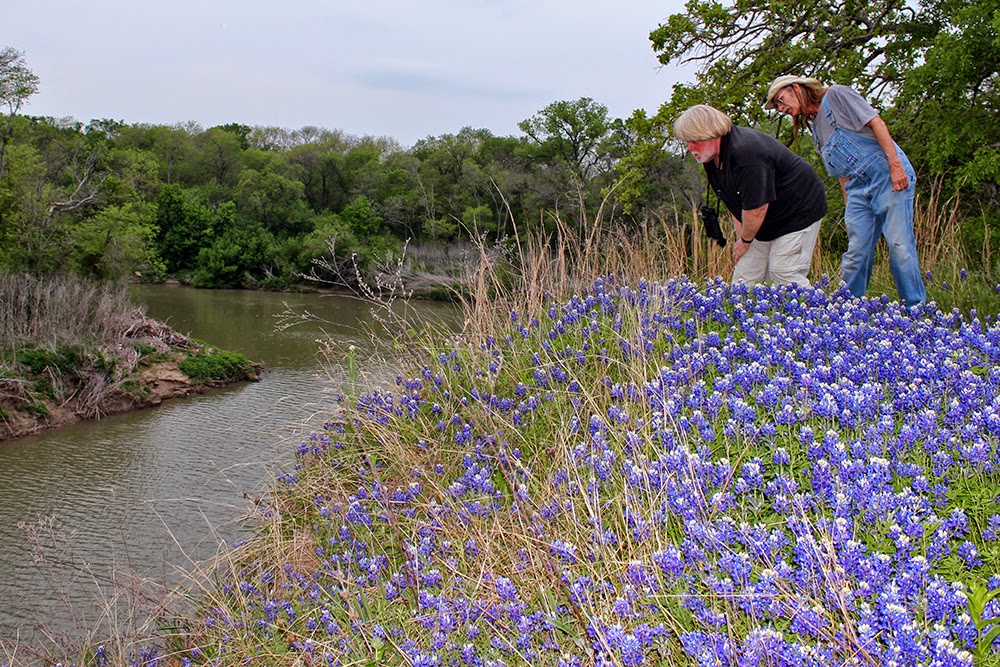
Master Naturalist Jim Flood and Canoe Guide Charles Allen among the bluebonnets a top McCommas Bluff. They are looking at the condition of native yucca on the high commanding bluff over the Trinity River.
Not even paying attention to the camera or the bluebonnets, Jim and Charles are taking census of the native yucca that populate the top of McCommas Bluff.

Charles Allen standing on the edge of the 30' plus cliff top at McCommas Bluff


Pollen Gatherers Of The Bluebonnets

The Bluebonnet is a member of the lupine family. If you look at the photo above, you will see a white or pale yellow spot on some flowers and a purple spot on other flowers. The flowers start out with a white or pale yellow spot. By the fifth day after the flower opens, the spot begins to turn pinkish and by the sixth day, the spot is completely purple.

Bees of all species will choose flowers based on the color of the spot. Studies suggest that over 90% of bee visits were to white-spotted flowers. It appears that bees will limit their visits almost exclusively to white-spotted flowers.


Pollen from fresh white-spotted flowers has a sticky feel too it and easier to cling to the body of a bee. As the pollen ages, it is less sticky and gets powdery. This in turn darkens the color of the flower to a reddish purple hue. That color indicator is a pretty good indicator for the bees.


In 1980 a scientific study authored by Schall and Leverich concluded that  bees can gather much more pollen from white marked flowers as much as 100x than from purple marked flowers. So, if a bee is looking to get the most pollen for its effort, the bee is going to pretty much ignore the purple marked old flowers and just forage on the white marked fresh flowers.

This marker seems to help the bee because it can be a more efficient pollen gatherer–and it is good for the bluebonnet because the white spot directs bees to flowers with good, fertile pollen and the transfer of this pollen is likely to result in successful cross-pollination for the bluebonnet. Some think that that the purple spot is the result of pollination. Flowers with white spots are not yet pollinated while those with purple spots are already pollinated.


In North Texas along the Trinity and the smaller tributaries that feed the river, small meadows and unblemished vistas can still be found in the wildscape. The chalk uplands here are not unlike those of other rivers, the Brazos, Navasota, Colorado. While those river basins mentioned are famous for their spring wildflowers, the Trinity is not. It should be.
Red Tailed Hawk surveying the landscape in the light of a setting sun