Showing posts sorted by relevance for query Little Lemmon Lake. Sort by date Show all posts

Friday, September 7, 2012

Birds of September -- Tropical Bird Redux On The Trinity


In recent decades it has become customary, and right I guess, and easy enough with hindsight, to damn the ancestral frame of mind that ravaged the world so fully and so soon. What I myself seem to damn mainly though, is just not having seen it. Without any virtuous hindsight I would likely have helped in the ravaging as did even most of those who loved it best. But God! To have viewed it entire, the soul and guts of what we had and gone forever now, except in books and such poignant remnants as small swift birds that journey to and from the distant Argentine, and call at night in the sky. John Graves Self-Portrait, With Birds; Some Semi-Ornithological Recollections

Talk of birds in Texas during the first weekend of September usually involves opening day of dove season. A quiet time of year when the dog days of summer are fairly scant for seeing wildlife. The birds of the Great Plains, the Mourning Dove, begin their migration from Nebraska and Kansas into North Texas offering hunters a chance to harvest birds in the fallow corn and sunflower fields that dot the outskirts of the metroplex.
Roseate Spoonbills and Wood Storks at Little Lemmon Lake, Labor Day Weekend 2012
It was with much surprise over Labor Day Weekend to see the scene above. Over one hundred rare Wood Storks feeding at Little Lemmon Lake. It has been my past experience that the birds move in like a flying circus in July for a couple weeks then leave. Birds who are easier to find on the rivers of South America than Texas. The Orinoco. The Amazon. The Tocantins. Birds of Brazil, Ecuador, Argentina. Why these birds end up 100 yards from Loop 12 in Dallas is beyond me.

The recurring recipe for attracting these wading birds seems to be shallow drying ponds and lakes that are knee deep on the bird. Find water that deep full of fish and it draws in birds like a magnet. Unique environments to attract birds like this simply do not exist in DFW to any degree. The Corps of Engineers Wetland Project to the north is much too deep and the same with many of the old gravel quarry ponds that dot southeast Dallas County.

Unlike many of the photos I usually take which are hip deep in mud or weeds the photos at Little Lemmon Lake were all taken standing on concrete. Some even standing on top of park benches that dot the lake. Getting to Little Lemmon Lake is a breeze. Located just south of Loop 12, dedicated parking lots exist for both the Loop 12 Boat Ramp and Little Lemmon Lake. The concrete path stretches from Little Lemmon Lake, south to Simpson Stuart Road. The best address I have for Little Lemmon Lake is the 4600 Block of Great Trinity Forest Way(Loop 12). Google Map link 4620 Great Trinity Forest Way.

Great Trinity Forest Trail Map

Originally purchased from Jack Apperson in the 1990s, Little Lemmon Lake has served as small recreational lake for decades in private hands. Leased off and on over the years by a local man named Bad Leg Fred, many locals still call the lake by his name. Bad Leg Fred Lake. Many spots named on maps, Google Earth and USGS surveys go by completely different names by the locals who call it home. Bear Hollar, The Post, The Crossing, Juju Heights, Pig Park Rodeo, Possum Bend. I always get a kick out of talking to the old timers on this side of the river because their oral history, what they witness with their own eyes is often completely different than what is printed in books, reports or the newspaper. Were it not for the wildlife, I think the people down here would be just as fascinating to know.
American Avocet, Tri-colored Heron and Snowy Egret

Later in the year than previous spottings, new bird species have shown up to share the lake. The overlap of migrations creates an interesting mix of birds from South America, birds from the US Interior/Pacific West Coast and birds migrating down from Canada.

One of the more interesting is the American Avocet. A chicken sized bird with a straw shaped beak that curves upwards. Black/White/Grey in appearance these birds live mostly in the Western United States and out on the Pacific Coast. In late summer, they often disperse further east and are listed as casual vagrants in North Texas.

Flock of American Avocets and a Great White Egret at Little Lemmon Lake.
The River Otter Family
North American River Otter and American Avocet at Little Lemmon Lake September 1st, 2012
Little Lemmon Lake still flies under the radar as literally one of the only places to see a North American River Otter Lutra canadensis in North Texas and possibly the only public spot in Dallas to see one on a routine basis. The river otters diet consists mainly of rough fish here in Texas, the kind of fish that abounds in the Trinity. Much of their lives and habits are simply not understood since they are few in number and hard to see here in Texas.


The birds actually follow the river otters around in the lake. Stirring up debris from the bottom of the shallow lake, the Avocet above follows at a comfortable distance to sift through the churned up silt.

Other birds take initiative on their own and in an interesting feat, a White Ibis killed a carp on its own then pecked pieces off one by one. The video clip is below.

I thought White Ibis preferred smaller minnow sized fish, crawfish and bugs. Pretty cool to see an Ibis take on a fish that probably outweighed the bird.


I lost count at over 100 Wood Storks in Little Lemmon Lake. The Wood Storks are easy to identify by their brownish heads and necks that almost resemble tree bark. The dozen or more Spoonbills and the countless herons, egrets, ibis and wading shorebirds must put the headcount there at over 500. As is customary for Wood Storks, they feed in organized groups, moving in unison from one end of the lake to the other driving prey in front of them.

Blue Winged Teal Ducks

Blue Winged Teal Ducks at Little Lemmon Lake

The first ducks to migrate south in the fall, the Blue Winged Teal often signals that fall is not far behind in North Texas. Smaller than other species of ducks, these birds are often mistaken for juveniles of other species. One of three teal duck species they are only about a foot long and weigh about a pound. The last two years there have been resident fall flocks of these in the furthermost southern wetland cell north of Loop 12 near the old Sleepy Hollow Country Club Parking lot. That particular pond is an older more mature pond leftover from the days when that area was a golf course. I would guess that the food sources are more plentiful there than the newer Wetland Cells closer to the river.

Canadian Geese
Canadian Geese

Not in the regular flyway of Canadian Geese who take a more easterly route, the group of four Canadian Geese seen above were in Little Lemmon Lake as I arrived and left shortly thereafter. Last winter two Canadian Geese were in the Wetland Cells north of Loop 12.
Wetland Cells looking downriver from the Highway 310 Bridge, September 1st


Lemmon Lake's Last Waterhole

Lemmon Lake on Labor Day Weekend


Gar carcass at Lemmon Lake

Lemmon Lake's last waterhole went dry sometime in August. Before that happened I stuck a camcorder in the waterhole to record what transpired during the night. The water, the trapped fish and the newly created mudflats are a big draw for the feral pigs, coyotes and bobcats that live down here. Below is some of the footage condensed down into 5 minutes. Looking through the footage, the coyotes howled all night long, spaced about 30 minutes apart. Almost the perfect length of time to insure zero sleep if you were camping down there. I have been down in this area when it was still light outside, a full hour before sunset and the coyotes will howl, often from places you walked just minutes before.

Below is the condensed video of that with notes of the times that certain things took place. At the time of the filming, the waterhole was teeming with gar, carp and even some baitfish.


A dry Lemmon Lake allows easy travel to some usually inaccessible spots on the eastern edge of the lake. Here the river runs down the east side of the dam and the erosion caused by periodic flooding has nearly undermined it in some places. The width of a sidewalk in some places I would guess it will not survive the next few flooding events.
East side of Lemmon Lake

Lemmon Lake is bisected by a spit of land running down the length of the lake. During normal lake conditions, the west side of the lake is open water while the east side remains a dense and deep swamp. Seen in the photo above, this is literally the deepest darkest part of the Great Trinity Forest where few people ever venture. The shorter plants here are handlebar high on a mountain bike, 3 1/2 feet. The grass beyond it is 8 feet or higher and a literal wall. To the right beyond the trees is the Trinity River. Currently the dry lakebed is easy to ride across. Without more rain soon, the lakebed will eventually crack making travel across it more difficult.


It's impossible to give a size of scale here looking out over this high sea of grass. Maybe one hundred acres or more of just raw wild swamp. So large that the trees seen in the foreground right are the same size as the trees on the distant horizon.


aNgRy Skunk at Lemmon Lake
Getting back to this area is not difficult. It just takes a tremendous leap of faith that something does not jump up at you from the weeds. Like skunks. The skunk at left and the others that wander around the lake bed must be the angriest little animals in all of Dallas. Like a group of rabid meth heads that boldly wander across the lake foraging for aquatic things left high and dry. Nasty little critters. They will jump at you, stomp their feet, turn around then aim their scent glands right at you while standing on their front paws. I was far enough away to not warrant spraying. I'd hate to come across one in the high weeds for sure.


The trail through the knee high weeds is easy to follow at the moment. Meandering along the north side of the dam, the trail is probably used mostly by pigs and coyotes. At dawn or dusk the chance to encounter one of these animals along this trail is probably high.

The photo at right is looking from southwest to northeast along the dam. The furthest trees are roughly 1500 feet way and all roughly the same size. Even seeing it for yourself, the distances are hard to grasp since there is no frame of reference.


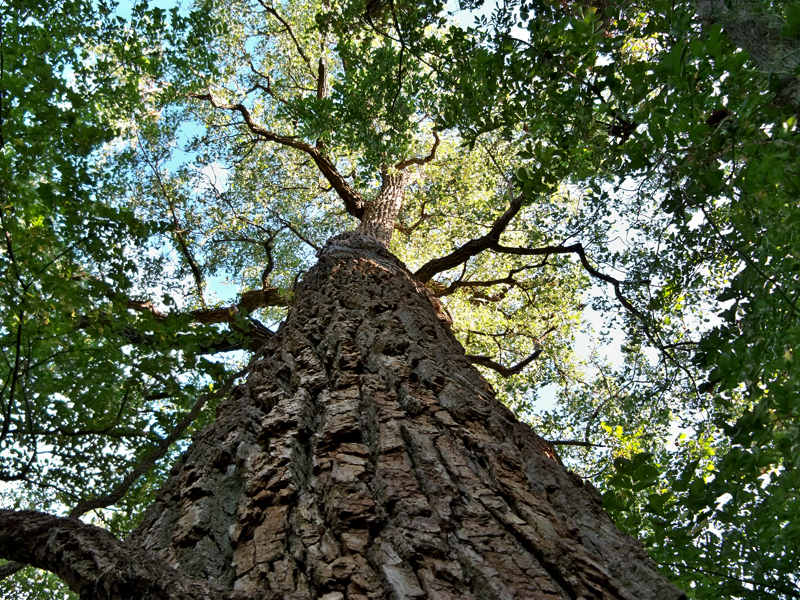
The one exception to the trees down here is the tallest cottonwood at the lake. The tallest tree in Dallas, according to the DFW Tree Database. At 120 feet in height, it towers over other trees in the area. It sits at the southeast corner of Lemmon Lake about 100 feet from the Trinity River. It lacks the crown spread and mass to be the largest tree in Dallas but has the height.

The tree is so tall that when you get to the base of it, you cannot even hope of seeing the top.


Spreadsheet noting the height of the cottonwood tree at this location

Trunk of the tallest tree in Dallas
The lake went dry here last summer and refilled during the heavy rains of last winter. Hopefully in the future this could be a great place to view wildlife year round. I was told it was originally on the short list of sites for the Trinity River Audubon Center. Wildlife abounds here with plants and animals not found within one hundred miles.

The headwinds facing this place are not so much to do with the land itself but the nefarious activities of some people who come down here. I have been told recently that hunting is not allowed down here, by anyone, for any circumstances. I keep getting emails from folks who have come across people hunting with dogs, a dead hog in a truck, people with firearms or as in the case of the photo to the right, a large tree stand. Pretty bold to do that.

Even taking the photos at Little Lemmon Lake on September 1st, a large amount of gunfire erupted from the west side of the lake on private property currently used as a salvage yard on Carbondale. Up to 100 rounds were fired in my general direction with a couple zipping over my head, many hitting the lake full of birds some of which are listed as Endangered Species. All the birds took off, none looked injured. Despite calling 911 to report the gunfire, no one called back(as they promised to) or came to investigate. Third time I have been shot at down there. Third time I called the police. Third time no one showed. The police down here that I meet in person keep telling me to report things like this because it will get more patrols in the area. Calling things like this in seems to not do much good, it appears. Be careful!

Sunday, March 6, 2011

Great Trinity Forest Trail, Joppa Preserve

Great Trinity Trail at River Oaks Park
The Trinity River Spine Trail is the longest paved path currently in the Great Trinity Forest. The path can be accessed in three spots:

River Oaks Park

Simpson Stuart Road


Phase I of the trail is 2.1 miles long.


Great Trinity Forest Trail Phase I

This trail is inside the Joppa Preserve, part of the Dallas County Open Space Project. Originally this land was part of the Millermore Plantation. Many of the pecan trees in the area were planted by the Miller family when it was a working farm. The original Miller cabin and the later Greek revival Millermore Mansion are now preserved at Old City Park in Dallas. The area later became known as Joppa and Floral Farms. Both were unincorporated freedman's communities for many decades without access to running water and city services.


Miller Cabin


Millermore Mansion

The path itself is the same width as the Katy Trail in Uptown. Currently there are not any public restrooms or working water fountains along the path.


The path roughly follows the shoreline of Little Lemmon Lake and then Lemmon Lake as it winds its way towards Simpson Stuart Road. Phase I of this trail was completed in the summer of 2010. Phase II which will run down the south bank of the Trinity towards McCommas Bluff will be completed some time in 2011.

Great Trinity Forest Trail, Joppa Preserve


Little Lemmon Lake, River Oaks Park
Video of the trail from Simpson Stuart area towards River Oaks Park


Foot bridge spanning creek that separates Little Lemmon Lake and Lemmon Lake. This was the filming location for the Texas Ranger scene in the movie Bonnie and Clyde.

Little Lemmon Lake

Same spot as photo above from Bonnie and Clyde

Great Trinity Trail Bridge between Lemmon Lake and Little Lemmon Lake


Same spot as photo above filmed in 1967


Good fishing in all three lakes. There is also a population of alligators in these lakes and one should be careful walking the shoreline near dawn or dusk. As a result, there are a number of warning signs near the lakes:

Wednesday, May 30, 2012

Airboating for alligator gar, a deer sighting and tropical birds at Joppa Preserve


The guy above is at the Loop 12 Boat Ramp after what he described as a "near fatal encounter" with the McCommas Bluff Lock and Dam on the evening of May 27, 2012. He was alligator gar hunting on this stretch of the Trinity River for the first time and was not aware that the McCommas Lock and Dam straddled the river below McCommas Bluff. He said that it was "1 in 1000" that he survived after getting hung up in the riffles, shoal, logs and concrete blocking the river there. He was pretty angry about it and shaking his head as he secured his airboat.

Signage exists at the Loop 12 Boat Ramp detailing the hazards of the boat ramp ahead but there are not any warnings about the navigable hazards up and down the river. That would include not only the 104 year old McCommas Bluff Lock but the brand new Standing Wave near Downtown. The alligator gar hunter seemed to be an experienced boater, mentioning he does most of his boating below Texoma on the Red River in water an inch deep. He suggested the city, county or Parks and Wildlife should install a sign at the boat ramp of those hazards.


Whitetail Buck At Loop 12
Whitetail Buck at Little Lemmon Lake, Great Trinity Forest Trail
Deer are so hard to see this time of year in the Great Trinity Forest. Most of the foliage is at a peak and sometimes seeing just 10 feet into the underbrush is difficult. The single whitetail in the photos above and below were taken just 3 minutes after I spoke with the airboater and not more than 200 yards away. The location is a small bridge that spans a canal separating Little Lemmon Lake from Lemmon Lake. At some point in the distant past I think this was the original channel for Five Mile Creek.
Deer with a dumped tire, only in the Great Trinity Forest
It's usually during the rut that bucks move around during the day coming closer to humans. So this particular deer out wandering around is something special for this time of year. It seemed to slowly drift off the concrete and back into the woods at a leisurely pace. Which was neat. Whitetail bucks lose their antlers in the winter and start to grow them back in April-May. The buck you see here has about a month of velvet growth so far and might have a decent sized rack of antlers come fall.

I checked with the DFW Urban Wildlife guy to see if this deer matches any of the deer in his automated photo collection and it does not.


The rebirth of Lemmon Lake and the return of the Roseate Spoonbills
Lemmon Lake May 27, 2012


Roseate Spoonbill May 27, 2012 at Lemmon Lake
I had written off Lemmon Lake as the victim of the 2011 drought. Baked to a crisp last summer the soil was literally sterilized of aquatic life by the heat. I thought that while the water would surely return the food chain of smaller insects and amphibians would take years to rebound. I was wrong. The bait fish, crawfish and frog populations are back full force. So are the birds from down south that feed on them.

Getting to a view of Lemmon Lake is difficult. Surrounded by thickets, bramble patches, poison ivy...and that's just the outer belt. Next comes a section of willow swamp, followed by a slog through snake infested 8 foot high reeds. The trail I whacked out of the undergrowth last year so that birders could visit has now become overgrown again to the point where one cannot even see it.  I chose a different bushwhacking route this spring and was rewarded with seeing an early set of Roseate Spoonbills. Hopefully, this is a sign of things to come for June and July with more strange birds of the tropics moving north for the summer.


Video of Lemmon Lake and a roosting Roseate Spoonbill in a willow tree with some Anhingas

White Ibis at Lemmon Lake


These feeding frenzys are interesting to watch. The Ibis organize into police lines, driving forward like a tractor plowing a field. The cranes, herons and egrets follow along either picking through the scraps or staying ahead of the ibis as they drive the larger fish forward. The larger shad as seen inset left are too large for the ibis and are readily picked up by the larger birds.


Where did all the mosquitoes go?
Southern Leopard Frog at Lemmon Lake

Red Swamp Crawfish at Lemmon Lake
I was last at Lemmon Lake in early May. It was a quick visit due to the clouds of mosquitoes in the brush. Within a minute of stepping off the concrete I was swarmed by the insects. My most recent trip...not a mosquito to be seen. I think the unusually large population of Southern Leopard Frogs might have something to do with that. The flooded timber of the winter and spring gave the tadpoles an excellent environment for brooding. This variety of frog is a swiss army knife of insect killing eating spiders, grasshoppers, flies and mosquitoes. Having these underfoot sure makes a trip more enjoyable.

It's interesting that all these photos were taken within 1/2 a mile of each other over about the course of an hour. The diversity of what exists down in that part of the Great Trinity Forest is just eye popping. The scenes of a guy with an airboat, deer, spoonbills, ibis and symphony of frogs are more out of a Florida swamp. Not a forgotten part of Dallas.


Tuesday, September 10, 2013

Wood Storks On The Rebound -- The Rare Species Returns To The Great Trinity Forest

Wood Storks in Dallas, Texas, photo taken by James Cartwright, August 1936
Some seventy seven years ago, a man named James "Jim" Cartwright took a small camera out fishing with him to an old bow on the Trinity River turned fishing club named Lemmon Lake. Out there one afternoon he took a photo of some strange looking birds that had flown in and were milling about on the grassy shore. Wood Storks. Late last year one of his descended relatives contacted me and I was given some of his old fishing photos from the lake. My interest gravitated to one photo in particular an old scratchy Wood Stork photo dated "August '36 Rod and Gun". That particular bird species in the next few decades would see its very population dwindle to almost nothing and faced the very real threat of extinction.

Wood Storks at Little Lemmon Lake, Joppa Preserve, Great Trinity Forest, Dallas, Texas August 2013

The 97th Meridian slices through North Texas as an imaginary line that exists only on drawn maps. In this locale, that line serves as a freeze/frost line in the winter separating brutal cold from the mild. In the fall the line is marked by great fall foliage to the east and barren brown to the west. In the spring, the great powerful fronts and dry lines rip off the plains to form thunderstorms.

During the summer, the 97th serves as an avian boundary of sorts for many wading birds that are common to the east and rarely if ever seen to the west. This is the time of year when the faint glow of a setting sun is oft punctuated behind the crests of ever rising thunderheads in the distance. In late summer 2013 as the seabreeze laden winds of the Gulf meet the hot winds off West Texas plains, the birds of the tropics find themselves at home in the Great Trinity Forest. The photos shown here were taken in late summer in a couple evenings when the weather quickly turned from sun to clouds to heavy storms and back to clear skies again.

I suppose it comes as a surprise to many that a bird of as rare a feather like the Wood Stork plans a summer vacation stay inside the city limits of Dallas. The record books of sightings of the species in our fair city draw a blank as to the migration of the bird. Not for lack of birds but for lack of perhaps sets of human eyes on the watch for them.

The Great Trinity Forest with its patchwork of wetlands and shallow ponds provides ideal habitat for wading birds. Just perfect. One such place known to attract such birds over the past few years is Joppa Preserve located south of Loop 12 and along the west bank of the Trinity River.

The wildlife laden areas of Joppa Preserve by modern standards is still difficult and remote to reach. The standard first time approach to the place is to clumsily step off the pavement into a mass of greenbriar thicket and poison ivy wondering if you will ever return. With the reward of remoteness to such a place comes the understanding that self-reliance is cornerstone of the visitor experience.

It's the gift of knowledge that surrounds this place. The deep hidden history of a spot. It seems that Dallas only offers parks with less adventure, no aura and no exploration, a quality of it's presence diminished is the product as a result. Joppa Preserve is not a cookie cutter park. It stands alone as one of the last great wild areas of North Texas.

The Wood Storks seen here in Joppa Preserve hail from the Mexican state of Campeche, western Guatemala and points south from there into the Amazon. They fly to Dallas as part of "dispersal" which occurs after their young have finished nesting. They leave the coast and head inland in search of habitat and food.


Wood Stork (Mycteria americana)


Wood storks (Mycteria americana) are large water birds that stand 2-4 feet tall and are the only stork in North America. They have wingspans as wide as 5 1/2 feet. They are mostly white, but have a black tail and many black feathers under their wings. Storks are related to ibises, herons and flamingos. They have no feathers on their head and neck, so the black skin underneath shows. This makes wood storks the only tall water birds with black, bald heads. Since they have no muscles attached to their voice box, they are very quiet birds.

Wood storks use the massive beak as their source of food gathering.  The feed in water no deeper than their beak and catch a variety of things in their bill which they then toss their head back and swallow.  This technique is known as “grope feeding”.  This because the stork does not use vision in food collection, but instead does everything by touch.  The reflex of the bill after it touches food is thought to be the fast of any reflex in the vertebrate world. When it feels a fish, the stork can snap its bill shut in as little as 20 milliseconds—an incredibly quick reaction time.


Below is a video clip shot in August 2013 of a Wood Stork flock working the middle of Little Lemmon Lake for prey

Their diet has been known to consist of fish, crayfish, salamanders, tadpoles, shrimp, frogs, insects and an occasional snake. Storks also use their feet to stir the bottom when collecting prey.  This technique startles the food from the vegetation into the beak. Some think that the water turbulence caused by this action simulates the water movement of a feeding frenzy, and can attract fish to become prey. 


Wood Storks were once hunted for their feathers and have also lost much of their habitat to swamp draining in Florida. In Texas, the Wood Storks migrate north in the early summer from Mexico to take advantage of drying lake beds and the abundance of fish found in them. There have been only a handful of sightings in the DFW area of Wood Storks. Joppa Preserve is special in that so many can be seen at one time. Wood Stork sightings are more numerous further to the south in the Houston and Corpus Christi areas where the habitat lends itself to Wood Stork feeding tactics. 

 A Threatened Species

In late 2012 Endangered Species Status for Wood Storks was downgraded to Threatened in the United States. The birds are given a statewide "Threatened" status in Texas. The Endangered listing applied to Wood Storks who live and breed east of the Mississippi in the Deep South and Florida. Wood Storks are still afforded the protections of Federal Threatened Status here in Texas but since they do not breed here they are given a lesser designation.


Passed in 1973 and reauthorized in 1988, the Endangered Species Act regulates a wide range of activities affecting plants and animals designated as endangered or threatened. By definition, endangered species is an animal or plant listed by regulation as being in danger of extinction. A threatened species is any animal or plant that is likely to become endangered within the foreseeable future. A species must be listed in the Federal Register as endangered or threatened for the provisions of the act to apply.  The Act prohibits the following activities involving endangered species:      

-Importing into or exporting from the United States.
-Taking (includes harassing, harming, pursuing, hunting, shooting, wounding, trapping, killing, capturing, or collecting) within the United States and its territorial seas.     
-Taking on the high seas.    
- Possessing, selling, delivering, carrying, transporting, or shipping any such species unlawfully taken within the United States or on the high seas.     
-Delivering, receiving, carrying, transporting, or shipping in interstate or foreign commerce in the course of a commercial activity.     
-Selling or offering for sale in interstate or foreign commerce
The United States breeding population of the Wood Stork declined from 20,000 pairs in the 1930's to about 10,000 pairs by 1965, and to a low of approximately 5,000 pairs in the mid 1970s.  Nesting primarily occurred in the Florida Everglades. The accepted explanation for the decline of the Wood Stork is the reduction of small fish necessary to support breeding colonies.  This population reduction is attributed to loss of wetland habitat as well as to changes in water hydrology from draining wetlands and changing water flow by constructing canals, levees and gates to alter water routing in southern portions of the United States.

Juvenile Wood Storks seen with tan-yellowish bills
Wood storks have a unique feeding technique and require higher fish concentrations than other wading birds.  Optimal water conditions for the Wood Stork involve periods of flooding, during which prey (fish) populations increase, alternating with drier periods, during which receding water levels concentrate fish at higher densities coinciding with the stork's nesting season.

This year it was rather interesting to see young Wood Storks in large numbers at Little Lemmon Lake. The young birds can be easily spotted by their yellowish-tan light colored beaks.


The Wood Stork , Bald Eagle and many other species of migratory birds owe their current existence in the United States to the determined, last-ditch efforts carried out under this legislative milestone. But attempting to pull species back from the brink of extinction can be an expensive and contentious proposition.  Even today, despite considerable conservation gains in the past few years, many challenges still threaten to drive species away from healthy populations, and onto the endangered species list.

The past half century has borne witness to dramatic changes in the quality and quantity of wildlife habitat. Throughout the United States, Mexico and South America, wetlands continue to be drained and filled, forests cut and fragmented, and grasslands developed for home construction. Many of these changes are not what they appear. While forest and woodland cover in some areas has actually increased, the quality of those habitats compared to the original woodlands may not be similar at all because of changes in vegetation composition and artificially abundant predator populations.  Other less intrusive land use practices have upset the natural balance as well.
As any ornthological minded person knows, some species are exceptionally rare, some are fairly common, and some can be found on almost any visit to the field. The differences one sees in species abundance occur naturally.  Natural events, like weather, predators, disease, and food and habitat availability, have shaped these patterns of species abundance for many centuries. In recent years, however, human activities have disrupted many of those natural events, resulting in a change in the shape of the environment. No place has seen more of that than the Trinity River.

The Trinity River As A Wildlife Highway

Wildlife, both fleet footed and on the fly, use the Trinity River as a main artery of travel from the parched uplands northwest of Fort Worth, clear to Trinity Bay on the Gulf of Mexico. It has likely been that way for hundreds of thousands of years, a route implanted upon the DNA of the species who frequent the river. Wood Storks are most likely no exception to that process.
Wood Storks at Little Lemmon Lake during a heavy thunderstorm

For continued survival of the United States population of wood storks, currently occupied habitat, roosting, and foraging environments must be protected from further loss or degradation.  A prerequisite for complete recovery of the population is the restoration and enhancement of suitable habitat throughout the variety of environments used by this species.

The very survival of the Wood Stork runs through places like Joppa Preserve and the Great Trinity Forest. An unlikely point of concern as so few people alive even know it exists. It has not been much of a going concern since the old Trinity Rod and Gun Club days when Jim Cartwright drowned worms here in the 1930s. Times change though and so do plans for development.
Little Lemmon Lake and Lemmon Lake are but just two of the dozen small ponds and marsh wetland areas in the Great Trinity Forest that give these wading birds forage area for food and habitat. There is grave concern at the moment that the dozen or so water bodies across the Trinity River to the east near the Trinity River Audubon Center will be impacted by a new planned golf course called the Trinity Forest Golf Course.

The AT&T Trail Construction, Habitat Loss For The Wood Stork?


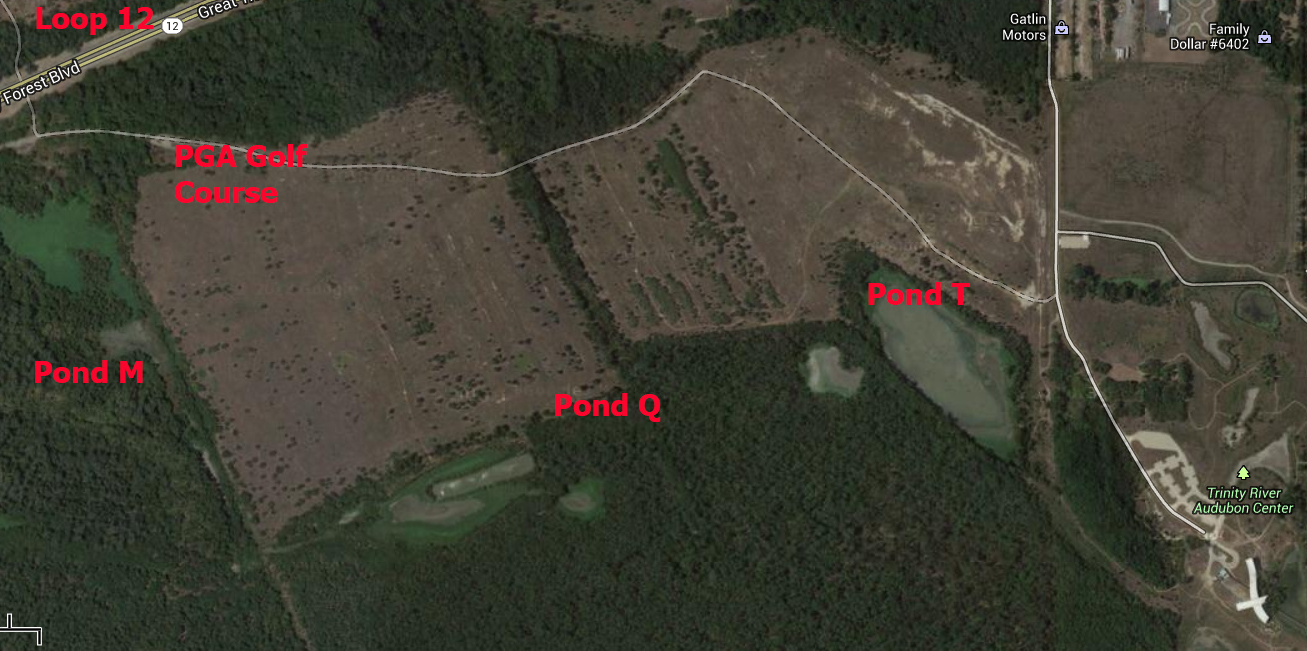
The AT&T Trail construction starts very soon, a concrete trail that will traverse one of the only undeveloped parcels of virgin hardwood bottomland left inside the city limits. It will also cut along the southern bank of "Pond T", what the friendly folks at the Audubon Center call the "Secret Pond". This pond serves as a virtual refuge for dozens of species of not just birds but river otters, beavers and deer. The impact of a new trail will degrade this special spot and have a negative impact on foraging Wood Storks.
Pond T, aka the "Secret Pond" which is one of many pocket ponds and lakes in the Great Trinity Forest
It seems odd that a place like Dallas would be such a touchstone for the survival of the Wood Stork. These old ponds are just the ideal habitat for them and every year more and more make their way up from the south. How can a trail be built in this area or a golf course developed without impacting the Wood Stork is an answer no one seems to have.

If we use Little Lemmon Lake as an example, the hydrology of such a water body is really unique inside the city limits. The lake sits just low enough so that the annual flooding events of the nearby Trinity River "overbank" into Little Lemmon. The fish, fry and aquatic life from the river regenerate the dry lakebed and transform it from a playa into a small lake teeming with life. As the weather dries and the punishing Texas sun works on evaporating the lake, wading birds flock in by the hundreds.

These are not the birds one might see at White Rock Lake. Sure intermixed are some Great Egrets, a few Herons but the other species are eye popping in diversity. Not seen anywhere else inside the city limits.

Most would stand jaw agape at seeing a Wood Stork ski in to visit with a flock of White Ibis. Just seeing the White Ibis for many would be a treat, watching a Wood Stork interact with them makes it so much more special.

Maybe the problem with the place is no one can take credit for what is going on here. No one can stand on a soapbox and say they are responsible for the habitat here or have somehow enhanced it to attract such wild birds. A freak of a natural place that the hand of man never had anything to do with. Imagine that.
Here the shorebirds, Sandpipers, work the mudflats along the shore with Black-Necked Stilts and Ibis beyond.

Two juvenile White Ibis center, two adult White Ibis on the margins at Little Lemmon Lake
Sandpipers in flight at Little Lemmon Lake
Take for instance the adult Black-Necked Stilt, Himantopus (mexicanus) mexicanus. Males and females are nearly indistinguishable, although the plumage on the backs of some females can be more brown than black in color. Stilts are remarkable because their legs are longer in proportion to their bodies than those of any other bird species except the flamingo.  The North American black-necked stilt is distinguished from the European black-winged stilt by the white spot above its eye. 

Don't see too many of these in Dallas, they often stick to flocks of other species, attracted to the very shallow water so many of them prefer.

Many of the birds here are fresh off the saltwater flats and coasts to the south. On occasion in the right light, the White Ibis can take on a pinkish shade of white, a hue, from the high amounts of saltwater crustaceans they consumed in the weeks before.


Wood Storks, Neotropic Cormorants and a Snowy Egret at Little Lemmon Lake
Hanging on by a fragile thread, the rare places left inside the city limits of Dallas that attract such wildlife seem to be in real peril from planned development. These smallish ponds and drying beds are the real endangered species of note. Oh so rare and important to so many species of birds, the world over, who seek out the water here for habitat. It would be a tremendous loss to the city as a whole, we would all be poorer for it, if the planned development here impacted the wildlife in any way.
Little Lemmon Lake as the storms clear after an evening thunderstorm