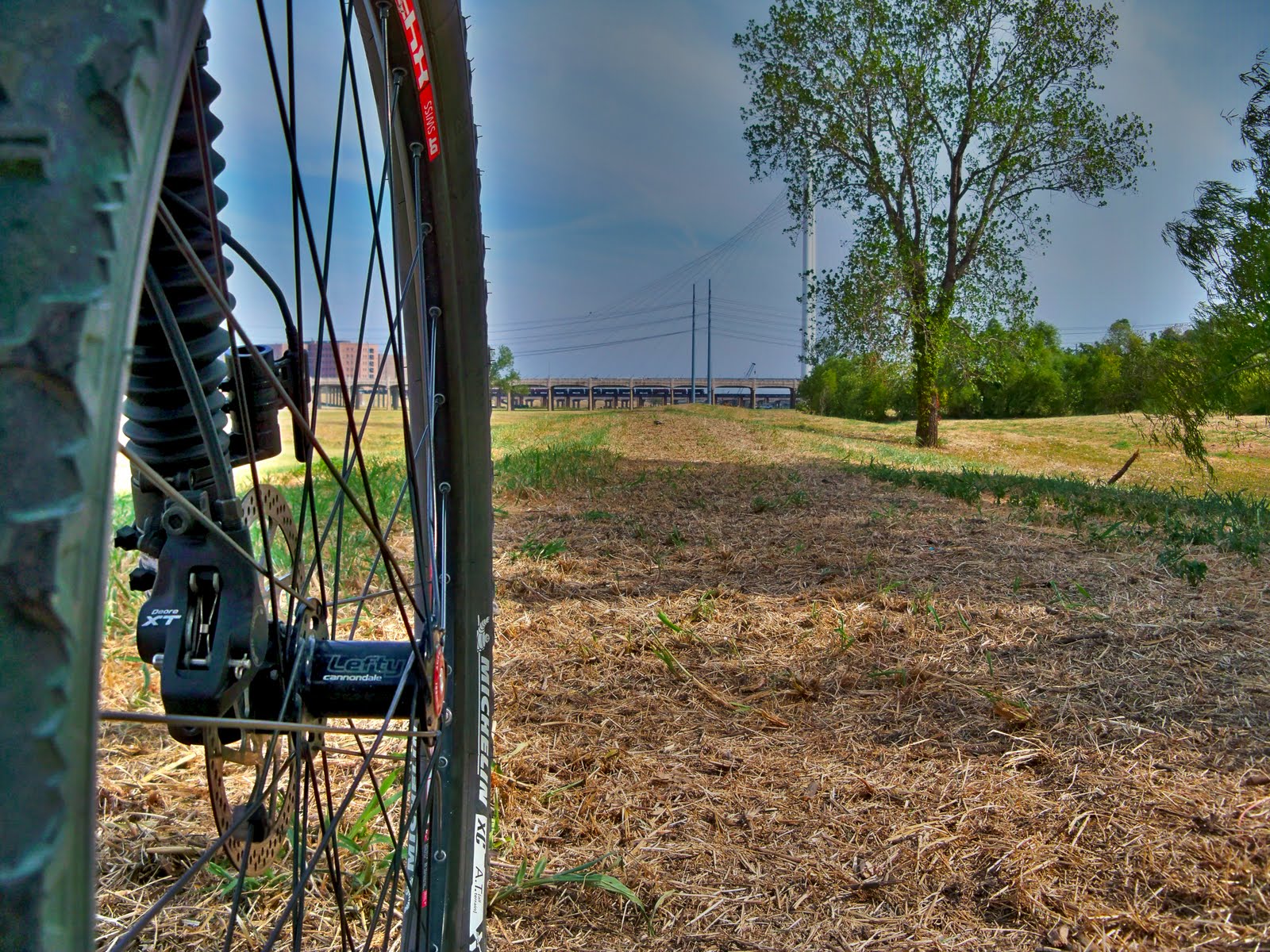
This practical guide takes readers to the best trails found in the Great Trinity Forest, all within easy reach of Downtown Dallas. Destinations include less traveled, low-traffic areas for hiking, mountain biking and horseback riding in the City of Dallas. Joppa Preserve, McCommas Bluff Preserve, Trinity River Wetlands, Texas Horse Park, Dallas Trinity Paddling Trail, Lower White Rock Creek, Sycamore Dixon, Texas Buckeye Trail, Dallas Whitewater Wave, Levee Trails, Rochester Park and more.
For over a century, Simpson Stuart Road has quietly disappeared into the riverbottoms of the Trinity River. Making a transition from concrete to asphalt to gravel to dirt to pecan covered forest floor in under a mile. The loud traffic of jake braking 18 wheelers carrying their burden to the McCommas Bluff Landfill quickly yields to near country road silence as one passes the Eco Park development. What was once an area known only by illegal dumpers is slowly being transformed into the new Trinity River Trail.
The horsemen in the area have known the day would come when their dirt trail would be paved. For them, horseback riding is a way of life. They grew up in rural ranch settings where their unorthodox looking Mexican saddles were more functional than the western style saddles we see here in Texas. They are experts in their craft. Often taken recently saddlebroken half wild horses on rides through the woods. A few sing and whistle as they ride with only the woods for an audience. Here you can get away with that, they say.
Horseback riders on the Trinity Trail September 18, 2011
It's the last ride. The last one on dirt. As you can see above the forms are in place. The dirt has been graded. All that's left is the rebar and concrete. In a week it will be concrete. The passing of an old trail and the beginning of a new one, the Trinity River Trail. It will connect the Trinity River Audubon Center with the south side of the river then make a U shape around to Simpson Stuart Road(photo above). From there it will connect with Phase I of the Trinity River Trail which skirts Lemmon Lake from Simpson Stuart to Loop 12. More can be read about Phase I in a previous post here
Simpson Stuart Road looking west, Greater Roadunner
Known as Camp Wisdom Road in western parts of Dallas, the road changes names to Simpson Stuart as it heads east. In the photo to the left you can see the traffic light for the I-45 overpass in the far distance to the west. Vehicle traffic is supposed to stop at the Eco Park building, in the photo you can see where the trail bollards(posts) to keep vehicles from driving down the closed section of road have been removed. In the foreground under the shade of a tree stands a Greater Roadrunner.
Dallas Roadrunner
This particular roadrunner has been spotted along this stretch of road for years. The Greater Roadunner (Geococcyx californianus) is part of the cuckoo family.This roadrunner is also known as the chaparral cock, ground cuckoo, and snake killer. This particular roadrunner seen in the photo on the right is probably what is responsible for all the small dead snakes that litter the road where it transitions from asphalt to gravel.
As you can see, this part of Dallas has more of a country rural feel to it than an urban environment. A neighborhood once known as Floral Farms, an unincorporated community in Dallas County. Hashed out of a piece of land between the Union Pacific tracks and the Trinity in the late 1940s, the area was annexed by Dallas within the next decade. Floral Farms afforded African American residents a community where they could live in a semi-rural setting and be away from the confines of the highly segregated urban areas at that time. The city eventually bought the homeowners out on a voluntary basis in the 1970s. Unlike Joppa that sits on a high piece of ground, Floral Farms sits not much higher than the river itself making it potentially flood prone. The removal of homes was done in a half-hearted manner so even 40 years later some structures still stand. Outhouses, sheds and foundations are still visible.
Abandoned Joppa Rodeo Pen in Floral Farms
Above is what remains of the Pig Park Rodeo in the Floral Farms ghost town/neighborhood. The Pig Park Rodeo began in the late 1970s-early 1980s by two brothers and ran into the early 1990s. The rodeo was very popular with people in the area. I'm still asked about it, where it is, what is left, will it come back.
Joppa Rodeo Arena Pig Park Rodeo
Above is what is left of the Joppa Rodeo Arena. A dilapidated fence marks the boundary of the old arena. In the background are sets of old wooden pens to hold animals used in the rodeo. The concentric ring you see in the arena is used by current horseback riders for training. Under the weeds, the pillow soft sandy loam of the arena still exists making an ideal place to train a horse. You can find the location of this old arena on Google Earth. Just look for the figure 8!
Father and son riding with the setting sun on the future Trinity Trail
So...close one chapter and begin a new one. The city says it wants to open the trail October 23, 2011. I'm not sure that is possible with the ongoing large open pit water main project scheduled for completion in 2012. I sincerely hope it's not another case of putting the cart before the horse like the Dallas Wave Park where it is opened then promptly closed. We'll see.
It would be fitting if the trail would open on October 23rd as that date is made famous in the Old Chisholm Trail song. There are 1000 different versus and variations sung by Leadbelly, Roy Rogers, Woodie Guthrie...but the first few lines have always stood the test of time:
Oh, come along boys and listen to my tale
I’ll tell you all my troubles on the ol’ Chisholm trail
On a ten dollar horse and a forty dollar saddle
I was ridin’ and a-punchin’ Texas cattle
We left ol’ Texas October twenty-third
Drivin’ up the trail with the U-2 herd
I’m up every mornin’ before daylight
And before I sleep the moon shines bright
The handful of times I have ridden this trail it seems I am shadowed by house gawkers driving up Kessler Parkway in their vehicles at 10 mph looking at the homes that line the street. Time to get out of your cars and hit the trail. Part of the Dallas Trail Network Plan, the Coombs Creek Trail in Oak Cliff offers access to the Trinity River Levee Trails and Oak Cliff along the winding Coombs Creek. Phase I of the trail completed within the last year sits at about 1.5 miles in length with another half mile of soft surface dirt trail on the north end that skirts the edge of a dirt berm and levee spillway for the creek. Trail runs from the Stevens Park Golf Course near the Tennis Courts(south end) and roughly terminates behind the Lone Star Doughnuts Bakery on Beckley(north end). The Coombs Creek Trail affords easier access to the Trinity River Levee than most other routes coming from Oak Cliff. While the trail does not quite reach the levees, it remains the best option at the moment for access to/from this part of town.
Below is the current southern end of the trail where it dead ends at the Stevens Park Golf Course near Kessler Parkway and Edgefield. Future plans include a build out towards Cockrell Hill.
Southern end of Coombs Creek Trail at Stevens Park Golf Course
The southern end of the trail abruptly stops just on the south side of the Tennis Courts. Plans are in the works to expand the trail south at some point. Until then, the city seems to tolerate foot traffic on the golf paths through the golf course. Most public courses require a green fee to be paid prior to entering a golf course, Stevens Park seems to have made an exception per this sign:
The cart path and elevation changes are really not suited for a bicycle. Better to bail out onto Kessler Parkway if you are using the Coombs Creek Trail as a route to travel to points beyond. This is not that bad of a route to take from the Katy Trail over to the Oak Cliff Nature Preserve since you avoid much of the traffic drama around the Bishop Arts District, Jefferson Blvd and some of the schools. Matter of fact, its the main reason I'm even mentioning a neighborhood trail like this. This trail completely works around Methodist Hospital, the somewhat heavier traffic and the hills. It's a low traffic to traffic free option if you want to explore this neighborhood.
Stevens Park Tennis Courts lower left with Bank of America Tower in the distance
The Coombs Creek Trail is nearly tabletop flat the entire length. Sylvan Avenue is the only large street to cross and the traffic signals/crosswalk are decent for what Dallas usually offers. Kessler Parkway and the Coombs Creek Trail were purpose designed as a flat winding road on what amounts to a bench cut in the Oak Cliff outcropping. Nearly 90 years ago, County Commissioner Ledbetter of Cockrell Hill wanted a scenic drive from Downtown Dallas, through newly minted Oak Cliff to Cockrell Hill. His vision was to build Kessler Parkway along the creek. To do it he needed to physically move the meandering creek to the west and take out much of the undulating rock in the way. Without a large budget, he simply emptied the Dallas County Jail and used large chain gangs of prisoners to clear the creek and build the roadbed.
Wildflowers on Coombs Creek Trail south of Sylvan
Much of the Coombs Creek Trail is shaded by large pecan and oak trees. The creek stays to the immediate west of the trail the entire length. Coombs Creek is actually misspelled. The creek is named after William Coombes, the first pioneer to settle this part of Dallas. He arrived in 1843 from Kentucky with two oxen, a wife, a parrot, a cat and a frying pan. He built the first log cabin in West Dallas near what is now Fort Worth Avenue.
Coombs Creek Trail soft surface section looking south towards paved section
The paved portion of the trail ends 1.5 miles from the Stevens Park Golf Course. From there the trail is soft surface as it approaches Beckley. There is a short and somewhat steep rise to the top of a flood protection levee and gate.
View of Calatrava Bridge from top of Coombs Creek Flood Protection Levee
From the point above you can get a good view of the Calatrava Bridge and Downtown Dallas. Here you can continue to follow the soft surface trail around the top of the levee as it curls around to the south and west.
Coombs Creek Flood Protection Gate
The gate above pumps water from Coombs Creek under Beckley and then over the Trinity Levee just east of the I-30 bridge. This structure was originally built in the late 1920s. It was rebuilt when I-30(the turnpike) was built decades later. Someone got the bright idea in the 1920s that this U shaped high walled levee would make an excellent backstop for bullets. It became the official Dallas Police Department firing range for about 15 years. Here many police officers and even civilians were trained in marksmanship.
Coombs Creek when it was a Dallas Police Department gun range
The photo above was taken in the same spot as the levee and gate photo. Dallas had a substantial civilian marksmanship program at this range where many women were taught how to use firearms during World War II.
Coombs Creek Spillway
If you continue around the levee on the soft surface trail, it will eventually come to an end at the Coombs Creek Spillway across from the main Dallas Post Office on I-30. Many people who frequent I-30 have seen the spillway which serves as an emergency floodway in case of a biblical flood.
View of Downtown Dallas from Coombs Creek Trail
If you want to get from the Coombs Creek Trail to the levees, note the photo above. Travel down the dirt road, through the gate and down the alley to the left. Beckley is on the other side of the building in the photo. In the distance you can see the levee road which will put you at the immediate east of the I-30 bridge. The alignment I have described above is one of the routes the city had on the drawing board to lengthen the Coombs Creek Trail to the levee.
Under the I-30 bridge looking towards the Large Marge
One other interesting public works project along Coombs Creek is the Kidd Springs drainage where it flows into Coombs Creek
Kidd Springs where it enters Coombs Creek
When the Trinity River was moved from its ancient bed to the new floodway, many of the old creeks and tributaries had to be rerouted too. One example is Kidd Springs. Seen above in it's current outlet, the creek flows underground 1500 feet and drops vertically almost 100 feet to meet Coombs Creek. This was a large undertaking in 1930 when it was constructed. Nearly all of it was dug through solid rock and once again, prisoner chain gangs were used to do some of the work. It was completed ahead of schedule and under budget.
Below is a 1930 photo of the same spot in the photo above
Kidd Springs at Coombs Creek
1930 photo of the Kidd Springs aqueduct through Oak Cliff
The photo above shows the massive undertaking. Until the drainage system for Central Expressway was built in the 1990s, this particular project was the deepest drainage tunnel in Dallas.
Home on Kessler Parkway @ Cedar Hill
The Coombs Creek Trail is only a 10 minute bike ride from the Katy Trail. Simply ride over the Continental Street Viaduct, get on the levee road, go up over the levee at I-30 and cross Beckley.
I think many recent transplants to Dallas or architecture snobs would really gain a unique point of view and new perspective to town visiting this area on foot or bike. Like most neighborhoods in Dallas, residents hate people looking at their homes from cars but always seem to welcome those walking a dog or riding a bike. This part of Dallas resembles Highland Park with hills. Check it out.
Running through the heart of Dallas at 30 feet high and over 24 miles in length, the Trinity River levees in Dallas have a combined 40 miles of dirt access roads open to the public. An additional 9 miles of soft surface trail are currently under construction inside the levees. The end goal is to connect the Katy Trail, the Trinity River Trails inside the levees, Trinity Strand Trail and the Oak Cliff neighborhood. The current access roads are utilitarian and serve the maintenance and construction needs of the levees. Good for heavy vehicles not so much for jogging, walking a dog or riding a bike. In the summer of 2011 an initiative was started to bring a new trail concept to the Trinity between the levees. One that would be more attractive to the average Dallasite and serve more of a recreation base than what the current access roads offer. The levee road and future trail are only minutes from the Katy Trail on the north side of the river and one minute from the Coombs Creek Trail that feeds in from Kessler Park on the south side of the river.
Many of the yet-to-be-constructed trails for the Trinity are bought and paid for with bond money as far back as 1996. Tangled in budgets, long range planning and government bureaucracy many of the planned trails are still in the distant future. Years away. The Trinity trail initiative was designed as a quick win solution to put something, anything down between the levees that people could enjoy sooner rather than later.
You can read more about the detailed specifics of the new Trinity Trail near Downtown here on the Team Better Block website:
A couple of city bridge and pump station projects will limit access to the levees in the near future. The closure of Sylvan Avenue for a new Sylvan Avenue Bridge will close Crow Park and the parking lot. The Pavaho Pump Project also commands a good chunk of real estate on the south levee near the Continental Bridge. Another issue is the pace of construction at the Santa Fe Trestle Trail. The trestle trail will serve as a vital crossing point at the southern terminus of the levee. Until the trestle is complete it will be hard for visitors to enjoy both sides of the river.
Best Access Points:
From the Katy Trail by bike:
Option 1:Ride down to the American Airlines Center, hang a right at the Hard Rock Cafe and go out Continental. You can cross the Continental Bridge to access the south levee from here -or- weave between the buildings that back up to the levee and climb the levee with your bike.
Option 2: Ride down to the American Airlines Center, head north on Victory Avenue under I-35. You will make a left on Oak Lawn where the Meddlesome Moth is located. Head south a couple blocks to where Oak Lawn dead-ends at Levee Street. Weave your way between a building and get up on the levee.
Either route takes less than 5 minutes from the Katy Trail. The route past the Meddlesome Moth is probably more low key traffic wise but does not offer the option of getting to the south side of the river.
From Oak Cliff:
Best route from the Arts District or Kessler Park is to hop on the Coombs Creek Trail to where it dead ends behind the Lone Star Doughnut Factory on Beckley. Cross the street and hop on the levee from there. From the Oak Cliff side you have more options for access to the levee since Canada Drive affords easier access.
The new trail is still in a rough cut form at the present time. Below are some photos from over the Labor Day Weekend showing the basic outline of where the trail is headed. Still in a "rough draft" form but easily rideable on a mountain bike. I believe the goal is to make it accessible enough for a baby stroller. Some sections that is already possible.
Newly cut Trinity River Trail between Commerce Street Bridge and Union Pacific Trestle
Trinity River Hike and Bike Trail under construction I-35 Bridge in distance looking west
Newly marked Trinity River Connector Trail east of Trammell Crow Park looking east towards Calatrava Bridge. This would be about where Oak Lawn dead ends at the levee
The levee system was built as a result of the tragic 1908 floods that engulfed much of Dallas. First planned by George Kessler in 1910, the plan was to straighten out the Trinity and limit the dangerous flooding in the future. Leslie Allen Stemmons was the visionary that saw it to completion in the early 1930s. The first levees of the 1930s were smaller and less robust than the ones we see today. Over the years many improvements have been made to keep up with the ever evolving requirements set forth by the Corps of Engineers.
Hawk near the Calatrava Bridge carrying what I believe to be possum parts as viewed from newly cut Trinity Trail
Stemmons created the 10,000 acre Trinity Industrial District out of the now reclaimed river bottoms which contribute an estimated 18% of the tax base for the city. The I-35 corridor, World Trade Center, Anatole Hotel, American Airlines Center and Trinity Design District now sit where the Trinity once flowed. The Trinity Strand Trail will follow the old riverbed through this area.
Map showing portion of Old Trinity River channel alignment
Many access points exist to get onto the road and trail. The formal trail that the City of Dallas has designated as the Trinity River Levee Trail runs from Trammel Crow Park on Sylvan Avenue to the Westmoreland Bridge upstream, across the old Westmoreland Bridge, then back to Sylvan Avenue. The city spent $300,000 to improve the levee road in this area to make it more of an all weather surface with gravel and brick dust. Best way to enjoy this stretch of trail is to travel clockwise since one has the best view of Downtown Dallas facing downstream from the south levee on the Oak Cliff side. This section is 6 miles in length total as a loop. It is also what one could call an "all weather surface". It drains well after a rain and can be walked on after weeks of wet weather. The majority of the levee roads throughout the levee system become a nasty gumbo like mess of blackland mud. Avoid.
Old Westmoreland Mockingbird Bridge over Trinity River. New Westmoreland Bridge built above old.
Photo above shows the old Westmoreland Bridge that was left intact when the new bridge was built in the 1970s. It provides an excellent crossing point if you are coming down the levee from Bachman Lake or from the Mountain Creek area.
The bridge is unofficially called the Bonnie and Clyde Bridge. Given the name since the two notorious outlaws once called this part of Dallas home and used the bridge frequently since they lived on opposite sides of the river from one another. Earlier in the post is a map showing the old river alignment. If you click on it to see a larger version you can get an idea of the hellhole West Dallas once was. A lawless area of murderers, crooks and no goods. Open pit dumps, gravel pits and raw sewage. Much of that has changed and the only telltale that there was once a dump in the area is the small shards of glass that glitter on the lower levee road near the Westmoreland Bridge on the south side. In that era most of the trash was still organic in nature, lots of paper products, plant/animal parts with the exception being glass. That's what you see.
Note: Access to the Trinity River Levees is limited to non-motorized vehicles, pedestrians and horse traffic. Driving a personal vehicle, motorcycle or ATV on the levee road is forbidden and subject to a fine.
Outside of the designated 6 mile loop between Sylvan and Westmoreland, I would suggest using a bicycle of some kind for exploring the levees rather than on foot. With a lack of facilities such as water fountains or restrooms, seeing it on foot becomes rather difficult. A bicycle with wide tires such as a mountain bike, cyclocross bike or even a beach cruiser will work well. The road surface varies from hardpack dirt to loose sand and gravel depending on the section you are riding.
View of Oak Cliff as seen from the end of the levee trail where Mountain Creek crosses under I-30 at the Dallas/Grand Prairie city limits
The photo above shows the end of the levee trail as it approaches I-30 at the Dallas/Grand Prairie border. In the distance you can see the abrupt rise of Oak Cliff and Chalk Hill in the background. A crude ATV trail exists under I-30 and towards Mountain Creek Lake. These trails are a rats nest of trails that only doubleback on themselves and not worth the effort of exploring. The trail surface above is typical of what one finds on the south levee. Pea to marble sized gravel, some places looser than others. As one travels further west on the levees the feel becomes more rural. You pass a couple rodeo rings, horse stables, chicken coops and the random piece of wandering livestock.
Trinity River Levee Trail and spring wildflowers from north levee
The same rural feel holds true heading up the north levee as it begins the gradual swing towards Bachman Lake and Love Field. The levees deaden much of the sound of the city.
Since the area inside the levees is a floodway, the prairie space in the floodplain can remain marshy and muddy for months after a rain. Take caution if you decide to venture off the establish roads as the underlying soil is often mud.
Wetland Pond near Downtown Dallas inside the levees
The marshy wetland above runs from the Sylvan Avenue Bridge to the recently built Calatrava Bridge. Quite a bit of poison ivy in this section and quite a few snakes as well. Flash flooding in this area is not an issue. After a storm, much of the water must be physically pumped over the levees by a series of large pump stations strategically placed to de-water areas behind the levees.
Houston Street Viaduct and Cliff Towers as viewed from Trinity Levee Trail
The Houston Street Viaduct recently celebrated its 100th birthday. Built in 1910 it was the world's longest concrete bridge at the time at a price of $600,000. The bridge was formally dedicated and opened on February 22, 1912. The bridge was originally constructed to include streetcar tracks, two sets. That never came to be a reality. The bridge now serves as a one-way north to south route from Downtown Dallas to Oak Cliff. It was placed on the National Register of Historic Places in 1984.
If you look carefully along the river channel you can find long abandoned bridges and roads that once served long forgotten areas like Eagle Ford and the old Singleton Road alignment.
One stop worth visiting is at the southeast corner of the Commerce Street Bridge. Here you get a decent view of Downtown Dallas and some basic background information on the Trinity River Project. Some of the information is outdated with projects that have been cancelled or are on hold.
Trinity River Overlook on southeast corner of Commerce Street Bridge
Trinity River Project Overview Panels
Levee Trail users in West Dallas
Despite the lack of a great running surface and limited access, many West Dallas residents use the levee top trail between Sylvan and Westmoreland in the evenings. Access to a quality facility such as a sidewalk or path in their neighborhood simply does not exist. While the planned Bernal Trail will help add to the infrastructure, long neglected areas like West Dallas simply lack the right kind of areas where people can stretch their legs. In addition, there is not any access to the levees via footbridge catwalk. The residents who use the levee trail in this area must navigate through the often swampy wet areas on the back side of the levees to reach the trail. It's cool to see people making the best of what they have and taking the initiative to get off the couch in the evenings.
Video clip of the moon rising behind the Margaret Hunt Hill Bridge in June of 2011. I had a general idea of where the moon would rise that evening but due to the haze on the horizon and some high clouds to the east, that trip was a bust. So, I just setup a spare camera on a tripod down near the bank of the river and let it run for half an hour unsupervised. There are so few people that ever get down in the floodplain that I was probably a mile or more away from the camera as it filmed. I was not concerned that anyone would come by and take it.
Bridging the Trinity River at the end of the Central Dallas floodway, the old Atchison Topeka & Santa Fe Railroad Trestle is being retrofitted into a hike and bike path. Below are some recent photos from August 2011 showing the most recent construction progress. The Oak Cliff (south) side of the path is largely complete. The north side still has considerable construction to finish and requires a climb up scaffolding to reach. Even though access to the bridge is easy from Oak Cliff/Moore Park, it's still an active construction area and should be avoided till complete.
Video riding up the approach and across the Santa Fe Trestle Trail, August 2011:
The bridge was originally built in 1926 and served as a main artery for the AT&SF Railroad in Dallas. Some old signs along the old right of way can still be found in the overgrowth. In 1985 the trestle was burned in an overnight fire destroying over half the structure. DART purchased the railway and bridge in 1989 later deciding to build a new bridge next to the old Santa Fe trestle rather than retrofitting the existing bridge. Since that time, the Corps of Engineers has floated the idea of removing it as the bridge acts as a partial obstruction for flood debris during high water.
Below is a photo taken in June 2010, a month or so before construction began on the Santa Fe Trestle Trail and the Dallas Wave whitewater park.
Santa Fe Trestle June 2010
At the time, the riverbank was overgrown with brush, poison ivy and ragweed.
Below is a video clip shot the same day, June 2010 of some fisherman boating up the Trinity River:
Below is roughly the same location in late May 2011, roughly 11 months after the first photo was taken. In the photo you can see the Dallas Wave, whitewater feature.
Southern approach ramp from Moore Park looking towards the trail bridge and DART bridge
Santa Fe Trestle Trail looking south
Incomplete north approach looking north towards Fair Park
Completion is rumored to be late 2011. The Trestle Trail shares the same name as the Santa Fe Trail that connects White Rock Lake with Deep Ellum. When complete the two trails will not connect to each other. All they share is a similar name. Access to the Santa Fe Trestle Trail will be from Moore Park on 8th Street and from a yet to be constructed parking area near the eastern end of Riverfront Blvd.
To access the levee trail and Santa Fe Trestle from White Rock Lake, I would suggest riding the Santa Fe Trail towards Fair Park. Through Fair Park and down Grand Avenue. Inside Fair Park, Grand Avenue is the gate closest to Big Tex and the main Fletcher's stand. Head south out that gate. Hang a right on Lamar, left on Corinth, left on Riverfront.
Heads up: In the past I would have suggested riding straight out Grand Avenue and crossing the Union Pacific tracks between the DART tracks and the Andrews Beer Distribution Warehouse. Due to safety concerns regarding recent pilferage of rolling stock, the Union Pacific Police heavily patrol the area. I was stopped once by one of their officers. He was a nice guy, just wondering what I was doing. He also made the point that I should not cross there.
The option of riding down Lamar to Corinth then under the railroad tracks using the Corinth underpass seems dangerous since it is so dark and the vehicle traffic is moving fast. I would have to coin flip which route to take. The easy route over the tracks or the more dangerous but legal Corinth route. Good news if you live in Oak Cliff you have it made!
I'm somewhat disappointed to see Dallas Water Utilities flexing their muscle on a project at McCommas Bluff Preserve. Over the years that I have been mountain biking in the Great Trinity Forest I have always brushed off right-of-way clearings, alignments and heavy construction. Newly cleared access roads and water main excavations have always opened new avenues to explore the woods into areas that were previously inaccessible. This time it's different.
I know that the soil in the river bottoms is so fertile that a bulldozer charging through the understory will be brushed off by the surrounding woods in a matter of weeks. A space opens and something nearby jumps into the fray to take the place. I also know that the Trinity River serves as the mother of all utility right of ways for gas, sewage, fiber optic cable and freshwater mains from area lakes. You have to break a few eggs to make an omelet. I realize the importance of utility right of ways and the need to keep them free of debris, brush and trees. If a company wanted to drill a gas or oil well down there I would be all for it. This time it's different.
I'm also probably guilty of not mentioning the somewhat difficult circumstances I encounter on a regular basis in the Trinity Forest. The illegal dumping, near constant sound of distant gunfire, butchered animal parts, marijuana farms, burned vehicles. I can look past that with a 1000 yard stare knowing distractions like that help keep some of the more special places, special. This time it's different.
McCommas Bluff has been a focal point of human activity for centuries. It was first mapped by the French explorers. It was first settled by William Shelton in the 1840s, an Illinois veteran from the Mexican War. The bluffs carried his name, Shelton's Bluff until shortly after the Civil War. In 1850, he married into the Dawdy Family who ran a ferry service on the Texas National Highway across the Trinity River downstream a few miles. Pronounced "Dowdy", the misspelling took and Dowdy Ferry Road is now over the old Texas National Highway route. Shelton, the Dawdy and Beeman families were all Illinois natives and they knew each other prior to immigrating to Texas. Dawdy and Beeman also appear together on muster roles for Bird's Fort. Together the three families owned most of the land along the Trinity just south of what is now Fair Park to Hutchins, in what was then Nacogdoches County in the Republic of Texas. The McCommas family purchased the Shelton land after the passing of William Shelton. The name Shelton's Bluff stuck through the Civil War, eventually changing names to McCommas Bluff on maps in 1880.
When efforts were made to navigate the Trinity River for the first time in the late 1800's, McCommas Bluff for a brief time was a beehive of activity. Land for a inland port was platted and surveyed. Some homes, a few businesses and a wharf for moving bales of cotton was even constructed. McCommas Bluff served as a staging center for cotton, bales were barged south to Porter's Bluff near present day Rice, Texas where they were put on larger barges before heading for the the coast. Nothing ever came of the plan since the river was not suited for boat traffic of that type.
In 1986, to commemorate the Texas Sesquicentennial , twin Texas Historical Markers were erected by the Texas Historical Commission to commemorate the history of the Trinity River. Identical historical markers were placed at McCommas Bluff and Reunion Plaza(near Reunion Tower). They read:
Navigation of the Upper Trinity River
Since the founding of Dallas, many of the city's leaders have dreamed of navigation on the upper Trinity River, but none of their attempts achieved lasting success. Fluctuating water levels and massive snags in the river below Dallas hindered early navigation. In 1866 the Trinity River Slack Water Navigation Co. proposed dams and locks for the waterway. Capt. James H. McGarvey and Confederate hero Dick Dowling piloted "Job Boat No. 1" from Galveston to Dallas, but the trip took over a year. In 1868 the Dallas-built "Sallie Haynes" began to carry cargo southward. Rising railroad freight charges spurred new interest in river shipping in the 1890s. The Trinity River Navigation Co., formed in 1892, operated "Snag Puller Dallas" and the "H. A. Harvey, Jr.," which carried 150 passengers. The "Harvey" made daily runs to McCommas Bluff, 13 miles downstream from Dallas, where a dam, dance pavilion, and picnic grounds created a popular recreation spot. In 1900 - 1915 the U. S. Government spent $2 million on river improvements, including a series of dams and locks, before World War I halted work. A critical 1921 Corps of Engineers report ended further federal investment. Despite sporadic interest in later years, the dream of Dallas an an inland port remains unrealized.
----------
You can walk right out of Reunion Tower and see the historical marker. It's twin at McCommas Bluff was stolen a number of years ago and never replaced. The post to which the historical marker was affixed remained. Until last week. When it was bulldozed. It had sat there since 1986, a relative newcomer to McCommas Bluff. The trees around it, while somewhat short in stature, varied in age from 50 to over 125 years old. Trees that witnessed most of the history mentioned above. They managed to survive the dozen other pipeline projects, gas line installations and water main redos.
I know how much fun running a chainsaw can be. Even better when you can just cut down stuff and not have to bother with cleaning it up. The photos below are before and afters of what it looked like as little as a month before the clearing began.
McCommas Bluff July 2011
One of the highlights of visiting the Great Trinity Forest for me is my usual turn around point, the end of the trail, what is usually a somewhat spectacular early evening view of McCommas Bluff from the far bank. It's about 20 miles from home, halfway. Makes you feel like you have been to some far off place seeing a piece of geography better suited for the Hill Country. I'm sure if it was in the Hill Country along the Guadalupe or Frio, Willie Nelson would have written a song about it. Making it here from where I live in North Dallas is usually no small feat, navigating the roads down to White Rock Lake, then south through what are the toughest and possibly most dangerous neighborhoods in Dallas.
McCommas Bluff August 2011
Both photos were taken virtually in the same spot. The large tree trunk in the foreground was from a 65 year old tree. Like I mentioned above, I respect the need to clear right of ways for projects. The results are somewhat drastic. Especially when one does not clean up after themselves.
Mountain bike ride with DORBA members April 2011 Great Trinity Forest
August 2011
Both photos were taken within 50 feet from one another. The cedars chopped down on the far bank have tree rings noting 50-125 years of growth on them. The trees that are closest to the waters edge show evidence that they had been sitting over a week. August 13th as a result of a rainstorm, the river rose three feet. The tree debris closest to the water shows mud lines where the river submerged the branches. You can also see a pipe with a layer of concrete over it running vertically down the bluff. This is the ROW for utilities. I would gather that in the past, any construction did not need such a large footprint to accomplish their construction.
McCommas Bluff July 2011
McCommas Bluff August 2011
It's just not the trees that are gone. It's the view. Arguably the only naturally photogenic piece of property on the Trinity, the view is damaged for a lifetime. Trees that grow on nearly bare limestone take many decades to grow. The trees chopped down cannot be replaced. I'm feel fortunate that I had the opportunity to take some photos of the bluffs and climb all over them before the clearing took place.
It's easy to answer the question of why this happened. Simple. They are working on a large water main. The harder question to answer is if the city and county are really serious about turning the "Great Trinity Forest" into a place that will attract an average person. Clear cutting the entrance to a nature preserve is probably not the way to do that.
They have budgeted an amount for the Great Trinity Forest equal to what it cost to build the new Dallas Cowboys Stadium. With little to show for it. Upstream from McCommas Bluff, just a 15 minute walk up the trail, they stage feel good tree plantings of small saplings at the Trinity River Audubon Center. The goal is to change the perception people have about the surrounding woods and how past transgressions of illegal landfills and pollution are things of the past. Downstream, just a 15 minute walk down the trail, is Gateway Park where the city and county have invested at least a million dollars to build a grand southern gateway to the Great Trinity Forest. You know where the Audubon Trail and the Gateway Trail meet? Yep. Right at that big bulldozed mess at the McCommas Bluff Preserve.
I know some people would be outraged that giving a piece of land status as not just a park, nature preserve and state historic landmark does not afford it some kind of protection. I'm not really one of those people that gets knee jerk reactions like that. This time it's different.